
Biomass Detoxification by Membrane Extraction
Robert W. Dong#, David L. Grzenia#, Matt J. Kipper*, S. Ranil Wickramasinghe#
#Ralph E Martin Department of Chemical Engineering University of Arkansas, Fayetteville, AR 72703.
*Department of Chemical and Biological Engineering, Colorado State University, Fort Collins, CO 80523.
Lignocellulosic biomass consists of three main components: cellulose, hemicellulose and lignin. Thermochemical pretreatment with dilute sulfuric acid is used to open up the biomass structure. Dilute sulfuric has been shown to be effective at producing a xylose-rich hemicellulose hydrolysate liquor while enhancing enzymatic digestibility. Unfortunately, thermochemical pretreatment using dilute acid also releases various compounds which are inhibitory to the microorganisms that are used in the subsequent fermentation step. There are three main groups of inhibitory compounds: aliphatic acids e.g. acetic, formic and levulinic acid, furan derivatives such as furfural and 5-hydroxymethylfurfural (HMF) and phenolic compounds. The presence of these inhibitory compounds in the fermentation media leads to reduced ethanol yields. Consequently, the hydrolysate must be detoxified prior to fermentation in order to remove inhibitory compounds and adjust the pH to values that are optimal for fermentation.
Previous studies1,2 have indicated the feasibility of using membrane extraction for biomass detoxification. The hydrolysate was pumped on one side of a polypropylene membrane while the organic phase, consisting of Alamine 336 in octanol was pumped on the other side. The organic phase filled the membrane pores. While extraction of all three classes of toxic compounds was demonstrated, transfer of the organic phase into the hydrolysate due to slight pressure fluctuations during operation often occurred. Given the toxicity of the organic phase to the microorganisms used in the subsequent fermentation steps, minimizing transfer is essential.
We have developed a polypropylene membrane with a hydrophilic and hydrophobic surface in order to minimize transfer of the organic phase. Polypropylene membranes were treated with carbon dioxide plasma to create radicals on the surface in order to attach acrylic acid, followed by layer by layer (LbL) deposition of polydiallyldimethyl ammonium chloride (PDADMAC) and polyacrylic acid (PAA). In order to verify that LbL deposition of polyelectrolytes on polypropylene membranes leads to a permanently attached layer that is not washed away, LbL deposition on model glass chips was also conducted. Polyelectrolyte multilayer formation on glass chips was monitored in situ using Fourier Transform Surface Plasmon Resonance as shown in Figure 1. The position of the FT-SPR peak as a function of time during rinse and polyelectrolyte adsorption steps is shown. Arrows indicate the time at which the solution flowing to the flow cell was changed.
Permeate fluxes as well as fluxes of inhibitory compounds have been determined for modified membranes. In these hydrophilic/hydrophobic membranes the aqueous/organic phase interface is immobilized inside the membrane pores making the membranes much more resistant to accidental transfer of a bulk phase from one side of the membrane to the other. Membrane extraction studies have been conducted to determine extraction of acetic acid, furfural and HMF into an organic phase consisting of 30% Alamine 336 in octanol.
References
1 D. L. Grzenia, D. J. Schell, S. R. Wickramasinghe, Membrane extraction for removal of acetic acid from biomass hydrolysates, J. Membr. Sc., 322(1) (2008) 189-195.
2 D. L. Grzenia, D. J. Schell, S. R. Wickramasinghe, Detoxification of biomass hydrolysates by reactive membrane extraction, J. Membr Sc., 348(1-2) (2010) 6-12.
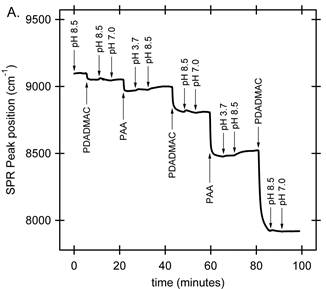
Figure 1 In situ FT-SPR data taken during the polyelectrolyte multilayer deposition on gold-coated glass chips. FT-SPR peak as a function of time during the deposition. Arrows indicate the beginning of an adsorption or rinse step.
See more of this Group/Topical: General Submissions