
Fouling Control during Surface Water Microfiltration by Electrochemical Pretreatment
Neranga P. Gamage and Shankar Chellam
Department of Civil and Environmental Engineering, University of Houston, Houston, TX 77204-4003
Coagulating colloids and natural organic matter in membrane feed waters by iron and aluminum salts is a common method to reduce fouling. Our research focuses on novel electrochemical coagulation methods as alternatives to conventional chemical coagulation for microfilter pretreatment [1, 2]. The objective of this presentation is to demonstrate improved performance by electrocoagulation and electroflotation of surface waters and quantify the intrinsic physicochemical mechanisms underlying electrolysis and microfiltration.
During electrolytic conditioning of surface water aluminum generation quantitatively obeyed Faraday's law. X-Ray diffractometry revealed the amorphous nature of Al(OH)3 precipitates. Moreover, cathodic production of fine hydrogen bubbles was empirically observed to induce floc flotation over relatively long durations. Two closely related electrochemical pretreatment methods, (i) electrocoagulation (entire electrochemically conditioned suspension was mixed well and transferred for microfiltration), (ii) electroflotation (pretreated water was transferred for microfiltration after skimming off the floating floc layer) were studied.
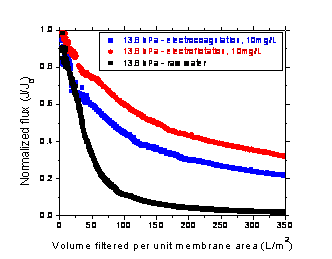
Both electrocoagulation and electroflotation significantly increased flux of a 0.22 mm modified PVDF membrane during dead-end, constant pressure microfiltration of surface water treatment. Further, electroflotation outperformed electrocoagulation for fouling control by decreasing total cake mass and cumulative cake resistance (Figure 1). In both methods, cake filtration was the predominant flux decline mechanism for the entire duration of filtration. Fouling increased at higher transmembrane pressures due to cake compressibility. Fouling following electrochemical pretreatment was lower at pH 6.4 compared with 7.5, and decreased only up to an intermediate aluminum dosage. Measured flux profiles were mechanistically interpreted using different colloid and fouling characterization techniques including optical microscopy for particle sizing and fractal dimension analysis, X-ray diffraction (XRD) for precipitate morphology, zeta potential of colloid surface charge, X-ray photoelectron spectroscopy (XPS) for chemical composition analysis of the foulants, and scanning electron microscopy (SEM) for morphological study of foulants. These results and their implications for drinking water treatment using low-pressure membranes will be discussed in detail during the presentation.
 |
 |
References
[1] N.P. Gamage, S. Chellam, Aluminum electrocoagulation pretreatment reduces fouling during surface water microfiltration, Journal of Membrane Science, 379 (2011) 97-105.
[2] N.P. Gamage, J.D. Rimer, S. Chellam, Improvements in permeate flux by aluminum electroflotation pretreatment during constant pressure microfiltration of surface water, Journal of Membrane Science, In revision (2012).