
On-board COX free H2 generation by for portable device applications using a catalytic hollow fibre membrane micro reactor
F.R. García-García*, M.A. Rahman, S. Sukcharoen and K. Li
Department of Chemical Engineering and Chemical Technology, Imperial College London, London SW7 2AZ, UK
This work discusses the use of asymmetric yttria stabilised zirconia (YSZ) hollow fibres as a membrane micro reactor substrate for COX free H2 production by ethanol steam reforming (ESR) reaction and the possibility to use them in portable device applications. The attractive physical and chemical properties of the asymmetric YSZ hollow fibres along with their low-cost manufacturing process present them as a key step in the intensification of heterogeneous catalytic gases phase processes which are relevant today such as the ESR reaction [1]. Likewise, the chemical-physical properties of ethanol, liquid at room temperature and atmospheric pressure along with its non-toxicity make it possible to use it as a “storage-molecule” of H2 for on-boarding applications [2]. In addition, the CO2 produced during the reaction is consumed for biomass growth which nearly closes carbon loop. Based upon all this, in this work a new catalytic hollow fiber membrane micro reactor (CHFMMR), which integrates both a catalytic micro-reactor and a Pd/Ag membrane in the same unit has been developed for on-boarding COX free H2 generation by ESR reaction [3][4]. As it is shown in Figure 1, the work has been divided in three stages; optimization, intensification and scale up of the process.
A series of NiO/MgO/CeO2 catalysts with a Ni content range from 5% to 30% were tested in ESR reaction using a fixed-bed reactor (FBR). The catalytic activity tests were performed at atmospheric pressure and between T=300-600ºC, under different reaction conditions: i.e. calcination temperature (400-700oC) and water steam to ethanol mole ratio (3:1, 5:1, 6:1, 7:1 and 9:1). The catalysts were synthesized by sol-gel Pechini method and characterized by XRD, N2 adsorption isotherms at -196 °C (SBET) and H2-TPR. Based upon the catalytic activity results obtained, 15% NiO/MgO/CeO2, which was the most active catalyst (H2 yield = 80% at 550 ºC), was deposited inside the finger-like region of the asymmetric YSZ hollow fibre in the development the CHFMMR.
Asymmetric YSZ hollow fibres fabricated by the phase-inversion technique followed by sintering at 1450 ºC, were used as a supports from both 15% NiO/MgO/CeO2 catalyst and Pd/Ag layer in the development of the CHFMMR. The Pd/Ag membrane was deposited onto the outer layer of the YSZ hollow fibre by electroless plating technique, followed by impregnation of the 15% NiO/MgO/CeO2 catalyst into the inner finger-like structure of the substrate using the sol-gel Pechini method. The CHFMMR was characterized by H2 and Ar permeation, Hg porosimetry, SEM and EDS surface mapping analysis. The catalytic activity results showed that the H2 production during the ESR reaction using the CHFMMR (2.80 ml/min) was five times higher than in a traditional FBR (0.53 ml/min)
Finally the high surface are/volume ratio of the asymmetric YSZ hollow fibres with tubular geometry and an outer diameter of less than 1 mm enable relatively easy to scale up the process by bundling the fibres into a module. A typical PEMFC requires 0.8 mL/min of H2 to produces 35W of electricity, which is sufficient for a laptop application [5]. Based on these, two different CHFMMR modules configurations which produce 1L/min of COX free H2 have been proposed: cylindrical (4 cm x 10 cm) and square (2 cm x 5.5 cm x 10 cm) both of them assemble a total of 350 fibres.
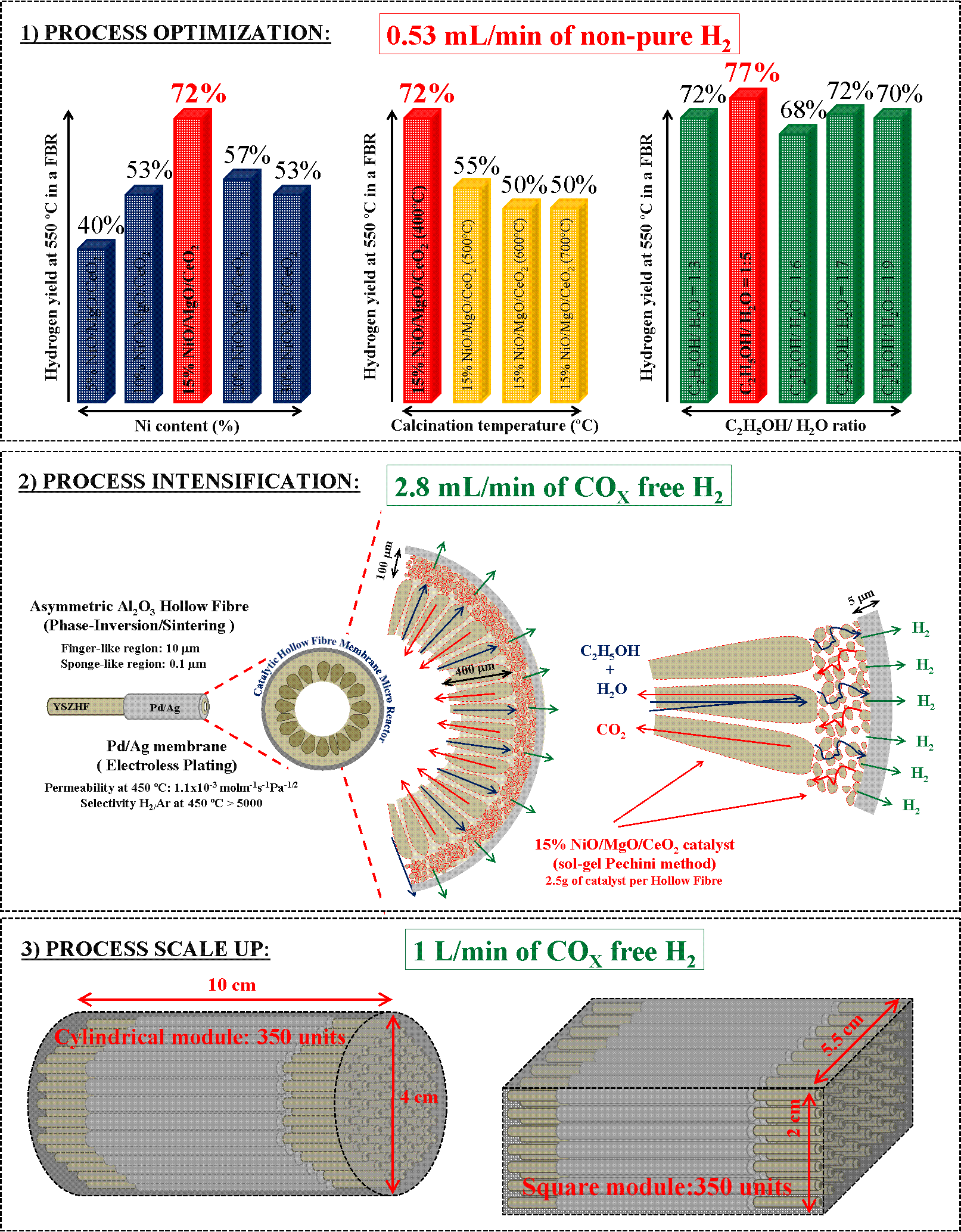
Figure 1: Work overview diagram.
[1] F.R. García-García, B.F.K. Kingsbury, M.A. Rahman, K. Li. Catalysis Today: In Press.
[2] A. Haryanto, S. Fernando, N. Murali, S. Adhikari. Energy & Fuels, 19 (2005) 2098-2106.
[3] M.A. Rahman, F.R. García-García, K. Li. Journal of Membrane Science, In Press.
[4] M.A. Rahman, F.R. García-García, K. Li. Catalysis Communications, 16 (2011) 128-132.
[5] .H. Son, W.C. Shin, Y.K. Lee, S.C. Lee, J.G. Ahn, S.I. Han, H.J. Kweon, J.Y. Kim, M.C. Kim, J.Y. Park. Journal of Power Sources, 185 (2008) 171–178.
See more of this Group/Topical: General Submissions