
Comparison of chemical and electrochemical coagulation pretreatment for fouling control in integrated dual membrane systems
Mutiara Ayu Sari1, Shankar Chellam1,2
1Department of Civil and Environmental Engineering, University of Houston, Houston, TX 77204-4003
2Department of Chemical Engineering, University of Houston, Houston, TX 77204-4004
Microfiltration (MF) alone can be integrated as pretreatment to reduce nanofiltration (NF) fouling rates during surface water treatment [1]. But, MF fouling in such dual membrane systems may be problematic for highly fouling waters. Hence, we hypothesized that pretreating MF feed water will reduce both MF and NF fouling thereby decreasing energy consumption, system downtime, and ultimately operating and capital costs. We comparatively evaluated conventional chemical coagulation with alum with electrolytic aluminum addition as MF pretreatment alternatives. Aluminum coagulation via in situ electrolysis of an elemental anode is advantageous since it eliminates the handling of corrosive chemicals and can be fully automated. The objective of this study is to compare electrocoagulation-MF, electroflotation-MF, alum coagulation-MF, and MF alone as pre-treatment alternatives for surface water NF.
Representative surface water from Lake Houston was electrocoagulated in a Perspex cell at pH 6.4. A 15 cm long aluminum rod (Puratronic grade, 99.9965% as Al, Alfa Aesar) served as the anode, which was surrounded by a porous cylindrical 316-stainless steel cathode. The same apparatus was employed for electroflotation, except that hydrogen bubbles released from the cathode was used for floc-flotation, to reduce the solids loading onto the microfilter. Conventional alum coagulation was performed using a programmable jar tester with 1-minute rapid mixing and 30 minutes flocculation. An aluminum dosage of 10 mg/L was found to be optimal for controlling fouling of a 0.45 mm Nylon microfilter and used for all experiments. These results were compared with a negative control, viz. MF alone with no coagulation pretreatment.
 Bench-scale
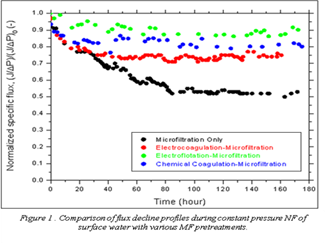
NF experiments were performed under constant pressure (470 kPa), recovery (80%),
temperature (~23 °C). A commercially available aromatic polyamide thin film
composite NF membrane (GE Osmonics DL) was employed. NF flux decline was best
controlled by electroflotation-MF, followed by alum coagulation-MF, electrocoagulation-MF,
and MF only, as depicted in Figure 1.
Autopsy of the membranes and feed water analyses revealed that the major NF foulant was natural organic matter (NOM). We are currently quantifying the removal of trihalomethane and haloacetic acid precursors by NF under various pretreatments. Since the properties of the NF membrane will also determine the efficiency of MF pretreatment [2], physical and chemical surface properties of NF membranes is being characterized by X-ray photoelectron spectroscopy (foulant composition), electron and atomic force microscopy (morphology and pore size), contact angle (hydrophobicity), and ζ potential (surface charge).
References
[1] Chellam S, Jacangelo JG, Bonacquisti TP, Schauer BA. Effect of pretreatment on surface water nanofiltration. Journal American Water Works Association 1997;89 (10):77-89.
[2] Van der Bruggen B, Kim JH, DiGiano FA, Geens J, Vandecasteele C. Influence of MF pretreatment on NF performance for aqueous solutions containing particles and an organic foulant. Separation and Purification Technology 2004;36 (3):203-13.