
Development of novel composite dual-layer nanofiltration hollow fiber membranes for water softening at low operation pressure
Lei Shi, Laurentia Setiawan, Rong Wang, Anthony G. Fane
Singapore Membrane Technology Centre, Nanyang Technological University, Singapore
Abstract
In the present study, fabrication of novel composite dual-layer nanofiltration hollow fiber membranes suitable for has been explored by the co-extrusion method in a single step phase inversion process using a triple spinneret, followed by chemical cross-linking treatment for the outer layer. The porous inner layer was made of polyethersulfone (PES) that provides mechanical support and low trans-membrane resistance, while the selective outer layer was made of cross-linked Torlon® polyamide-imide (PAI) membrane, which carries positive charges on the surface. The positively charged NF hollow fiber membrane holds great potential in application for the recovery of valuable cationic macromolecules in the bioprocess and pharmaceutical industries or for the removal of multi-valent cations in water softening process, as well as for the removal of dyes and heavy metals in the textiles and automotive industries.
The newly developed dual-layer NF hollow fiber membranes were characterised in terms of morphology, mechanical strength and chlorine tolerance. Figure 1 shows the SEM morphology of a dual-layer NF hollow fiber, and Figure 2 illustrates static chlorine resistance test of cross-linked dual layer membrane. The results indicated that this new membrane can be considered as a valuable complement to the existing short supply of positively charged NF membranes, especially in the hollow fiber configuration. The membrane were further tested for Ca2+ and Mg2+ removal from a mixed salt solution with 3000 ppm TDS, and the experiments show that the membrane is able to achieve up to 94% rejection to divalent cations with a water flux of 16 LMH/bar at a low operation pressure of 2 bar. The promising performance makes the membrane attractive for cutting cost of energy consumption in industrial applications.
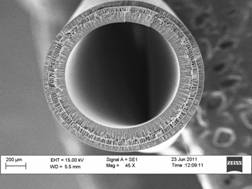
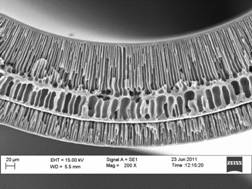
Figure 1.Morphology of dual layer hollow fiber membranes
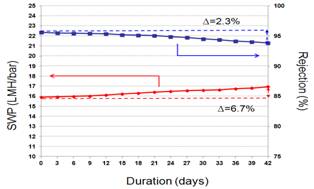
Figure 2: Static chlorine resistance test of cross-linked dual layer hollow fiber membrane