
Introduction
The sector of heating, ventilation and air conditioning (HVAC) accounts for one third of the industrial nations' energy demand and is far-off from being a sustainable process [1]. A promising approach to enhance its compatibility with state of the art energy saving standards is the replacement of ordinary heat exchangers by rotary or counter current enthalpy exchangers [2-4]. However current technologies grapple either with insufficient recovery rates or impermissible lacks of hygiene. In order to address these problems, an innovative, hygienic, membrane-based enthalpy exchanger with reasonable high recovery rates was developed.
Experimental work
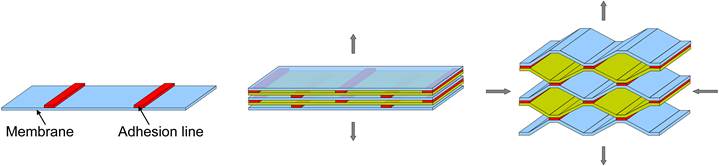
Alternating glue line patterns are applied via a computer controlled automated process on dense, flat sheet membranes. Hereby a defined number of membrane layers is interconnected to a membrane stack, which is unfolded subsequently to a 3D-structure (see Fig. 1). Compared to state of the art enthalpy exchangers the novel structure makes additional support, spacer or sealing technology superfluous. An accurate description of all crucial manufacturing steps within the first part of the presentation ensures a reliable understanding of the general module design. Subsequently the results of some auspicious performance measurements are presented and discussed. Pressure loss and sensible as well as latent heat recovery were investigated for different inner module geometries.
|
Fig.1.: Module assembly of a honeycomb structure
|
Results
First modules have been assembled in labscale and shown the general feasibility of the novel module concept. Surprisingly the pressure loss of a sophisticated dimpled structure turned out to be rather low compared to the one of a straightforward honeycomb structure. The heat recovery of all modules was mainly influenced by the active surface area, while the moisture recovery was observed to be dependent on the membrane materials used. Even though the modules do not meet commercial standards up to now, thess first results announce a crucial step in the development of an economic and ecologic enthalpy exchanger. Therefore it can be seen as a promising approach for boosting the market share of enthalpy exchangers.
Acknowledgements
This work was partly supported by the Bundesministerium fuer Bildung und Forschung (BMBF), Germany within the programme "KMU-innovativ: Ressourcen- und Energieeffizienz" (support code: 01LY0805A). All results and contents are at the responsibility of the author.
References
[1] Zhang, L., Liang, C., & Pei, L.:
"Heat and moisture transfer in application scale parallel-plates enthalpy
exchangers with novel membrane materials", Journal of Membrane Science,
325(2), 672-682, 2008.
[2] L.Z. Zhang: "Energy performance of independent air
dehumidification systems with energy recovery measures", Energy (Oxford,
United Kingdom) 31 (8-9), p.1228-1242, 2006.
[3] K.R. Kistler, E.L. Cussler:
"Membrane modules for building ventilation, Trans IChemE,
Vol 80, Part A, p.53-64, 2002.
[4] Harriman, L. G., Plager, D., & Douglas,
K.: "Dehumidification and Cooling Loads From Ventilation Air", ASHRAE
Journal, 37-45, 1997.
See more of this Group/Topical: General Submissions