
NAMS - 2012
ABSTRACT
Bacterial attachment and biofilm formation are common in numerous applications outside of membrane science ranging from the use of medical implant devices to nautical shipping. The use of small, pulsed electric currents and/or voltage to prevent bio-attachment has been found to be efficacious in these applications. The same approach has not been applied to polymeric membranes due to the highly insulating nature of polymers. To this end, highly electrically conductive thin film polymeric coatings were created by cross-linking poly(vinyl alcohol) with carboxylated multiwalled carbon nanotubes (CNT-COOHs) and succinic acid. This thin film was then deposited on and reacted with an ultrafiltration membrane to produce an electrically conductive UF membrane. These membranes demonstrated high electrical conductivity, high pure water flux with good particle separation, high flexibility, low polymer crystallinity, and low surface tensions. Optimally formed membranes showed electrical resistivity as low as 2.8×10⁻⁴ W-m (conductivities as high as 3.6×10³ S/m), pure water flux of 1440 L/m2-h at pressures of 550 kPa, and triple-point initial contact angles as low as 40o with high hysteresis.
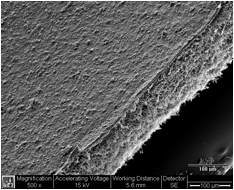
Figure 1: This is an image of a cross-section of a pressure-filtered PVA-CNT membrane containing 5 w/% CNT with respect to PVA. The thickness of this surface coating is significantly less than that of the cellulose nitrate support membrane. The coating is approximately 1.0 µm.
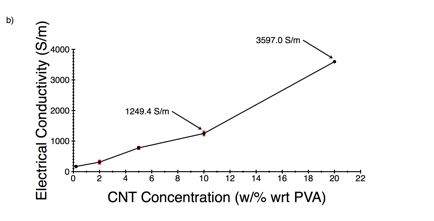
Figure 2: The conductivity of the PVA-CNT membranes is found to be very high on the order of 4×10³ S/m – on the same order of magnitude as graphite. The conductivity of the membranes increases with greater CNT concentration. Increasing CNT concentrations over 10 w/% with respect to PVA drastically effects the conductivity of the membranes.
See more of this Group/Topical: General Submissions