
Phase inversion of polymer casting mixtures filled with hierarchical functional nanostructures is proposed as a synthetic route for the design of multifunctional membranes. The structure and reactivity/function of such membranes can be independently controlled by regulating the relative content of components representing different levels in the nanofiller hierarchy (Fig. 1).
In a systematic membrane synthesis study, functional nanocomposite membranes with embedded hierarchical nanostructures were prepared using a modified version of a phase inversion method. Employed as fillers, exfoliated graphene nanoplatelets (xGnPs) decorated by nanogold were added to the polymer-solvent-porogen (polysulfone-NMP-PEG) mixture prior to casting. The nanoplatelets acted as anchoring “mats” for the smaller, function-bearing (catalytic) gold nanoparticles. Thus, the hierarchy included 2 levels:
- Level 1: xGnP ”carrier mat” reliably embedded within the underlying membrane. An inexpensive material, nanoplatelets consist of several layers of graphene, which is a single layer 2D macromolecule with sp2 bonded network of carbon atoms. These two-dimensional nanoplatelets (from 2×2 µm2 to 15×15 µm2 in surface area and only 2 to 12 nm in thickness) serve as delivery vehicles for smaller functional nanoparticles to ensure their minimal aggregation and controlled placement.
- Level 2: Smaller function-bearing nanoparticles (catalytic nanogold) anchored to the carrier “mat.”
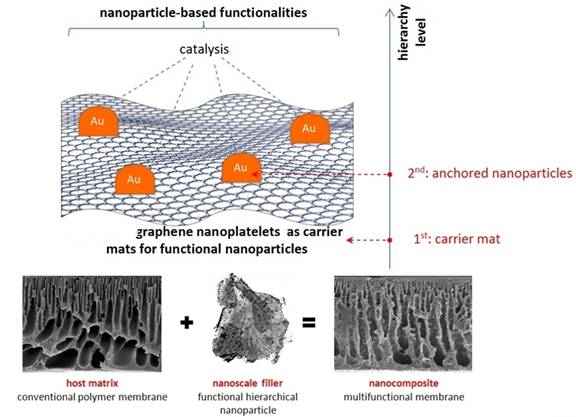
Figure 1: Concept of hierarchical nanoarchitecture as an approach to membrane design for improved nanoparticle dispersion, controlled placement, and structure-function decoupling.
The reactivity of nanocomposite membranes was characterized in experiments on the Au-catalyzed reduction of 4-nitrophenol during the filtration of a mixture of 4-nitrophenol and sodium borohydride solutions through the membranes (Fig. 2).
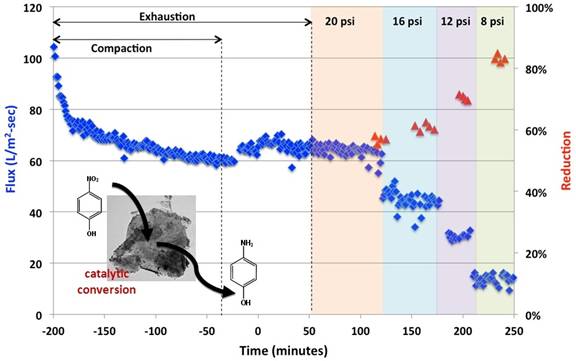
Figure 2: Steps in the experimental determination of the catalytic efficiency of designed membranes: 1) membrane compaction; 2) exhaustion of adsorptive capacity of the membrane; 3) 4-nitrophenol reduction.
Introduction of only 0.1 wt% of the filler resulted in a 22-fold increase in membrane permeability when compared with that of neat PSf membranes (Fig. 3). Importantly, this increase was accompanied by a statistically significant increase of rejection of 12 kDa dextran from 28% ± 5% to 69% ± 10%. As xGnP/PSf loading increased further, the permeability remained relatively constant. The dextran rejection was also maintained at approximately same level over the (0.1 – 1.0)% range of xGnP/PSf loadings but then decreased to the level typical for neat PSf membranes when the loading reached 2%wt xGnP/PSf.
By mixing Au-decorated xGnPs and Au-free xGnPs in different relative amounts and adding mixtures to the membrane, the structure (controlled by the total amount of xGnPs) and reactivity (controlled by the total surface area of gold nanoparticles) could be regulated independently (Figs. 3 and 4).
Decreased shedding of nanoparticles by the nanocomposites membranes is another potential benefit of anchoring functional nanoparticles to the larger carrier “mats”.
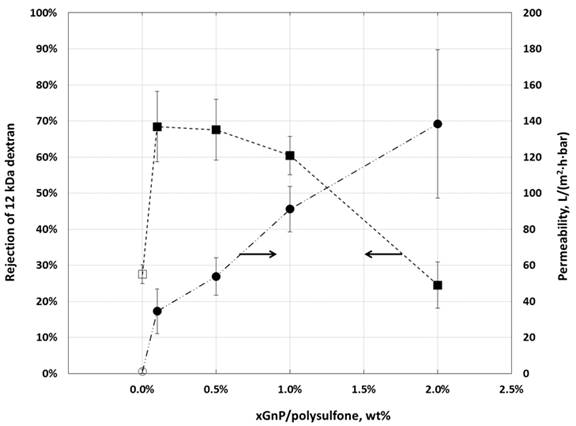
Figure 3. Permeability and rejection of 12 kDa dextran as a function of xGnP loading. Error bars correspond to the 90% confidence level.
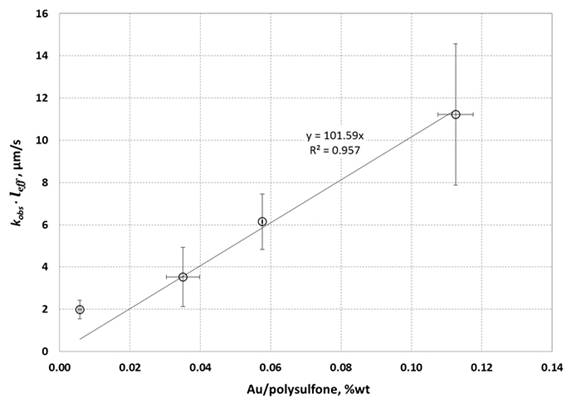
Figure 4. Observed reaction constant as a function of Au/PSf loading. Error bars correspond to the 90% confidence level.