
Background
As the world population is increasing, there is an increased demand for food, and aquaculture is the fastest expanding segment of agriculture. There is a growing interest for recirculating aquaculture systems (RAS) for cultivation of live feed, larvae and fry, and on-growing fish. In RAS more than 90% of the water is being recycled back to the rearing tanks after treatment. By applying RAS it is possible to conserve heat and water, eliminate escapement of farmed fish to the natural habitat, reduce the loads of biosolids and sludge deposits to the surrounding water area, and control the bacterial population by microbial maturation of the water. A stable concentration of substrate is a selective force to trigger water maturation and growth of a slow growing beneficial bacterial community. Most diseases of marine fish larvae are suggested to be caused by opportunistic microorganisms that become pathogenic when the fish larvae are under stressed conditions.
However, the water treatment systems of today leave the colloidal particles in RAS. This fraction will accumulate and can dissolve into microbe substrate, reduce disinfection efficiency, smothers the gills of the fish, harbour pathogens and increase fouling of rearing tanks and equipment. For successful implementation of RAS, more advanced systems for enhanced particle separation and nutrient reduction is required. Introduction of membrane filtration is a potential technology in the further development of water treatment in RAS, in particular the membrane bioreactor (MBR).
Research
Membrane filtration was first applied in a pilot live feed production system with two water treatment regimes run in parallel, conventional RAS (cRAS) and RAS implementing an MBR unit (RAS-MBR). The RAS-MBR treatment scheme was designed with a submerged ultrafiltration membrane module (pore size 50 nm) vacuum operated in an outside-in mode. Experiments were conducted for the production of the marine live feed organisms copepods (Acartia tonsa) and rotifers (Brachionus ibericus). The membrane was operated in dead end mode, and water exchange in the tank of 4 times per day, and partly cross flow mode, and water exchange in the tank of 2 times per day, respectively.
However, the impact membrane filtration has on concentration of nutrients and colloids in the live feed production tanks were not readily apparent based on particle analysis. As an example, figure 1 shows results from the rotifer production. The amount of suspended solids added during feeding apparently exceeded the amount removed in the recycle system indicating a need for higher recirculation rate and different system operating conditions.
A long term (60 days) experiment for the intensive rearing of cod larvae (Gadus morhua) in conventional RAS and RAS implementing an MBR unit was investigated. Cod larvae are more sensitive to water quality than copepods and rotifers, and the beneficial effects of removing colloids were expected to be more apparent. To enhance the removal of colloids in the production tanks, additional modes of membrane operation was applied. The system was operated with a higher recycle rate, and a cross flow mode with daily extraction of sludge from the membrane concentrate. These results will be discussed further during the presentation in New Orleans.
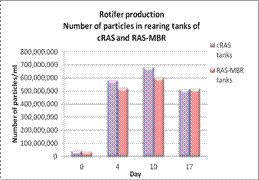
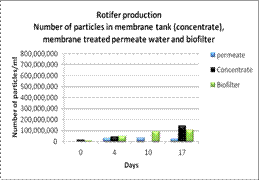
Figure 1. Number of particles in production tanks (cRAS and RAS-MBR) and water treatment units
See more of this Group/Topical: General Submissions