
Membranes with high water vapour permeation rates find use in many applications, including protective clothing, dehydration, and humidification. One interesting application is in energy recovery ventilation for building heating, ventilation, and air conditioning (HVAC) systems. An energy recovery ventilator (ERV) improves building energy efficiency by transporting heat and water vapour using a membrane exchanger. In the exchanger, building incoming and outgoing air streams are passed over opposing sides of a membrane, through which heat and moisture are transferred. This effectively ‘recycles' the energy utilized to condition building air. High-efficiency HVAC ERV systems have the potential to save over 65% of energy associated with the conditioning of outdoor air in buildings [1]. At the same time, these devices help improve indoor air quality in buildings. Membranes for these devices must have high vapour permeation rates, and be selective for water vapour over other gases and contaminants that may be present in the outgoing indoor air.
Current high performance membrane materials for ERV devices are based on porous substrates with thin selective water vapour permeable coatings [2]. Improved water vapour permeation performance in these materials is desirable, both to improve recovery efficiency and decrease size and cost. Our analysis of commercially available materials indicates that the substrate materials utilized contribute significant resistance to vapour transport in the membrane (up to 50%). We present a study of a resistance model for membrane materials in these devices, which analyses the performance of higher flux substrates and higher permeation polymeric coatings.
Our findings indicate that electro-spun nanofibrous materials may be promising substrates for water vapour transport membranes. These materials offer very high porosity (>80%), essentially no dead-ended pores, and their pore size and thickness can be controlled to facilitate application of a coating layer [3]. By impregnating these nanofibrous substrates with a dense water vapour permeable polymer layer, we demonstrate that selective nanofibrous membranes can be created with improved water vapour transport rates over current materials.
A design of experiments was completed to direct the fabrication of electrospun nanofibrous membranes for water vapour transport. The effect of nanofibre deposition, nanofibre diameter, and impregnation solution concentration on membrane performance was studied. Nanofibre scaffolds were created by the controlled deposition of fibres onto polyester non-woven supports via electrospinning techniques. In order to form selective membranes, the nanofibre layer was impregnated with polymeric solutions including cross-linked polyether-polyurethane (PEO-PU) copolymer, polyether-block-amides (PEBAX), and perfluoronated sulfonic acid (Nafion). PEO-PU polymers are of particular interest since they are available in aqueous dispersions, allowing for ease of manufacture. These PEO-PU polymers have hard and soft segments in which the hard urethane segments provide mechanical strength and can be cross-linked, and the soft PEO segments are amorphous and can agglomerate and form transport ‘channels' in the presence of water to allow high moisture transport rates and sufficient selectivity [4]. The performance of membranes from the three polymeric coatings were compared and analysed using a resistance model. The nano-fibrous membranes created demonstrate a new class of membrane for selective water vapour transport.
The materials fabricated were evaluated by SEM to determine fiber diameter, pore size, surface porosity in the nano-fibrous substrates, and to determine coating effectiveness and thickness in the membrane samples. The coating lay-down was found to be directly related to both the polymer concentration in the coating solution and the nanofibre substrate areal density. The water vapour and oxygen transport rates of the materials were measured using a custom counter-flow permeation apparatus. This apparatus simulates the operating conditions and geometry of actual devices and over-comes some of the established issues associated with measuring water vapour transport in highly permeable materials [5–7]. The nano-fibrous materials demonstrate improved water vapour permeation rates over current commercial materials and comparable selectively of water vapour over oxygen.
A further benefit of utilizing nanofibrous scaffolds as a basis for fabrication is that membranes can be created on a wide variety of support layers, allowing for the creation of formable membrane materials (see Figure 1). Formable membranes allow the manufacture of exchanger plate directly from the membrane material, allowing significantly higher membrane surface area per volume, the development of counter-flow designs, and multi-directional transport in the flow channels. These features allow for increased exchanger efficiency and decreased cost. We present the performance of a sub-scale prototype exchanger based on formed nanofibrous membranes in comparison to alternative and current generation exchanger designs.
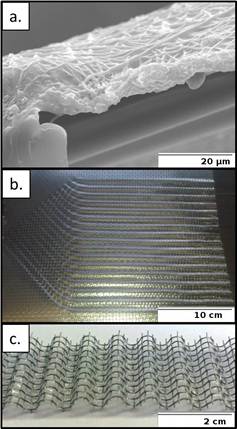
Figure 1: Cross-section of nanofibrous membrane (a.); Nanofibrous membrane formed into an exchanger plate (b.); Corrugated nanofibrous membrane (c.)
References
[1] L.-Z. Zhang, “Heat and mass transfer in a quasi-counter flow membrane-based total heat exchanger,” International Journal of Heat and Mass Transfer, vol. 53, no. 23–24, pp. 5478–5486, Nov. 2010.
[2] R. Huizing, “COATED MEMBRANES FOR ENTHALPY EXCHANGE AND OTHER APPLICATIONS,” U.S. Patent WO 2010/132983A1.
[3] K. Yoon, B. S. Hsiao, and B. Chu, “High flux nanofiltration membranes based on interfacially polymerized polyamide barrier layer on polyacrylonitrile nanofibrous scaffolds,” Journal of Membrane Science, vol. 326, no. 2, pp. 484–492, Jan. 2009.
[4] G. R. Lomax, “Breathable polyurethane membranes for textile and related industries,” J. Mater. Chem., vol. 17, no. 27, pp. 2775–2784, 2007.
[5] S. J. Metz, W. J. C. van de Ven, J. Potreck, M. H. V. Mulder, and M. Wessling, “Transport of water vapor and inert gas mixtures through highly selective and highly permeable polymer membranes,” Journal of Membrane Science, vol. 251, no. 1–2, pp. 29–41, Apr. 2005.
[6] E. A. McCullough, M. Kwon, and H. Shim, “A comparison of standard methods for measuring water vapour permeability of fabrics,” Measurement Science and Technology, vol. 14, no. 8, pp. 1402–1408, 2003.
[7] P. Gibson, C. Kendrick, D. Rivin, L. Sicuranza, and M. Charmchi, “An Automated Water Vapor Diffusion Test Method for Fabrics, Laminates, and Films,” Journal of Industrial Textiles, vol. 24, no. 4, pp. 322–345, Apr. 1995.
See more of this Group/Topical: General Submissions