
MEMBRANE FILTRATION IN RAS - EFFECTS ON TANK BACTERIAL COMMUNITIES
P.-A. Wold*, A. Buran Holan, I. Overrein, D. Altin, K. Attramadal, G. Řie, and T.O. Leiknes.
* Norwegian University of Science and Technology; Department of Hydraulic and Environmental Engineering; N-7491 Trondheim, Norway. E-mail: per-arvid.wold@ntnu.no
Background
Recirculating aquaculture systems (RAS) is an upcoming production system in intensive fish production, and has several advantages compared to pond and cage aquaculture systems due to environmental control and reduced need for water. In aquaculture water treatment systems of today, solids are filtered and rapidly removed by components for particle removal, usually a micro screen filter and a particle trap, to avoid mineralization to smaller particles and sudden increase in nutrient and nitrogen compounds in the water. However these systems leave the dissolved, colloidal and fine fraction in the treated water. This particle fraction will accumulate in RAS and might be harmful to fish health in that it increases the proliferation of pathogenic bacteria when it dissolves to microbe substrate (i.e. by disinfection actions like ozonation) and offers protection from disinfection. Fine particles are also a source of mechanical stress to fish respiratory organs, increasing the risk for disease outbreak.
A conventional membrane system uses microfiltration with pore size of 0.1 – 10 µm, or ultrafiltration with pore size of 0.001 – 0.1 µm, and has a great potential for removing the colloidal fraction and microorganisms in the RAS system.
Research
The aim of this pilot study was to determine the effect of removing the fine colloid particles on water quality and microbial composition in the rearing tanks. A small-scale pilot plant for the production of the planktonic live feed organisms Acartia tonsa (a copepod) and Brachionus ibericus (a rotifer) was built as a conventional RAS (cRAS) and RAS-MBR with a membrane bioreactor unit (MBR) operated as an immersed outside-in configuration with a constant flux. Live feed organisms are needed during start-feeding of larvae in marine fish fry production. Water exchange rates in production tanks were adjusted to keep the planktonic organisms freely in the water column (2x day-1 for rotifers and 4x day-1 for copepods). Copepods were fed live microalgae and rotifers were fed algae paste.
Membrane filtration reduced the amount of fine colloidal particles and bacteria returning to the rearing tanks after water treatment. The number of bacteria in the permeate water returning to the rotifers tanks in the RAS-MBR system was at the most 72% lower than the number of bacteria in the biofilter water going to the rotifer tanks in the cRAS (Figure 1). The number of bacteria in the permeate water going to the copepod tanks in the RAS-MBR system was at the most 85% lower than the number of bacteria in the biofilter water going to the copepod tanks in the cRAS system (Figure 2). However the number of bacteria was not significantly lower in the live feed cultivation tanks applying RAS-MBR treatment scheme compared to cRAS treatment scheme, indicating a need for higher circulation rate and different membrane operating conditions.
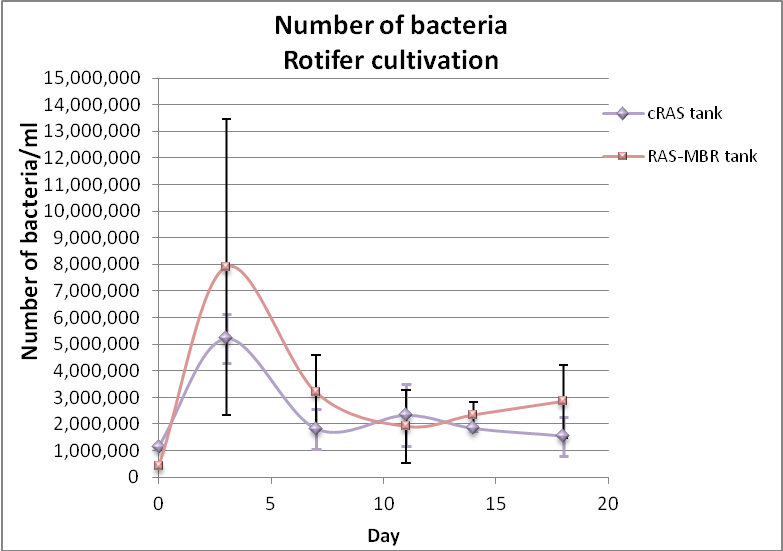
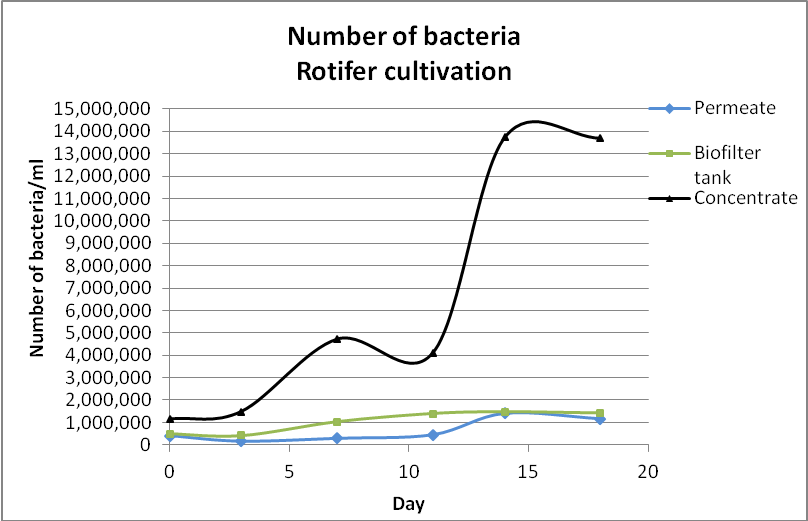
Figure 1. Number of bacteria in production tanks (cRAS and RAS-MBR- left) and the water treatment unit (right) during the rotifer experiment
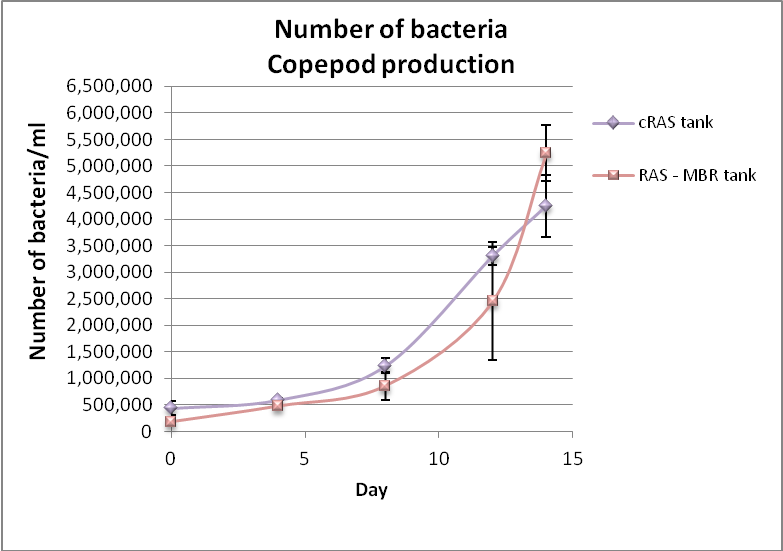
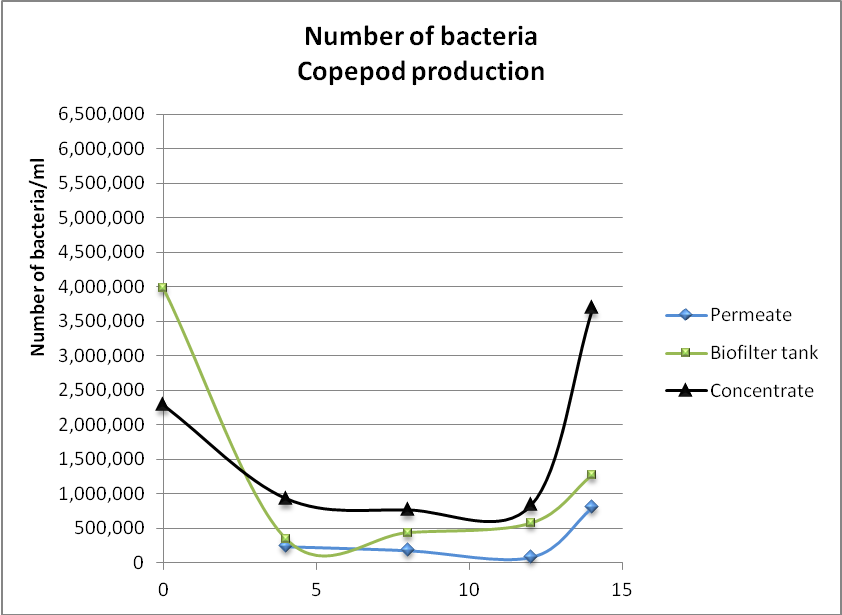
Figure 2. Number of bacteria in production tanks (cRAS and RAS-MBR- left) and the water treatment unit (right) during the copepod experiment
In the copepod system, bacteria number was initially low and increased exponentially after the first week of the experiment, but in the rotifer system number of bacteria peaked during the first days of the experiment (Figure 1 and 2). Bacterial number in production tanks increased due to the addition of organic matter when feeding the copepods and rotifers. The observed difference was between experiments were probably caused by the choice of diet (live algae vs. algae paste).
Samples for identifying the bacterial composition in the rearing tanks by Fluorescence in situ Hybridization (FISH) and Denaturing Gradient Gel Electrophoresis (DGGE) were taken in rearing tanks, biofilter, membrane permeate and concentrate, and these results will be discussed further during the presentation. The impact of a more efficient removal of the colloidal fraction is these days being investigated in a start-feeding experiment on Atlantic cod larvae (Gadus morhua) with higher recirculation rates, and also including a species which is more sensitive to water quality parameters than rotifers and copepods.