
TorOve Leiknes1,Cheng Sun1
1NTNU, Department of Hydraulic and Environmental Engineering
Abstract:
Fouling of membranes in water and wastewater treatment is a complex phenomenon caused by many mechanisms such as precipitation of inorganic salts (scaling), accumulation of organic substances (adsorption, concentration polarization), deposition of inorganic and organic particles as well as biofilm formation by the deposition and/or growth of microorganisms. In membrane bioreactor systems (MBR) biofouling is particularly a challenge in that it is very dynamic in nature and difficult to assess in terms of what are the main foulants and fouling mechanisms. Several investigations have been conducted to determine the nature and structure of biofouling and how it is impacted by operating conditions, with the aim to propose good fouling control and mitigation strategies. Confocal laser scanning microscopy (CLSM) is a tool that has been used by several investigators to study the microbial communities as well as EPS constituents without destroying the biofilm structures or changing the biological environment, thereby getting a better understanding of biofouling in membrane filtration. In this study CLMS has been used as a tool to compare biofouling properties and response in activated sludge MBRs vs. biofilm MBRs.
Two MBR pilot reactors were operated in parallel under as near identical conditions as possible, supplied by the same feed water source to create comparable biofouling layers on the membrane surface. Real wastewater collected from a public sewer in Trondheim, Norway, was used in the study. One pilot plant was designed as an activated sludge MBR and the second one as a biofilm MBR, both systems equipped with the same type of flat-sheet membrane module. Tests were conducted with a flux of 10 Lm-2h-1 giving a HRT of 10 h, and SRT in the AS-MBR of around 43 days. Various loading rates and operating conditions were applied. Membrane samples were analysed at different times of operation of the systems. Three different stains were applied in this study identifying the cells (staining of nucleic acids), polysaccharides and proteins. Using image analysis biofouling properties such as thickness, coverage, porosity, and biovolume were investigated.
Results example; low organic loading rate and without membrane relaxation. The results of the TMP development and analysis of the corresponding biofouling thickness is shown in Figure 1. From these result it can be seen that similar performance is observed with varying thickness in the fouling layer indicating some difference in the properties. The CLSM results are shown in Figure 2. Comparison of the systems after 168 and 312 h operation time with a low loading rate revealed a similar fouling rate for both systems of -2,56 x 10⁻⁴ bar/h but a 2-times faster biocake growth for the AS-MBR, which could be due to the higher amount of suspended solids. The calculated porosity showed with a minimum porosity at height between 5 and 10 μm for the AS-MBR and an exponentially decreasing porosity for the BF-MBR with minimum porosity at the membrane surface. Carbohydrate as well as protein density was higher in the AS-MBR but cell density was higher in the BF-MBR. The calculated total biovolume was generally lower in BF-MBR, with similar protein volume, less carbohydrate but significantly higher cell volume compared to AS-MBR. Further details of the comparison, including results from the high organic loading rates and varying operating modes, will be presented.
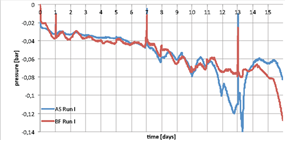
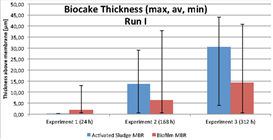
Figure 1. TMP development and biofouling thickness measurement
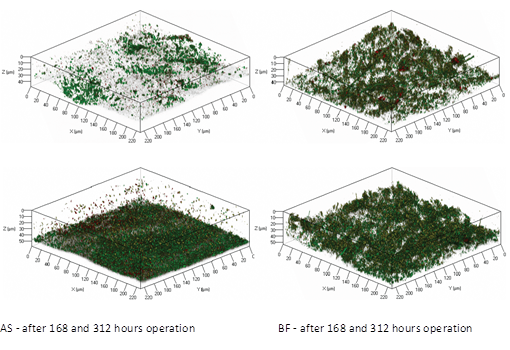
Figure 2. Images of biofouling development in AS and BF after 168 and 312 hours of operation
See more of this Group/Topical: General Submissions