
The impact of cake compressibility in coagulation-microfiltration of
Natural Organic Matter (NOM)
Compressibility of the coagulated materials has been
found as one of the major limiting factors in coagulation-membrane filtration
that can compromise the performance and the economics of a treatment system [1, 2]. Inline coagulation (IC) was proposed as
an alternative to the conventional tank coagulation (TC) setup for
coagulation-microfiltration (MF) process of water containing NOM with
advantages in terms of simplicity of the setup without compromising the
separation performance. It was found that removal efficiency was dependent to
the dose of coagulant regardless to the applied configuration of the coagulant
step [3]. However, at the same time the
trans-membrane pressure (TMP) increase in filtration cycles was found higher in
IC than that in TC. Although the nature
of the membrane fouling was backwash-reversible, it is necessary to investigate
the reason for such a phenomenon to be able to optimize the IC configuration.
Filtration data from the previous study of IC-MF (Metawater
Co., Ltd.) [3] using
aluminium-based coagulant (PAX-18, Kemira) and the current study using iron-based coagulant
(PIX-111, Kemira) in a same molar dose of the
coagulant treating water containing 6.90±0.23 mg C/L NOM will be presented.
Different IC configurations in terms of the applied G-values and the coagulant
types produced similar removal efficiency of around 69.1±1.1 % of the dissolved
organic carbon. The behavior of cake material during filtration experiments was
assessed by applying resistance-in-series model. The specific properties of
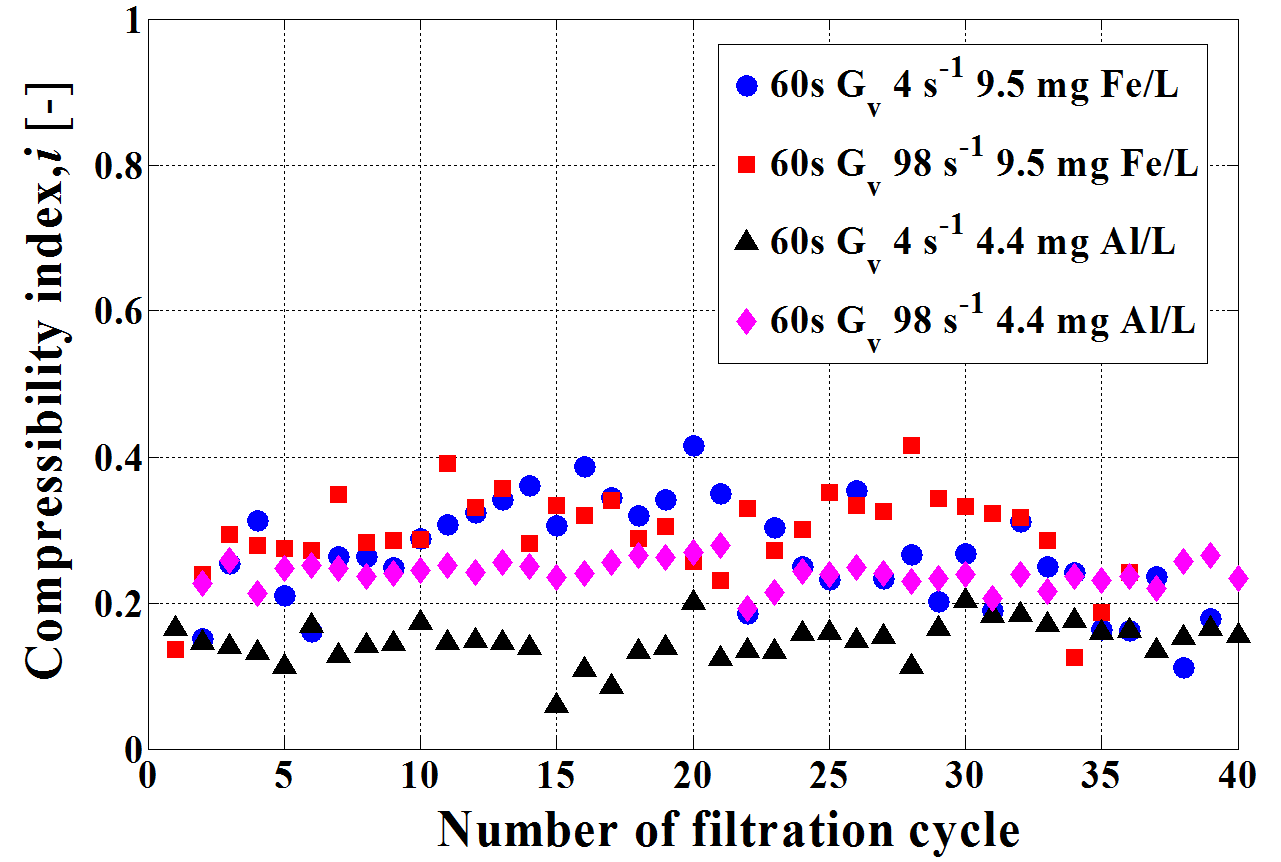
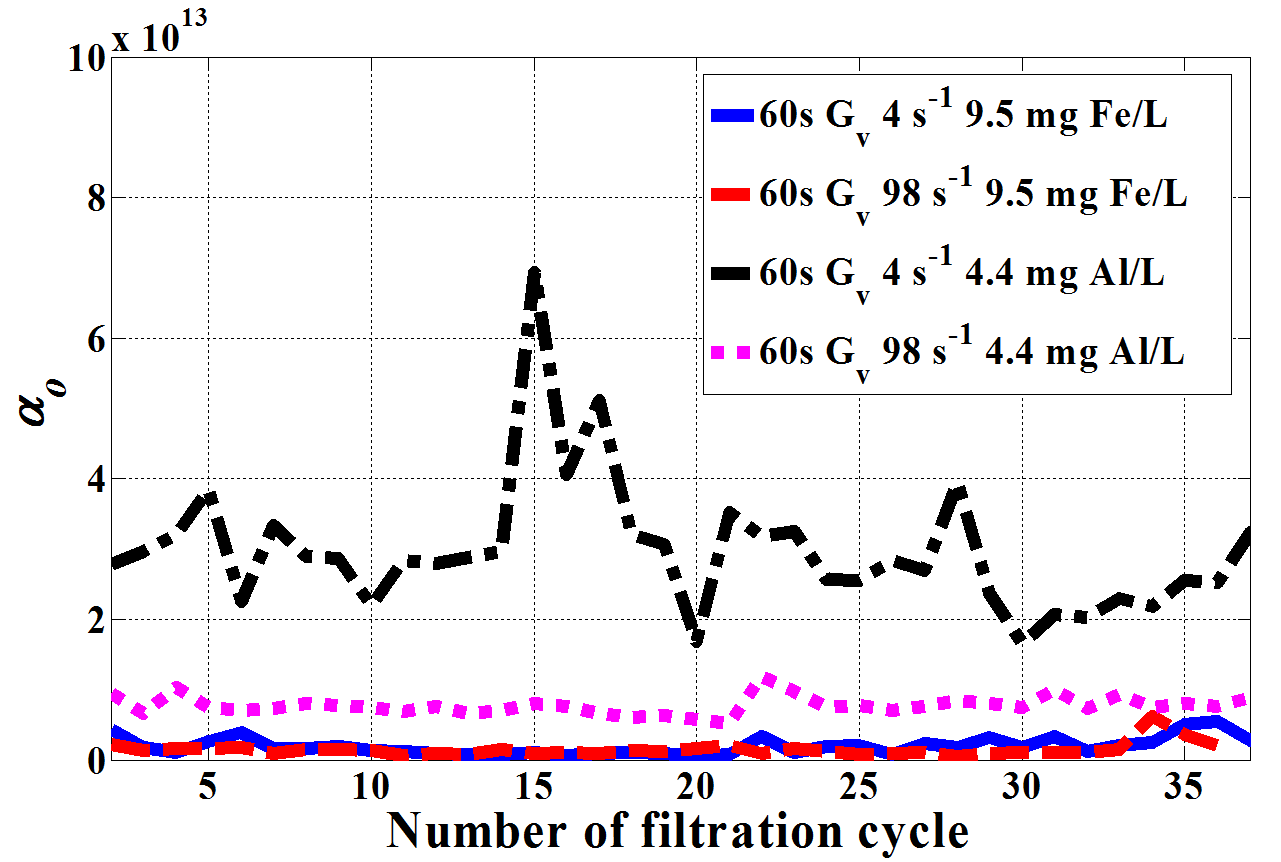
cake layer i.e. compressibility index (i) and zero pressure specific cake resistance (alphao)
were obtained from fitting specific cake resistance and trans-cake pressure
with power-law model. Figure 1 and 2 depict the behavior of the two parameters.
Figure 1. Compressibility index as a function of filtration cycles Figure 2. alphao as a function of filtration cycles Figure 1 and 2 showed the impact of different
configurations on the parameters that representing the cake compressibility
and, thus, affecting the filtration behavior.
Iron-based coagulant seems to give higher compressibility indices
compared to the aluminium-based coagulant. On
contrary, alphao
values of the aluminium –based coagulant were higher
than that of the iron-based coagulant. In order to exemplify the physical
meaning of this behavior, the result of floc size
measurements using camera-based instrument (XPT-C, Prozesstechnik GmbH) will be
included in the presentation to elaborate the calculation-based result as
presented above. Reference
See more of this Group/Topical: General Submissions