
Calcium-phosphate-scale formation on reverse osmosis (RO) membranes is a major limiting factor for cost-effective desalination of municipal wastewater due to the relatively high phosphate concentrations. The aim of this study was to evaluate how RO membrane surface chemistry triggers scaling, particularly of calcium phosphate. We were interested in studying the influence of organic molecules and bio-molecules on mineralization, as it is well known that such compounds are highly abundant on the membrane surface due to membrane biofouling. We have found that some organic functional groups induce mineralization while others inhibit that, and accordingly we proposed guidelines for develop of membranes that are less prone to scaling.
Initially we designed a solution that simulates the ionic profile of secondary effluents of wastewater during desalination (named SSE). The effect of surface chemistry on mineralization was studied by equilibration of SSE solution with Langmuir films exposing different organic functional groups and measurement of pressure-area (Langmuir) isotherms combined with inductively coupled plasma (ICP) elemental analyses of the formed interfacial precipitate. An example for a pressure-area isotherm for stearic acid is given in Fig. 1.
The results showed acceleration of calcium-phosphate mineralization by the surface functional groups in the following order: PO4 > COOH ~ NH2 > COOH : NH2 (1:1) > OH > ethylene glycol. Immersion of gold-coated silicon wafers self-assembled with different alkanethiols in SSE solution showed formation of a hydroxyapatite precipitate by x-ray diffraction and by infrared spectroscopic analysis. Data showed diverse influences of functional groups on mineralization, implying low calcium-phosphate scaling for uncharged surfaces or surfaces coated with both positively and negatively charged groups [1]. This information is valuable for understanding scaling processes and for design of novel low-scaling membranes for water desalination [2].
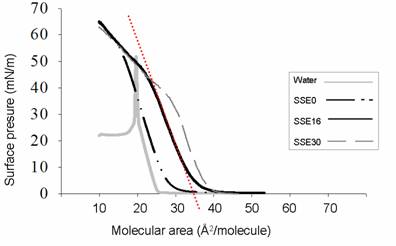
Figure 1: Langmuir isotherms of stearic-acid on sub-phase of water (solid gray line), of SSE equilibrated for 15 min before compression (dash dotted black line), of SSE equilibrated for 16 h (solid black line) and for 30 h. A tangent line drawn at the steepest slope (dotted red line) represents the limiting area per molecule.
Subsequently, the influence of biofilms on calcium phosphate mineralization was studied; several biopolymers representing the chemistry of biofilms, namely BSA, fibrinogen, lysozyme, and alginic acid were examined by the Langmuir isotherms coupled with Brewster angle microscope (BAM) and Infrared reflection-adsorption spectroscopy (IRRAS).
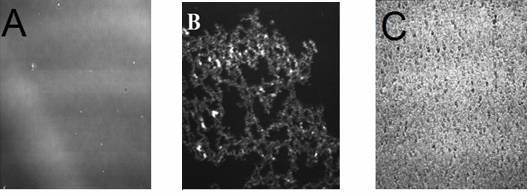
Figure 2: Brewster angle microscope (BAM) images of BSA films equilibrated for 15 min with water (A), with SSE solution (B), and with SSE solution for 18 hr (C).
Langmuir pressure – area isotherms of BSA films over SSE showed that the build-up of a mineralized layer at the interface was accelerated by the BSA film. Brewster angle microscopy further supported this finding (Fig. 2) where the mineral layer was clearly observed at the interface, and IRRAS analysis identified a phosphate peak at 1,030 cm-1 indicating that the mineral was calcium phosphate. The effects of fibrinogen, lysozyme, and alginic acid were examined by the same methodology, and their effects were compared and quantified.
The importance of this work lays in understanding the influence of membrane chemistry and of biofouling-born substances, and in particular extra-cellular polymeric substances (EPS) present on membrane surface during operation on calcium phosphate scaling in RO desalination of wastewater. The results obtained here could help minimizing scaling by tickling membrane surface chemistry and design of novel membranes that are less susceptible to mineral scaling.
[1] Z. Steiner, H. Rapaport, Y. Oren and R. Kasher (2010). Environ. Sci. & Technol. 44, 7937-7943.
[2] R. Mukhopadhyay, Chemical & Engineering News, Nov. 3rd, 2010. http://pubs.acs.org/cen/news/88/i41/8841news.html