
Gold-coated Oligoamide Mimetic of Thin Film Composite Nanofilteration Membrane Synthesized using Layer Chemistry for Study of Adsorption of Foulants and Surfactants
Rajender Kumar*1 and Roni Kasher1
1Department of Desalination & Water Treatment, Zuckerberg Institute for Water Research, Jacob Blaustein Institutes for Desert Research, Ben-Gurion University of the Negev, Sede Boqer Campus 84990, Israel
rajendershimla@gmail.com (RK); kasher@bgu.ac.il (R K)
Abstract
Nanofilteration (NF) membranes play an important role in waste water reclamation technologies. Despite of their huge potential in supplementing world's fresh water need they suffer from the problem of fouling. The fouling leads to the membrane deterioration in time. Cleaning the membranes with various types of surfactants and acid/base wash are helpful but are not fully efficient to reverse the damage caused by fouling. The fouling is highly complex phenomenon that is not precisely understood owing to lack of knowledge of exact surface chemistry. One of the main reasons for this gap is that commercial membranes are not suitable for the sensitive surface analysis [1]. To mitigate the problem of analysis and study of fouling we designed and prepared a surface mimetic of polyamide NF membranes. This mimetic is a films, composed of oligoamide layers on the gold surface using covalent layer chemistry. The oligoamide film has the similar chemistry as of NF membranes, i.e trimesoyl chloride coupled with piperazine as amine moiety. Several oligoamide films ranging from 0-12 layers were synthesized (Fig.1) and characterized using different surface analysis techniques such as contact angle analysis, ellipsometry, ATR-FTIR and XPS. The surface charge of the layers having different excess of amine and carboxylic acid groups were measured using streaming potential analyses. Each of the synthesized oligoamide films showed its characteristic surface chemical properties such as wettability, crosslinking and chemical composition thus providing a way to pre-design the oligoamide film depending upon the type of application and chemistry.
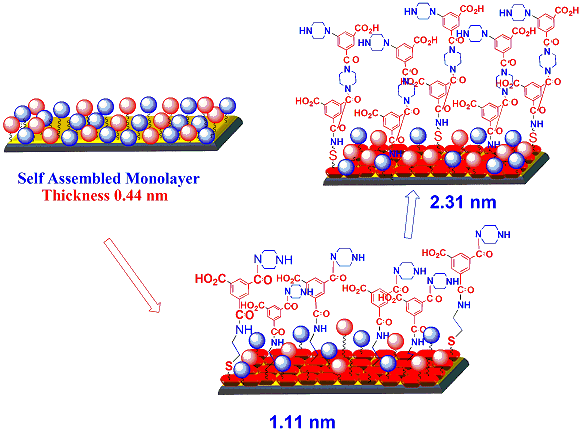
Figure.1: Graphical representation of oligoamide mimetic of NF membrane synthesized on gold surface
From the different coating layers synthesized, surfaces chosen for fouling studies were oligoamide films that resemble exactly the chemistry of commercial NF membranes in terms of wettability and chemical composition. Fouling studies were conducted by measuring the adsorption of common organic foulants as bovine serum albumin (BSA), fibrinogen (Fib) and alginic acid and their corresponding mixtures using Quartz Crystal Microbalance with Dissipation Monitoring (QCM-D) and Ellipsometry (Fig.2).
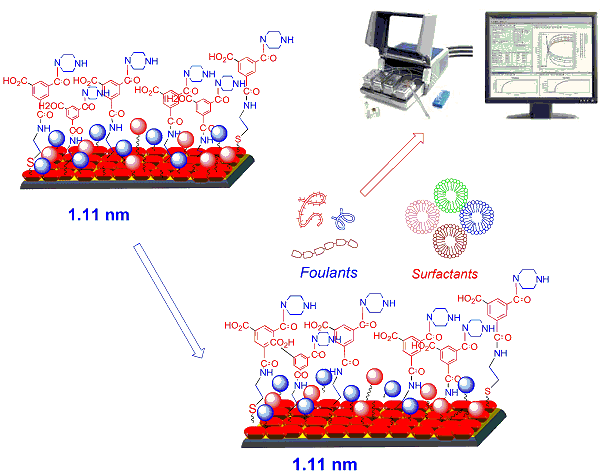
Figure.2: Graphical representation of adsorption of foulants and surfactants on oligoamide mimetic of NF membranes studied using QCM-D and ellipsometry.
Adsorption studies of mixtures of foulants showed that the alginic acid show significant effect on adsorption of BSA and Fib. The effect of different electrolyte concentration viz NaCl and CaCl2 on adsorption was studied. The calcium containing electrolyte was found to have significant effect on adsorption of foulants particularly for alginic acid, probably due to the formation of gel structure with calcium ions. In general the NF mimetic chemistry showed better tolerance towards the alginic acid compared to protein foulants which could be attributed to highly negative charge of the NF mimetic (and NF membranes), with the repulsion of highly negatively charged alginic acid.
Membrane cleaning using surfactants allows controlling the fouling to some extent. Evaluation of surfactants efficiency requires knowledge about the interaction of these surfactants with the membranes [2]. The adsorption and desorption behavior of various surfactants like ionic sodium dodecyl sulphate (SDS), cetyltrimethylammonium bromide (CTAB) and non-ionic (Triton-X) was studied. The surface interaction of the surfactants with NF mimetic, in the absence of foulants, was studied at different concentrations above and below their respective critical micelle concentration in pure water as well as in electrolyte solution. QCM-D studies revealed that the surfactants influence each other's adsorption behavior when present together. The results yielded important information about adsorption and desorption behavior of foulants and surfactants on NF membranes and give considerable depth in understanding the mechanism of fouling and cleaning behavior of surfactants. This study provides tools to study fouling and information of surfactant cleaning, and fouling mechanisms, and hence may lead to efficient use of surfactants to cope with NF membrane fouling.
References
See more of this Group/Topical: General Submissions