
Composition and kinetics of graft-polymerization layer of NF polyamide membranes with oppositely charged monomers
Gagik Ghazaryan, Sophia Belfer, and Roni Kasher
Department of Desalination & Water Treatment, Zuckerberg Institute for Water Research, Ben-Gurion University of the Negev, Sede Boqer Campus 84990, Israel
gagik@post.bgu.ac.il (G.G.); sbelfer@bgu.ac.il (S.B.); kasher@bgu.ac.il (R.K.)
Polyamide thin-film composite reverse osmosis (RO) and nanofiltration (NF) membranes are widely used in highly important membrane technologies such as sea water and brackish water desalination. However, a major drawback in RO and NF technologies is biofouling and organic fouling. An attractive route to overcome the fouling problem is membrane modification.
In previous studies we have described in situ surface modifications of RO and NF membranes which reduce their fouling tendencies, based on redox-initiated graft polymerization of hydrophilic, methacrylate monomers onto the membrane surface.1 Recently, we reported the use of graft polymerization by oppositely charged methacrylate monomers to increase the hydrophilicity and biofouling resistance of PVDF coated gold wafers.2 The use of oppositely charged monomers has an advantage of creating hydrophilic surface with minimal change of surface charge. Hence, in this study we investigated the kinetics and molecular mechanisms of graft polymerization with two oppositely charged monomers onto NF membranes (Fig. 1). Understanding the mechanisms of polymerization and surface properties would allow one to control graft polymerization of NF, such as surface charge.
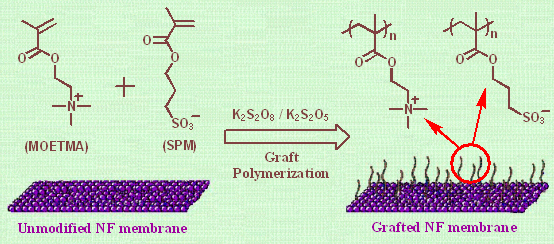
Figure 1. Schematic representation of graft copolymerization of NF270 membrane with MOETMA and SPM monomers.
The monomers used in this study were 2-[methacryloyloxyethyl] trimethylammonium chloride (MOETMA) and 3-sulfopropyl methacrylate potassium salt (SPM), bearing positive and negative charges, respectively (Fig. 1). Graft polymerization with different ratios of the monomers was performed to see the effect of monomer composition of resulted graft layer, while keeping the total concentration of both monomers constant (1.6M). For each particular ratio, the grafting was performed with varied reaction time. Moreover, the factor of temperature was examined, as well.
Chemical surface characterization of the modified NF270 membranes were performed by X-ray photoelectron spectroscopy (XPS) and by attenuated total reflection Fourier transform infrared (ATR-FTIR) spectroscopy, and confirmed the presence of the expected grafted polymer brushes. The ATR-FTIR study was also used for quantitative estimation of degree of grafting and showed that the degree of grafting increased with time. Moreover, the ATR-FTIR showed that a monomer ratio of 3:1 for MOETMA:SPM had the fastest polymerization kinetics.
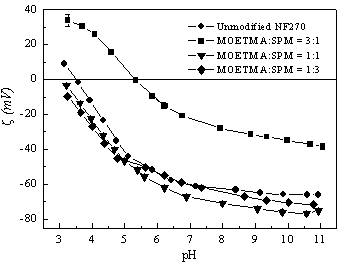
Figure 2. Zeta potential (ζ) curves of NF270 unmodified and modified for 5 minutes with MOETMA and SPM monomers at different ratios.
The surface charge of grafted membranes was studied by the streaming potential method in the pH range of 3–11. As can be seen in Fig. 2, after 5 min. grafting by MOETMA:SPM=3:1 the membrane surface charge increased by ~ 30 mV in comparison to unmodified membrane, whereas all other modifications had much smaller effect, of less than 9 mV. In 30 min. grafting the 3:1 monomer ratio resulted in even higher increase in surface charge, which is also seen in other monomer ratios. We assume that when the grafting mixture contains excess of positively charged MOETMA, the kinetics is faster due to the interplay of negative charge of membrane surface and positively charged MOETMA. For all membranes modified at different monomers ratios the titration curves become very flat compared to unmodified NF membrane. The zeta potential values for all modified membranes are in accordance with the charge of monomer in excess in the polymerization mixture; hence the curve of MOETMA:SPM=1:1 modified membrane is higher than the 1:3 modified membrane, and the MOETMA:SPM=3:1 modification resulted in the highest curve.
This study unravels molecular mechanisms of graft polymerization, and is a first step toward pre-designed NF membranes in terms of surface charge, hydrophilicity and surface chemical composition, which may lead to improved NF membranes.
References
1. Belfer S., Purinson Y., Fainshtein R., Radchenko Y., Kedem O. Surface modification of commercial composite polyamide reverse osmosis membranes. J. Memb. Sci. 1998, 139, 175–181.
2. Herzberg M., Sweity M., Brami M., Kaufman Y., Freger V., Oron G., Belfer S., Kasher R. Surface properties and reduced biofouling of graft-copolymers that possess oppositely charged groups. Biomacromolecules 2011, 12, 1169–1177.