
Immobilization of PEG-Derived Antimicrobial Peptides onto Reverse Osmosis Membranes to Reduce Biofilm Formation
Nitzan Shtreimer Kandiyote1, Moran Kopel2, Ehud Banin2, Roni Kasher1
1Department of Desalination & Water Treatment, Zuckerberg Institute for Water Research, The Blaustein Institutes for Desert Research, Ben-Gurion University of the Negev, Sde-Boqer 84990, Israel 2The Institute for Nanotechnology and Advanced Materials, The Mina and Everard Goodman Faculty of Life Sciences, Bar-Ilan University, Ramat-Gan 52900, Israel
Today, reverse osmosis (RO) membrane processes are among the most important technologies for water treatment and desalination. A major drawback in membrane based water treatment applications is membrane biofouling, resulting in an increase of feed channel pressure drop and decline of flux. Recently, our research group has developed a new approach to reduce biofilm growth based on immobilization of antimicrobial peptides (AMPs) on the surface of RO polyamide membranes. AMPs have a broad spectrum of activity against bacteria, fungi and are effective at low concentrations. It is well-known that, in order to preserve the activity of the peptide it should be linked to the surface via a long molecular tether such as polyethyleneglycol (PEG). In addition, immobilization of PEG molecules on RO surface has the potential of improving the membrane antifouling properties.
We describe a new methodology of linking active peptides to RO membranes by using PEGylated AMPs. The peptide D-Modelin-1 was synthesized and coupled to PEG by using solid phase peptide synthesis (SPPS) and Fmoc-chemistry. Mass spectrometry and analytical RP-HPLC confirmed the structure of PEGylated peptide and thus the success of the synthesis. PEG-D-Modelin-1 was then immobilized on aromatic polyamide RO membrane by two steps (fig. 1): In step (1) a maleimide linker was attached to the free carboxyl groups present on RO membranes by the use of coupling reagents. In step (2), PEG-D-Modelin-1 was coupled to the membrane via maleimide-thiol chemistry which afford site specific coupling.

Figure1: Immobilization of PEGylated AMPs on RO aromatic polyamide membranes.
The loading of model peptide compared to PEGylated peptide on the RO surface was evaluated in solution by the use of a fluorescent labeled peptide. The result showed that the loading by the new methodology (2 steps, Fig. 1) was significantly more effective than linking PEG and the peptide in two separate steps.
The inhibition of biofilm growth by RO membranes immobilized with PEG-D-Modelin-1 was tested in a flow cell using Green Fluorescent Protein (GFP) expressing bacteria. The results showed that the modified membrane reduced biofilm formation by ~ 40% (fig.2).
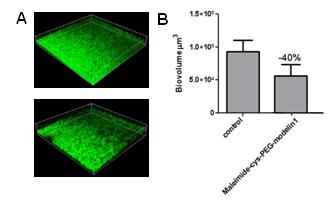
Figure 2: Inhibition of biofilm growth of GFP expressing Pseudomonas aeruginosa in a flow cell as visualized by CLSM of a control RO membrane (A; top) and a membrane immobilized with PEG-D-Modelin-1 peptide (A; bottom), and a quantitative analysis of biofilm volume of the two membranes (B).
The transport properties of modified membranes was tested, and compared to non-modified membrane by using a cross-flow RO system. It was found that the modification reduced the membrane permeate flux by 40%, however NaCl rejection was not affected.
In conclusion, immobilization of AMPs on RO membranes reduced biofilm growth, and is a promising approach to cope with biofouling. The procedure described in this study increased dramatically the synthesis efficiency, without interfering with the biological activity of the peptides.