
Today, heavy duty trucks generate electricity during idling by running diesel engines. Due to rising fuel prices and stronger environmental protection regulations, alternatives to the generation of on board electricity are desired.
Fuel cell based auxiliary power units (APU) are such an alternative and one of the most promising mobile applications for fuel cells. To avoid a dedicated H2-storage, the H2 needs to be generated on board by reforming diesel fuel.
Figure 1 (top) depicts a conventional fuel cell system, comprising a reforming unit, which generates a synthesis gas consisting mainly of H2O, H2, CO, CO2 and CH4. CO is a catalyst poison for low temperature fuel cells. It is converted to H2 in two shift stages (high temperature shift, HTS, and low temperature shift, LTS) by water gas shift reaction. The remaining CO is oxidized in a selective oxidation unit (SELOX). The reformate stream is used to generate electricity in a polymer electrolyte membrane fuel cell (PEM-FC).
An alternative system purifies the hydrogen by physically separating hydrogen from the other reformate gases using a highly selective palladium membrane (Figure 1, bottom). The hydrogen is generated by steam reforming of diesel fuel yielding higher efficiency than alternative concepts such as partial oxidation or autothermal reforming. Furthermore, the hydrogen partial pressure in the reformate gas from steam reforming is higher. Thus, the membrane is used more efficiently for hydrogen separation. The high purity hydrogen gas can be completely used in the fuel cell and, as no poisoning takes place, a higher efficiency of the fuel cell is expected within this setup compared to a conventional fuel processor.
We model the overall system efficiency for the membrane reformer system under different operating conditions. The system is dimensioned with respect to a target H2 production rate of 0,06 kg/h (corresponds to 2 kWthermal). The model of the membrane reformer was implemented in FORTRAN and interfaced with Aspen Plus.
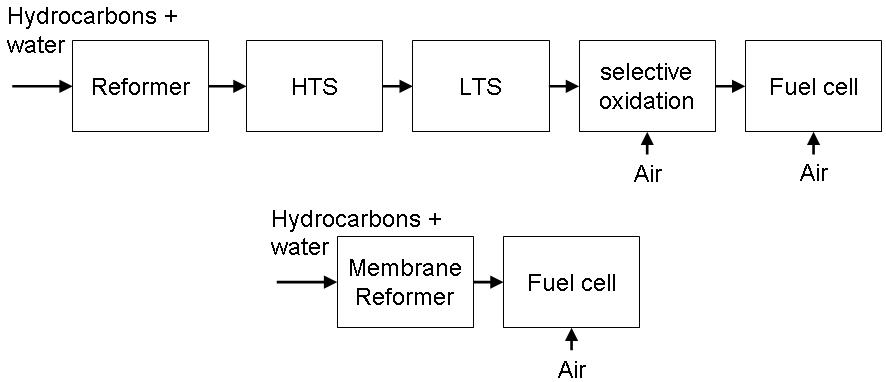
Fig. 1. State of the art fuel cell based APU system (top) and novel membrane reformer system (bottom).
For mobile applications, all water needed in the system must be recovered from the offgas streams. Thus, water recovery by condensation of water contained in the offgas streams was included in the system model and the impact of the modified operation conditions on the APU system efficiency was evaluated.
See more of this Group/Topical: General Submissions