
Introduction
The depleting supply and rising cost of crude oil has recently created extensive interest in converting biomass and agricultural wastes for energy production. Butanol produced by fermentation of biomass (Biobutanol) has been proposed as a substitute for diesel fuel and gasoline; it is considered as a potential biofuel with superior properties when compared to ethanol. Butanol has a higher energy density, and lower vapor pressure than ethanol and gasoline. Butanol can be used as a replacement for gasoline gallon for gallon, and has been demonstrated to work in vehicles designed for use with gasoline without modification. Ethanol can only be used as an additive to gasoline up to about 85% and then only after modifications to the engine.
Bio-butanol can be produced by fermentation of biomass by the A.B.E. process. However, the concentration of n-butanol (the most common butanol isomer produced in fermentation) is lower than that achieved in ethanol fermentation. In addition, acetone and ethanol are also produced. The feedstocks are the same as for ethanol: energy crops such as sugar beets, sugar cane, corn grain, wheat and cassava, prospective non-food energy crops such as switchgrass, as well as agricultural byproducts such as straw and corn stalks.
Iso-butanol, a butanol isomer with branched chain structure, gives a higher octane number than the isomeric n-butanol. Iso-butanol is also produced naturally during the fermentation of carbohydrates and may also be a byproduct of the decay of organic matter. Iso-butanol, along with other low molecular weight alcohols can also be produced by some engineered microorganisms such as corynebacterium. In recent years, production of iso-butanol has also been investigated using engineered microbial strains that can reach higher concentrations during aerobic cultivations.
Butanol, unlike ethanol has a much lower solubility in water and thus requires much less energy for separating from water. N-butanol/water and iso-butanol/water solutions are typically separated with two distillation columns as both form heterogeneous azeotropes in the distillation processes. Typical starting concentrations for enriched n-butanol/water and iso-butanol/water mixtures are smaller than 9 wt%.
Because distillations from aqueous solutions are energy intensive, pervaporation could be an energy savings separation alternative, as much less energy is potentially required compared to evaporation methods. The permeability of hydrophobic membranes towards butanols involves transfer of polar molecules (the alcohols) from a polar medium (water) into a nonpolar environment (the membrane). Moreover, selective pervaporation of organics from aqueous-organic solution requires elastomeric membranes. As such, a hydrophobic elastomeric membrane material such as PDMS is suitable for removing butanol from water as previously demonstrated by other researchers.
Polydimethylsiloxane (PDMS) silicone is one of the most widely known membrane materials because of its high permeability to vapors and gases. It has been widely used in spiral wound membrane modules as well as skinned on porous hollow fibers in applications ranging from pervaporation and liquid contacting to gas separation. However, it has not been commonly used in a dense homogeneous hollow fiber format, mainly because of the difficulty and cost in forming PDMS into suitably sized dense hollow fibers. MedArray has developed a low cost method for forming dense, homogeneous PDMS hollow fibers and has packaged the hollow fibers in membrane modules or various sizes with membrane area densities as high as 5,000 m2/m3. A homogeneous hollow fiber membrane configuration provides many advantages over the spiral wound format, including up to ten times higher membrane area density per volume, no porous substrate to impede gas transfer or limit compatibility, and substantially lower cost per unit area.
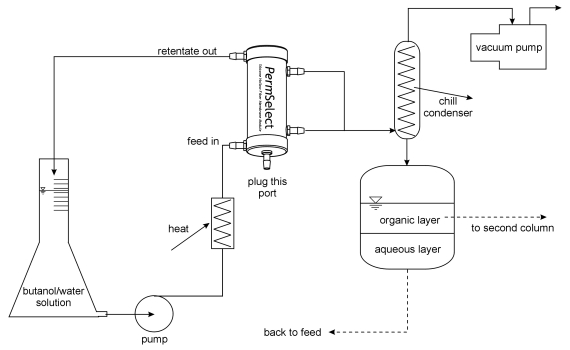
The work presented here is directed toward demonstrating the efficacy of MedArray's PDMS membrane hollow fiber modules to separate butanols from water by pervaporation. Pervaporation could replace the first distillation column; the butanol/water solutions can be fed to a membrane module, instead of the first distillation column. The butanol (and some water) will permeate the membrane while butanol depleted water (retentate) recirculates continuously through the module. The permeate consists of butanol and water vapors which when condensed, automatically separate into two liquid layers (aqueous and organic) because of the poor solubility of butanol in water. The liquid layers are contained in a separator decanter. The enriched water phase from the bottom of the separator could be fed back into the feed side of the membrane module, while the enriched butanol phase on top could be decanted and fed to the second distillation column. Finally, highly purified butanol emerges from the bottom of the column while the azeotrope which exits the top of the column, is condensed, and then fed back to the separator.
Methods
The membrane modules used were MedArray's PDMSXA-8300 containing 10600 PDMS hollow fibers in a 3.2 mm diameter housing, providing an exposed length of 8.3 cm with effective surface area 0.56 m2.The dimensions of the hollow fiber are as follows: outside diameter 300 microns, wall thickness 56 microns. These modules were tested while simulating a series of butanol separation applications.
2.8kg of a mixture of n-butanol/water or iso-butanol/water was filled into a flask with a graduated volume scale at the neck. A centrifugal pump circulated the mixture through the membrane module as the feed. The permeate was driven across the membrane by vacuum or a sweep gas. The initial and final concentrations of the feed were determined by GC.
The membrane module performance can be characterized in terms of permeation flux (J) and separation factor (a) defined as:
J = Q/(At)
a = [xp/(1-xp)]/[xf/(1-xf)]
where Q is the mass of permeate collected over a time interval t, A is the effective membrane area for permeation; xp and xf are the mass fractions of butanol in the permeate and feed, respectively.
Results
The permeation flux, for each butanol isomer and water for various initial conditions is presented below:
With tube side feed flow (*except Test 7 which had shell side feed flow):
Test | Butanol Isomer | Initial Feed Conc. wt% | Temp. °C | Sweep or Vacuum | Final Feed Conc. wt% | Flux J g/hr/m2 butanol | Flux J g/hr/m2 water | Separation Factor a |
1 | Iso-butanol | 7.5 | 42 | vacuum | 1.6 | 71.5 | 67.8 | 22.0 |
2 | Iso-butanol | 7.5 | 27 | vacuum | 3.6 | 42.2 | 29.0 | 24.6 |
3 | Iso-butanol | 7.5 | 26 | N2 sweep | 5.4 | 23.1 | 12.1 | 27.8 |
4 | 1-butanol | 7.5 | 27 | vacuum | 3.3 | 45.1 | 32.9 | 23.7 |
5 | 1-butanol | 6.3 | 25 | N2 sweep | 5.1 | 13.3 | 9.4 | 23.4 |
6 | 1-butanol | 7.5 | 25 | air sweep | 6.3 | 14 | 11.4 | 16.6 |
7* | 1-butanol | 7.5 | 25 | N2 sweep | 6.3 | 12.3 | 11.1 | 17.8 |
Conclusions
Based on these results, we conclude that PDMS hollow fiber membrane modules can be used effectively in iso-butanol/water and 1-butanol/water separation processes. At higher temperature, permeation flux is higher, but the separation factor is lower.