
Composite polymer-inorganic nanoparticles as regenerable coatings for fouling control on reverse osmosis membranes
Megan A. Smith, David A. Ladner
Membrane fouling plagues all types of membrane filtration, from large-pore microfiltration to nonporous reverse osmosis (RO). Significant past and ongoing research efforts have focused on permanent surface modifications to reduce foulant adhesion, but another approach is to temporarily modify the surfaces by applying a coating that serves as a barrier between the membrane and foulant. This coating is electrostatically bound to the membrane at operational pH and removed with a simple acid wash once fouling has occurred. The coating can then be re-applied in-situ, and in this sense is "regenerable."
Experiments were performed to investigate the adhesion and removal properties of composite polymer-inorganic nanoparticles (NPs) as regenerable coatings on RO membranes. The NPs were approximately 10-nm in diameter and were composed of an inorganic material (silver or TiO2) enshrouded in a polymer to impart surface functionality and charge. For negatively charged NPs, the polymer shroud was polyacrylate and for positively charged NPs the polymer was polydiallyldimethylammonium chloride (polyDADMAC). Positively charged NPs could be attached directly to the RO membrane through electrostatic attraction between the NPs and the negatively charged membrane. To adhere negatively charged NPs, polyDADMAC was first used as an intermediate, positively charged layer.
Acid washing removed the positively charged NPs and the polyDADMAC intermediate coating holding the negatively charged NPs by protonating the carboxyl groups on the membrane and causing electrostatic repulsion. Coating and removal phases were characterized primarily by measurement of the surface zeta potential with an electrokinetic analyzer (SurPASS, Anton Parr). Representative zeta potential curves are shown in Figure 1. Additional characterization was performed using scanning electron microscopy (SEM) and attenuated total reflectance Fourier-transform infrared (ATR-FTIR) spectroscopy. Some NP layers could be easily removed from the membrane surface, while others were more tightly bound. PolyDADMAC bound strongly to the membrane at operational pH and was easily removed at pH values below the membrane's isoelectric point. Future work on improving the surface coverage and testing the ability of the coatings to release foulants in-situ will be performed.
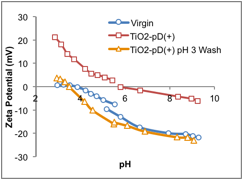
Figure 1: Zeta potential measurements from titrations of a virgin RO membrane (Filmtec SW30HR), the membrane coated with a TiO2-polyDADMAC positively charge composite NP [TiO2-pD(+)], and a membrane that was coated then cleaned with a pH 3 wash.
See more of this Group/Topical: General Submissions