
Biofouling is a major concern for most membrane-based water filtration operations, but many other fields outside of water filtration are plagued by this common problem as well. Bacterial attachment and biofilm formation are ubiquitous concerns in applications ranging from the use of medical implant devices to nautical shipping. The use of small, pulsed electric currents and/or voltage to prevent bio-attachment has been found to be efficacious in these applications. The same approach has not been applied to polymeric membranes due to their highly insulating nature. We have invented a novel porous polymer nanocomposite coating that is highly electrically conducting. This coating can be applied to membranes without affecting the separation characteristics of the membrane. As a result, the coated membranes have high water flux, low surface hydrophobicity, and narrow pore size distribution, while also being highly electrically conductive. Examples of these membranes are show in figure 1.
In order to prove this membrane coating's touted ability against bacterial attachment, we designed and built a unique cross-flow water filtration vessel with insulated electrical leads connecting the electrically conducting membrane to an AC voltage generator. A schematic of this device is shown in figure 2. This membrane was tested in highly bacterially contaminated waters, with initial bacterial populations as high as 1010 bacteria/L. Flux tests were run for 24 hours, and fluxes decreased by approximately 40% for both membranes connected to the voltage source and for those that were not. However, flux decrease was caused by biofouling only for the membranes that were not connected to the voltage source, while flux decrease in those that were electrically charged was only caused by bacterial attachment. As a result flux could be almost entirely recovered for the latter membranes. After 24 hours, the cross flow of water was rapidly increased and bacteria that were pressure compacted on the surface of the membranes that were connected to the voltage source, were washed away. After 1 minute of this cross-flow flushing, 90% of the flux could be recovered during further filtration of bacterially contaminated waters. In the control experiments, however, the formed biofilm remained fixed to the surface of the membrane during cross-flow flushing and flux could not be recovered. The prevention of biofilm formation by the electrically conductive membranes connected to the voltage source was a long-term effect and did not decrease with use.
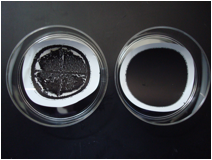
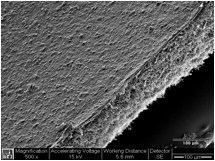
Figure 1: In the left image is shown a comparison of un-crosslinked, unstable CNTs on a support membrane (leftmost membrane) with CNTs that have been cross-linked to PVA with succinic acid (right membrane) producing a smooth, highly electrically conductive coating. Shown on the right is an SEM cross-section of the highly electrically conductive PVA-CNT cross-linked membrane. The thickness of this surface coating is approximately 1.0 µm, which is significantly less than that of the support membrane.
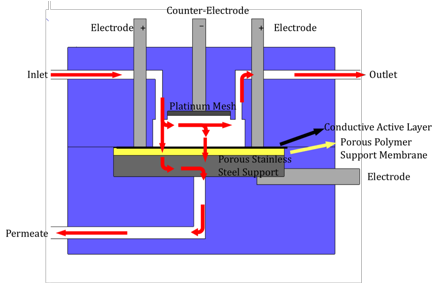
Figure 2: A schematic diagram of the electrified cross-flow cell. Bacteria in 10% LB media are filtered through the flow cell and across the electrically conductive membrane, while an AC voltage source charges the membrane through contact with insulated electrodes (shown in light grey).