
Highly-performed nanofibers-supported thin-film-composite membranes for engineered osmosis: fabrication and characterization
Nhu-Ngoc Bui, Jeffrey R. McCutcheon*
Department of Chemical, Materials & Biomolecular Engineering and Center for Environmental Sciences and Engineering; University of Connecticut; Storrs, Connecticut, USA
Abstract
In this study, robust thin film composite forward osmosis membranes supported by hydrophilic nanofibers electrospun from blends of polyacrylonitrile (PAN) and cellulose acetate (CA) at different weight ratios were reproducibly fabricated and characterized. These membranes exhibited two to three times higher osmotic water flux than the standard commercial forward osmosis membrane. To the best of our knowledge, these membranes outperformed almost all forward osmosis flat sheet membranes have been reported in open literature. The osmotic water flux was dependent on the hydrophilicity and the pore sizes of the nanofibrous structures. The more hydrophilic PAN-supported TFC membranes performs the highest average osmotic water flux of 55 L/m2h in pressure-retarded osmosis (PRO) mode and about 30 L/m2h in forward osmosis (FO) mode when using 1.5M NaCl as the draw solution at 25oC. The corresponding reverse salt flux ranged from 0.5 to 2 g/m2h. Also, flux performance of these TFC membranes increased with the concentration of polymer dope used to fabricate electrospun nanofibers. The mechanical strength tests shown a significant increase in tensile strength and Young's modulus of the TFC membranes compared with the nanofibrous supports. These results suggest that electrospun nanofibrous supported polyamide composite membranes may effectively enable applications like forward osmosis where internal concentration polarization is the performance-limiting factor.
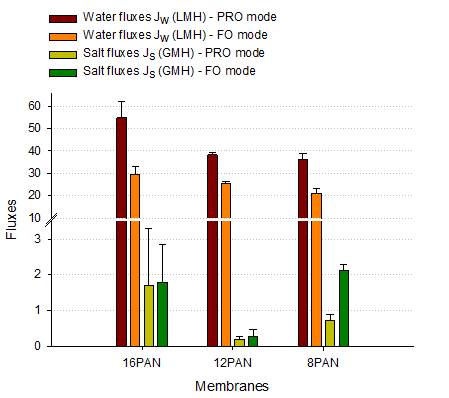
Figure 1. Osmotic water fluxes and reverse salt fluxes of TFC membranes supported on PAN nanofibrous mats electrospun from solutions having different polymer concentration. Experimental conditions: 1.5M NaCl draw solution, deionized water feed solution, measured volumetric flow rate of the feed and draw solution were 0.5 lpm, temperature of both feed and draw solution was 25.0±0.5 oC.
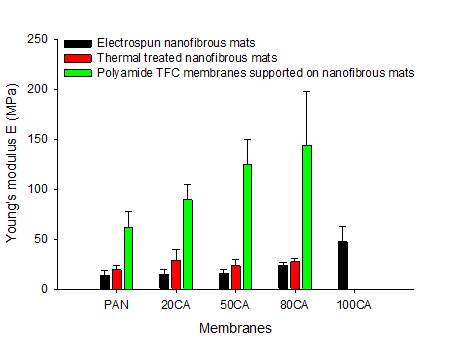
Figure 2. Young's modulus of electrospun nanofibrous supports and TFC membranes fabricated on PAN/CA nanofibers at different polymer weight ratios.