
Eyal Kaufman1, Sophia Belfer1, Roni Kasher, Viatcheslav Freger2, and Moshe Herzberg1*
1Zuckerberg Institute for Water Research -
ZIWR
Ben-Gurion University of the Negev
Sede Boqer Campus, 84990
eyalkoyfman@gmail.com, kasher@bgu.ac.il , sbelfer@bgu.ac.il, herzberg@bgu.ac.il
2Department of Chemical Engineering
Technion – Israel Institute of Technology, Haifa, 32000
Keywords: ultrafiltration, biofouling, membrane bioreactors (MBR), graft-polymerization.
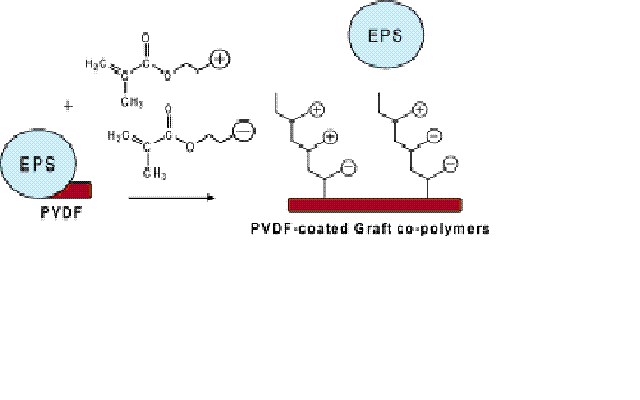
Membrane bio-reactors (MBRs) have emerged as a promising technology for wastewater treatment. During that process UF membranes are used as a selective barrier between the bioreactor compartment and the reclaimed water. Biofilm formation on the membrane surface is probably one of the major drawbacks of this technique, which reduces the overall performance gradually ADDIN RW.CITE{{2 Meng, F. 2009}}(Meng et al. 2009). One of the promising techniques that recently were shown to reduce membrane biofilm formation is graft-polymerization from the membrane surface using positively and negatively charged monomers as depicted in Figure 1. The increased hydrophilicity of the membrane surface, its neutral charge, and its swelling characteristics followed by the monomers reduces its biofouling propensity ADDIN RW.CITE{{1 Herzberg, M. 2011}}(Herzberg et al. 2011).
In the present study, preparation and characterization of UF membranes, surface-modified using simultaneous graft- polymerization of negatively charged sulfopropyl methacrylate (SPM) and positively charged methacryloyloxyethyl trimethylammonium (MOETMA) monomers, is described. The water permeability of three different grafted and pristine membrane fibers were measured three times, each time for a period of three weeks of usage inside an MBR under operational conditions of municipal wastewater treatment achieving tertiary effluents water quality. The permeability of the grafted membranes showed significantly higher and more sustainable permeability as well as significantly more facile flux restoration with only physical back-flushing.
Further
biofouling studies of grafted-polymerized surfaces
with SPM and MOETMA monomers were carried out in a quartz crystal microbalance
with dissipation monitoring (QCM-D) technology. Using PVDF coated QCM-D sensors
grafted with a mixture of SPM and MOETMA monomers, we delineated the mechanism,
by which the grafted hydrophilic and overall neutral polymer repels MBR originated
extracellular polymeric substances (EPS) from the modified surface and reduces
its propensity to fouling. QCM-D results show that the grafted hydrophilic and
electrically neutral layer formed by mixed positive and negative monomers
swells and becomes hydrated. This effect is enhanced upon addition of a salt to
solution, which apparently disrupts ionic bonds within the polymer. A decrease
in the resonance frequency (an indicator of the mass attached to the surface)
and larger dissipation (viscous effects within the attached layer) indicate
that water is effectively “immobilized” within the grafted polymer, which
weakens adhesion of the EPS molecules.
Figure SEQ Figure \* ARABIC 1: Schematic illustration of the antibiofouling grafted membrane surface. PVDF is the
material of the UF membrane and EPS presents the fouling material. Reproduced
with permission from ADDIN RW.CITE{{1
Herzberg, M. 2011}}(Herzberg et al. 2011). References
ADDIN RW.BIBHerzberg,
M., Sweity, A., Brami, M., Kaufman, Y., Freger, V., Oron, G., Belfer, S. &
Kasher, R. 2011, "Surface Properties and Reduced Biofouling of
Graft-Copolymers That Possess Oppositely Charged Groups", Biomacromolecules,
.
Meng, F., Chae, S.R., Drews, A., Kraume, M., Shin, H.S.
& Yang, F. 2009, "Recent advances in membrane bioreactors (MBRs):
membrane fouling and membrane material", Water research, vol. 43,
no. 6, pp. 1489-1512.
See more of this Group/Topical: General Submissions