
Organic Solvent Nanofiltration (OSN) is an emerging technology for conventional separation and purification processes. A challenge in nanofiltration and reverse osmosis is to broaden the applications from aqueous to organic feeds. This requires solvent-resistant membranes that preserve their separation characteristics under a large range of solvents, as well as defect-free morphology and controlled MWCOs.
Using integrally skinned membranes we have difficulty in imposing control of the structure of the top layer, which controls selectivity, flux and separation. There is little room to alter the structure of integrally skinned membranes by playing with the chemistry because their formation process is quite limited to linear, soluble polymers 1. Only a few of such linear polymers have the right combination of flux and solute rejection characteristics to generate commercially attractive OSN membranes.
One way to solve this problem is to make the top layer in a separate step (e.g. by interfacial polymerization) using alternative chemistries, resulting in Thin Film Composite (TFC) membranes. Composite membranes have key advantages compared to integrally skinned asymmetric membranes. In TFC membranes, the top layer can be formed of a large variety of chemical compositions, including both linear and crosslinked polymers. Furthermore, each individual layer can be optimized separately. The thin top layer can be optimized for the desired flux and solute rejection, and the support layer can be optimized for maximum strength and compression resistance as well as a minimum resistance to permeate flow.
The performance, composition and morphology of TFC membranes depends on many parameters used on the formation of the barrier top-layer and post-reaction treatment. It is well known that TFC membranes characteristically show a trade-off between permeability and solute rejection, which can be overcome by carefully choosing reaction and post-reaction parameters 2.
Polyimides (PI) have been used as polymers for solvent resistant nanofiltration 3, 4 and ultrafiltration 5 membranes. These polymers present high resistance against a wide range of organic solvents, high temperature durability, and high mechanical properties which make them one of the most suitable polymers for the development of OSN membranes.
Here, we propose the formation of a new generation of organic solvent nanofiltration (OSN) membranes: High flux Thin Film Composite membranes (TFC) via interfacial polymerization. In this work, PI UF membranes were used as supports for the formation of organic solvent nanofiltration TFC membranes. Promising results have been obtained by varying different parameters on the formation of the top-layer, enhancing solvent flux and solute rejection. These new OSN TFC membranes have shown good rejection, high flux and good reproducibility in different organic solvents, including DMF and THF and even Toluene (see Figure 1, 2 and 3). Finally, to further improve flux for more hydrophobic solvents, different chemistries have been used, successfully enhancing hydrophobic solvents flux; including Toluene (see Figure 3). They are the first OSN TFC membranes prepared via interfacial polymerization to be resistant in DMF and to exhibit much higher permeabilities, with comparable rejections to commercial OSN integrally skinned asymmetric membranes. Thus, we believe that novel OSN TFC membranes prepared by interfacial polymerization may offer new degrees of freedom in membrane design, which could lead to the next generation of high performance OSN membranes.
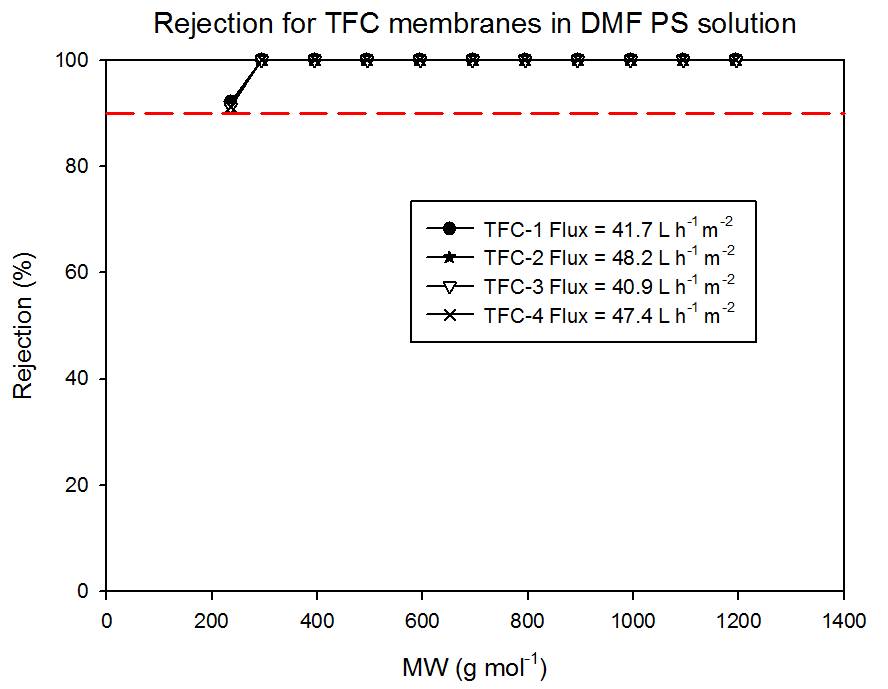
Figure 1. MWCO curves and fluxes of TFC membranes. Nanofiltration of a feed solution comprising polystyrene oligomers dissolved in DMF has been performed at 30 bar and 30oC.
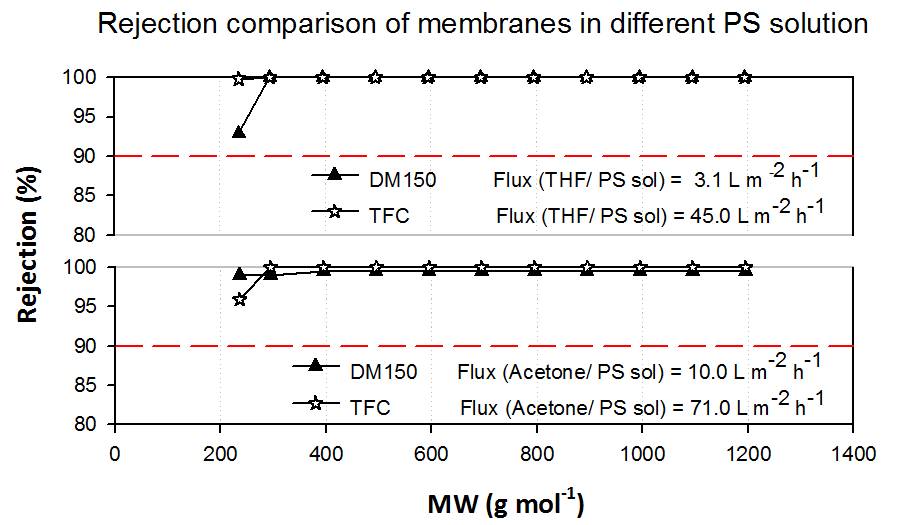
Figure 2. MWCO curves and fluxes of TFC membranes and commercial OSN IS asymmetric membranes (DM150). Nanofiltration of a feed solution comprising polystyrene oligomers dissolved in THF or acetone has been performed at 30 bar and 30oC.
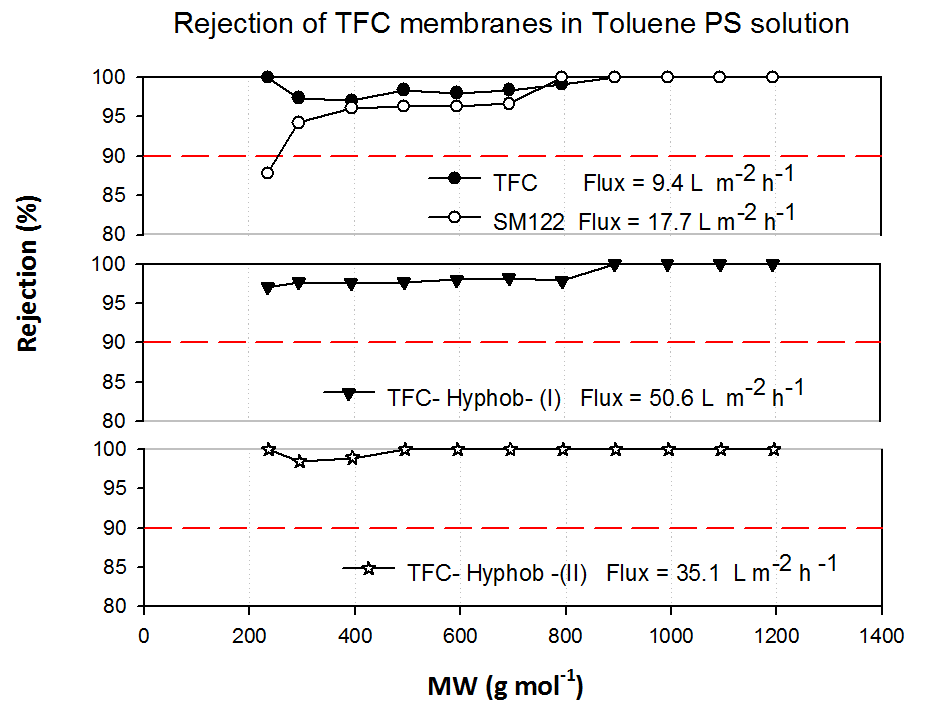
Figure 3. MWCO curves and flux of TFC hyphob membranes and commercial OSN IS asymmetric membranes (SM122). Nanofiltration of a feed solution comprising polystyrene oligomers dissolved in Toluene has been performed at 30 bar and 30oC.
References
[1] R. J. Petersen, et al., J. Membr. Sci., 83, 81, 1993.
[2] Vandezande P, Gevers L E M and Vankelecom I F J et al., J. Chem. Soc. Rev, 37, 365, 2008.