
Approaches to creating stimulus-responsive membranes have been explored for decades for liquid separations or controlled release applications yielding materials whose permeability varies, triggered by a change of pH, temperature, or ionic strength of the adjacent liquid, or the exposure to light, an electrical or a magnetic field. It remains a challenge, however, to mimic the specific and locally acting molecular recognition mechanism found in Nature for triggering a change of permeability in cell membranes, where a specific target-receptor interaction triggers a conformational change of a membrane transporter protein resulting in turn in a variation of the effective diameter of the cell membrane pores.
While the incorporation of such transporter proteins is one route to creating artificial molecular stimuli-responsive membranes, a possibly more robust and simpler one is the surface modification of a porous membrane structure with simpler molecules but likewise capable of recognition of a molecular stimulus, such as DNA-aptamers. The capacity of DNA-aptamers to reversibly and specifically bind to target molecules of virtually any molecular size while undergoing a conformational change is being explored since very recently for the surface modification of nanoparticless or biosensors1. The challenge for membrane barriers, however, has remained in the application of their molecular recognition principle on a larger substrate area, and most of all to achieve reversibility in its conformational changes for repeated applications.
We here report on the performance of self-assembled stimuli-responsive interfaces based on DNA-aptamers which respond upon a molecular recognition of a relatively small molecule, adenosine-triphosphate (ATP) rather than a bulk stimulus such as temperature or pH. These interfaces were incorporated both into mesoporous structures as well as nanoporous membranes2 and upon contacting with the target molecule, they were supposed to cause a change in membrane permeability owing to the significant conformational change of the aptamer receptor molecules. This work will highlight both the capacity of DNA-aptamers for triggering permeability or controlled release, as well as the characterization techniques employed for elucidating and verifying their function and dimensions of the respective conformational changes.
The surface of nanoporous alumina membranes and mesoporous particles was adequately modified for the immobilization of an ATP-aptamer (receptor) as well its unselective mutated form as a negative control. Flouresceine was then used as a tracer molecule in an adjacent feed solution and its permeation across the modified nanoporous membranes monitored as a function of the presence of ATP (target) in the feed. For characterizing the ATP-aptamer responsive membranes, characterization techniques such as quartz crystal microbalance with dissipation monitoring (QCM-D), surface plasmon resonance (SPR) and dual polarization interferometry (DPI) were employed. The latter proved particularly useful in case where changes were only in the sub-nm range. With regard to the receptor molecules, we opted for an ATP-binding aptamer because ATP with a molar mass of 507,18 g·mol-1 may still be considered a small molecule, and as such posed a challenge to serve as a trigger for conformational changes that would be sufficient to reversibly change the permeability of the overall membrane barrier.
The self-assembled stimuli-responsive membrane barrier, with its concept depicted in Figure 1, as well as mesoporous particles based on aptamers were capable of reversibly changing their permeability or controlled release upon the molecular recognition of ATP, rather than respond to a bulk stimulus.
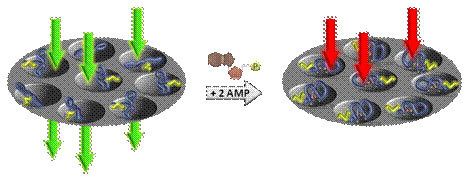
Figure 1: Schematic of the gate-keeper membranes developed. In absence of the target (ATP), fluoresceine freely permeates the nanoporous membrane; in presence of the target, ATP, the DNA-aptamer undergoes a drastic conformational change causing a relative blocking of the pore.
Negative controls using both mutated aptamers or GTP as a target rather than ATP did not show any significant response of the membrane, whatsoever, proving that the concept proposed did actually rely on a highly selective molecular recognition mechanism as is hitherto mainly known from biological membranes. When the system proposed was furthermore tested under varying medium compositions, such as the presence of serum in order to simulate physiological conditions, no deterioration of the stimuli-responsiveness was observed. The proof-of-concept of our membrane design is particularly promising as aptamers as acting receptor molecules can be selected toward virtually any kind of target, ranging from small molecules to proteins and even cells, and therefore presenting a wide range of possible applications in biomedicine or bioseparations in general.
1.Özalp, V.C., and Schäfer , T. Chem. Eur. J., 17(36), 9893–9896, 2011
2. Schäfer, T. and Özalp, V.C., 2012, submitted
See more of this Group/Topical: General Submissions