
297700 Investigation of Novel Nano Nano Composite Membrane for CO2 Capture
DEVELOPMENT OF NOVEL NANOCOMPOSITE MEMBRANE FOR CO2 CAPTURE
Vajiheh Nafisi, M.T. Guzman Gutierrez, May-Britt Hägg*
Norwegian University of Science and Technology
E-mail: may-britt.hagg@chemeng.ntnu.no
Keywords (CO2 Capture, Gas Separation, Membrane, Nanoparticle, 6FDA-Durene, PEBAX)
ABSTRACT
The global warming is one of the world's major environmental issues. Reduction of greenhouse gas emissions by the capture of carbon dioxide from flue gas is one out of different kinds of methods to try to address this problem. Due to the economical and environmental advantages of membrane separation over other separation technologies, a lot of research activities are being carried out for development of sophisticated membrane materials such as facilitated transport membranes, polymeric, inorganic and mixed matrix materials for CO2 capture.
When used in industrial applications the membrane will need to be chemically resistant to the harsh environment in flue gas. Polyimides combine excellent thermal and chemical stability with a very wide range of CO2 permeability. Some polyimides, particularly those incorporating the group 6FDA possess high CO2 permeability. Thus some aromatic polyimides with a favorable balance of properties such as solubility, crystallinity, glass transition temperature, density or free volume have achieved importance for application in gas separation technology. Polyimides are generally synthesized by the reaction of a diamine and dianhydride in an aprotic solvent to form a polyamic acid. This polymer then undergoes a polycondensation reaction to form desired polyimide.
PEBAX is a thermoplastic polymer with two separated microphases, with polyamide as hard phase and an amorphous polyether. Polyether block amide (PEBA) resin is best known under the trademark PEBAX, and is a thermoplastic elastomer combining linear chains of rigid polyamide segments interspaced with flexible polyether segments. The structure of the PEBAX repeating unit includes an aliphatic polyamide “hard segment” and an amorphous polyether “soft segment.” The soft segment is either poly(ethylene oxide) or poly(tetramethylene oxide). This crystalline/amorphous structure creates a blend of properties of thermoplastics and rubbers. In application to permeation, it was believed that the hard amide block provides the mechanical strength, whereas gas transport occurs primarily in the soft ether segments. In applications involving the removal of CO2 from gas mixtures, PEBA was found to have high selectivity for polar or quadrupolar/nonpolar systems like CO2/N2.
Composite materials could combine the basic properties of organic and inorganic materials and offer specific advantages for the preparation of mixed matrix membranes (MMMs) with excellent separation performances. Composite materials such as polymers with embedded nano-inorganic particles have been investigated in the recent years and possess the potential to provide a solution to the trade-off between permeability and selectivity for polymer membranes published by Robeson. Metal organic frameworks (MOFs) are a relatively new class of microporous materials comprised of transition metals and transition metal oxides connected by organic linkages to create microporous structures. It is important to choose polymer with the quality which match the nano fillers as much as possible.
The objective of this study is to investigate the effect of different nanoparticles like TiO2, Si and Zif-8 on gas permeation properties of the solid poly(ether-b-amide) copolymer membrane PEBAX2533 and 6FDA-Durene Diamine. In this work some novel hybrid nanocomposite membranes have been developed. Synthesis of a hybrid nanocomposite membrane was performed by incorporating various above mentioned nanoparticles in PEBAX and synthesized 6FDA-durene polymer matrices.
In this work 6FDA-durene polyimide was synthesized by two step polycondensation reaction from purified durene diamine and 6FDA as monomers [Fig.1] and PEBAX was purchased from Arkema. The synthesized polymer was characterized with FT-IR, NMR, DSC, TGA, SEC and viscosity measurements. FTIR spectra show the reaction has been completed and TGA results show promising thermal stability of the polymer. The synthesized aromatic polyimide has high Tg around 416°C.
Flat sheet dense Nanocomposite membranes of the synthesized polymer and PEBAX have been tested for single gas permeation characterization. Some results of synthesized 6FDA-Durene are shown in Table.1.
Some of the results of gas permeation properties of mixed matrix PEBAX membrane are shown in Table.2. In the further work permeation properties of selected membranes will be documented for relevant mixtures. Then optimizing the membranes with respect to performance for flue gas separation will be the next step. Characterization of the developed polymeric nano-composite membranes will be performed before and after exposure to gases at various temperatures and pressures in order to check their durability. More results will be detailed out in the presentation.
|
Fig.1. Polycondensation reaction scheme of synthesis 6FDA-Durene |
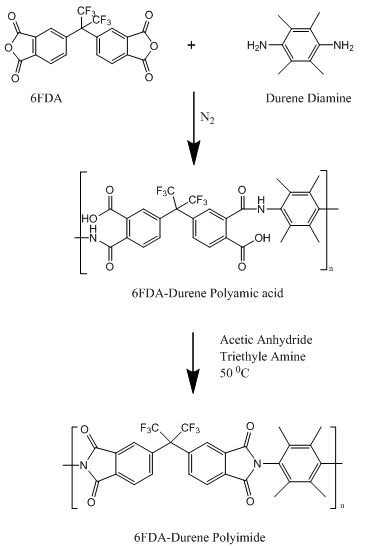
Table.1. Gas permeability of 6FDA-Durene in Barrer and Ideal selectivity factor measured at 2 and 4 Bar at 21 °C
Tg °C | Td °C | N2 (Barrer)
| O2 (Barrer)
| CO2 (Barrer)
| CH4 (Barrer)
| CO2/N2
| CO2/CH4
|
415
| >500
| 30.7
| 92
| 644.7
| 25.1
| 20.9
| 25.6
|
Table.2. Gas permeability of Mixed matrix PEBAX membranes in Barrer and Ideal selectivity factor measured at 2 Bar at 21 °C
Nanoparticle%
| N2 (Barrer)
| O2 (Barrer)
| CO2 (Barrer)
| CH4 (Barrer)
| CO2/N2
| CO2/CH4
|
Zif-3%
| 16,65
| 44,51
| 471,95
| 53,69
| 28,35
| 8,79
|
Zif-5%
| 14,30
| 27,62
| 330,71
| 36,24
| 23,12
| 9,12
|
Zif-7%
| 11,39
| 28,04
| 314,62
| 32,66
| 27,62
| 9,63
|
Si-3%
| 13,87
| 34,52
| 325,53
| 40,85
| 23,47
| 7,97
|
Si-5%
| 14,70
| 29,54
| 317,57
| 34,06
| 21,00
| 9,32
|
Si-7%
| 12,53
| 28,75
| 312,25
| 32,71
| 24,92
| 9,55
|
Acknowledgment: This work is financed by the BIGCCS-project coordinated by Sintef.
See more of this Group/Topical: General Submissions