
298482 Wastewater NF/RO Biofouling Research: Physico-Chemical Causes For Sphingomonas SPP. Prevalence
WASTEWATER NF/RO BIOFOULING RESEARCH: PHYSICO-CHEMICAL CAUSES FOR SPHINGOMONAS SPP. PREVALENCE AS CONFIRMED BY QCM-D AND MICROFLUIDICS.
Gutman,J.1; Kaufman,Y.1; Kawahara,K.2; Arnusch, C1; S.L.; Walker3, S.L.; Freger,V.4; Herzberg, M1#.
1 Department of Desalination and Water Treatment, Zuckerberg Institute of Water Research ; Ben Gurion University of the Negev, Israel. 2 Department of Applied Material and Life Science, College of Engineering, Kanto Gakuin University, Yokohama, Japan3 .Department of Chemical and Environmental Engineering,University of California, Riverside, USA4 Wolfson Department of Chemical Engineering, Technion - Israel Institute of Technology, Haifa, Israel. #corresponding author herzberg@bgu.ac.il
Recent studies show that bacteria belonging to the Sphingomonas spp. dominate the bacterial community found in biofilms developing in reverse osmosis (RO) systems all over the world ADDIN RW.CITE{{332 Al Ashhab, A. In prep.; 52 Bereschenko, LA 2010; 334 Khambhaty, Y. 2011; 63 Xu, P. 2010}}(Al Ashhab et al. In prep.,Bereschenko et al. 2010,Khambhaty and Plumb 2011,Xu et al. 2010). These systems are characterized by oligotrophic conditions, high shear and pressure.
Sphingomonas spp. are aerobic, gram-negative bacteria. Unlike other gram-negative aerobic bacteria, which outer cell membrane is mainly composed of lipopolysaccharides (LPS), Sphingomonas spp. contain different outer-membrane component, glycosphingolipid (GSL) (Fig.1) ADDIN RW.CITE{{54 Kawasaki, S. 1994}}(Kawasaki et al. 1994).
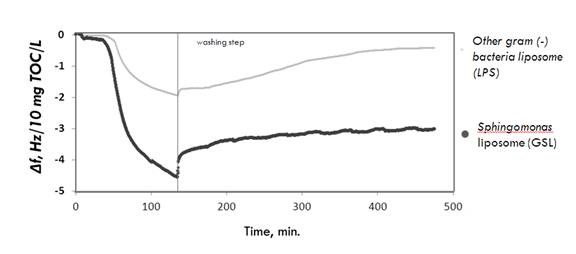
Fig.1: QCM-D analysis of GSL/LPS vesicles adhesion (up to 130 min.) and their washing from the polyamide surface with 100mM NaCl background solution (130 min. and up). Reduction in Δf suggests mass adhesion to surface.
We hypothesize that there are different interactions between LPS contacting bacteria and the RO membrane surface compared to the interactions of GSL containing bacteria, the Sphingomonas spp. LPS/GSL vesicles were used in this study to elucidate the role of this components in bacterial adhesion.
Quartz crystal microbalance with dissipation (QCM-D) allows monitoring the frequency and energy dissipation response upon adhesion of molecules to the surface of freely oscillating sensor, with user-specific surface chemical characteristics. Applying this technique, while using NF/RO mimetic surface (polyamide) it was shown that GSL vesicles adhere in higher rate to the polyamide surface while forming stronger interactions, in comparison to LPS (Fig.1)
Water permeability measurements using microfluidic RO flow-cell (Fig.2) were performed, subjecting the NF/RO membrane to either GSL or LPS vesicles. High adhesion of GSL was correlated with low permeability and lower adhesion of LPS resulted in higher permeability of the membrane.
It is to be concluded that GSL are likely to contribute to the adherence of the Sphingomonas spp. to the NF/RO membranes by the following means (1) Contribution to the hydrophobic characteristics of the bacterial cell (2) Enhancing rate of adhesion (3) Reducing the rate of detachment upon cleaning. This findings suggest further investment in developing highly hydrophilic surfaces, a possible physico-chemical relief to the Sphingomonas spp. problem.
ADDIN RW.BIBReferences
Al Ashhab A, Herzberg M, Gillor O (In prep.) The microbial community of fouled reverse osmosis membranes under different fluxes.
Bereschenko L, Stams A, Euverink G, van Loosdrecht M (2010) Biofilm formation on reverse osmosis membranes is initiated and dominated by Sphingomonas spp. Appl Environ Microbiol. 76: 2623-2632
Kawasaki S, Moriguchi R, Sekiya K, Nakai T, Ono E, Kume K, Kawahara K (1994) The cell envelope structure of the lipopolysaccharide-lacking gram-negative bacterium Sphingomonas paucimobilis. J Bacteriol 176: 284-290.
Khambhaty Y, Plumb J (2011) Characterization of bacterial population associated with a brackish water desalination membrane. Desalination 269: 35-40
Xu P, Bellona C, Drewes JE (2010) Fouling of nanofiltration and reverse osmosis membranes during municipal wastewater reclamation: Membrane autopsy results from pilot-scale investigations. J Membr Sci 353: 111-121