
298737 Permeation Properties of Thin, Self-Supported Pd77%Ag23% Membranes
Palladium-based membranes have lately been the focus of many studies due to their high hydrogen permeability and selectivity, which are potential properties for hydrogen separation technologies [1]. Hydrogen permeability can be enhanced by heat treatment procedures in air (HTA) [2]. For thin membranes the total hydrogen flux through the membrane can be doubled with heat treatment. However the phenomena behind this advantageous effect are still not clear. In this work, a new approach to the heat treatment in air procedure has been investigated.
Hydrogen permeation behavior of pure hydrogen through Pd77%Ag23% membranes of nominal thickness ~2.20, 4.67 and 8.48 µm has been studied as a function of temperature and pressure with no use of sweep gas. The membranes were prepared with a sputtering method developed by SINTEF [3-4], and mounted in a micro channel configuration allowing for hydrogen permeation experiments [5]. The heat treatment in air was performed using the following sequence: i) HTA of the permeate side, ii) HTA of the feed side, iii) HTA of both sides one more time. Each step was carried out for one hour. Atomic force microscopy (AFM) measurements were performed for all as-grown membranes, as well as after heat treatment in air. AFM images were also taken for 2.20 µm and 8.48 µm thick membranes after hydrogen stabilization with no further treatment.
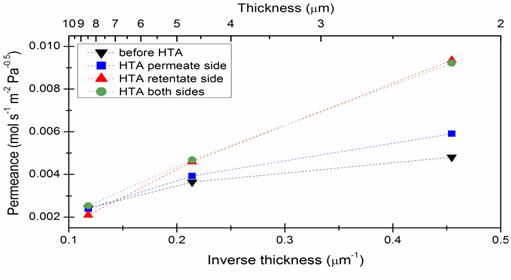
Fig.1. Permeance versus inverse thickness at 300 °C for each single step.
Hydrogen permeance at 300 °C, as a function of inverse thickness, is plotted in Figure 1. HTA has larger effect as the membrane thickness decreases, with practically no effect for the 8.48 µm thick membrane. Moreover the permeance increases after each of the first two steps of the HTA method, whereas there is no significant change in the third. Permeances obtained after heat treatment in air of both sides, are comparable to previous values reported in literature for all membranes [6].
(a)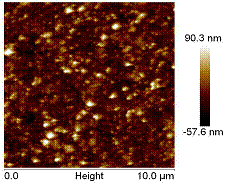
(b)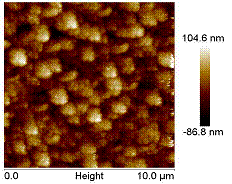
(c)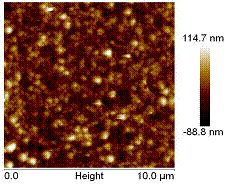
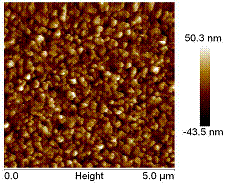
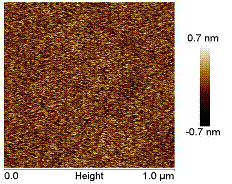
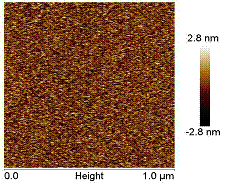
Fig.2: AFM images of 8.48 µm thick membrane for as-growth sample (a) feed side (left) permeate side (right), after hydrogen stabilization sample (b) feed side (left) permeate side (right), after heat treatment in air sample (c) feed side (left) permeate side (right).
Figure 2 shows AFM images for the 8.48 µm thick membrane. Hydrogen exposure caused significant increase of the roughness on the feed side of the membrane. The permeate side roughness is enhanced only after heat treatment in air. Results indicates that the HTA process influences the surface roughness of the membranes, but that hydrogen adsorption has a stronger effect on surface restructuring than the desorption. The data also imply that adsorption phenomena and surface restructuring strongly affect the permeation properties of thin membranes (≤4 µm).
The authors would like to acknowledge for financial support the Research Council of Norway through the RENERGI Programme (190779/S60) and NTNU, SINTEF and Statoil ASA through the Gas Technology Centre NTNU-SINTEF. Marit Stange is also gratefully acknowledged for the manufacturing of the Pd-alloy films.
Key Words: PdAg membranes, Hydrogen Permeation, Surface Characterization.
References:
[1] S.N. Paglieri, J.D. Way, “Innovations in palladium membrane research”, Sep. Purif. Methods (2002) 31: 1-169.
[2] A.L. Mejdell, H. Klette, A. Ramachandran, A. Borg, R. Bredesen, Hydrogen permeation of thin, free-standing Pd/Ag23% mebranes before and after heat treatment in air, J. Membr. Sci. (2008) 307: 96–104.
[3] R. Bredesen, H. Klette, “Method of manufacturing thin metal membranes”, US Patent 6,086, 729 (2000).
[4] H. Klette, R. Bredesen, “Sputtering of very thin palladium-alloy hydrogen separation membranes”, Membr. Technol. (2005) 2005: 7-9.
[5] A.L. Mejdell, M. Jřndahl, T.A. Peters, R. Bredesen, H.J. Venvik, “Experimental investigation of a microchannel membrane configuration with a 1.4 μm Pd/Ag23 wt% membrane – Effects of flow and pressure”, J. Membr. Sci. (2009) 327: 6-10.
[6] A.L. Mejdell, H. Klette, A. Ramachandran, A. Borg, R. Bredesen, Hydrogen permeation of thin, free-standing Pd/Ag23% membranes before and after heat treatment in air, J. Membr. Sci. (2008) 307: 96–104.
See more of this Group/Topical: General Submissions