
299590 Artificial Water Channels: A Primitive Mimic of Gramicidin-A Channel
Artificial water channels: a primitive mimic of Gramicidin-A channel
Mihail Barboiu,1* Yann Le Duc,1 Arnaud Gilles,1 Pierre-André Cazade,2 Mathieu Michau,1 Yves Marie Legrand,1 Arie van der Lee,1 Benoît Coasne2, Joshua Post,3 Tom Fyles3
1Adaptive Supramolecular Nanosystems Group, Institut Européen des Membranes, ENSCM-UMII- UMR-CNRS5635, Place Eugène Bataillon CC047, 34095 Montpellier Cedex 5, France.
2 Institut Charles Gerhardt Montpellier (ICGM), UMR 5253 CNRS/ENSCM/Université de Montpellier II, 8 rue de l’Ecole Normale, F-34296 Montpellier, France
3Department of Chemistry, University of Victoria, Victoria, BC, V8W3V6, Canada
yves-marie.legrand@univ-montp2.fr
Gramicidin A, gA, one of the best characterized biological pore structures, is of primordial inspiration for the design of artificial ion channels. The dipolar structure of gA helps to overcome the high energy barrier to water and ion translocation, disposed in a single-file inside the channel. Particularly interesting, the dipolar alignment of water molecules also observed inside other channels (1) can control ionic conduction. Within this context, we recently proved (2,3) that synthetic chiral imidazole-quartets can align the water dipoles within water-channels (Fig. 1).

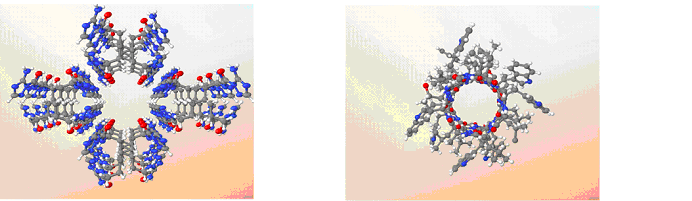
Fig. 1. A. Crystal structure of TCT: Four double-helix entities form tightly interacting cyclic octamers resulting in the formation of T-channels. B. Pore structures of T-channel (left) and gA (right) at the same dimensional scale.
Up to now, polarizable systems with electrostatic or steric asymmetry have been used to generate dipolar ion-pumping through artificial channels. Herein, we report that the bolaamphiphile triazole, TCT self-assembles to form stable T-channels in lipid bilayers (Fig. 2A). Like in gA channels, the carbonyl moieties, pointing toward the T-channel core and surrounding the transport direction, are solvated by water. The net-dipolar alignment of water molecules along the chiral pore surfaces influences the conduction of protons/ions, envisioned to diffuse along dipolar hydrophilic pathways.
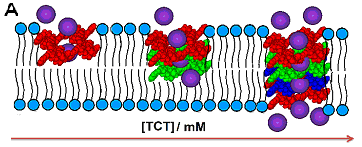
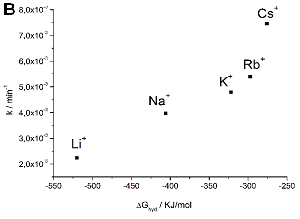
Fig.
2.
A. Possible hierarchical self-assembly of T-channels for increasing
TCT
concentrations in the bilayer membrane B. Transport activity of
T-channels versus dehydration energy of alkali cations
The transport activity of T-channels versus dehydration energy of alkali cations shows an increasing single order exponential behavior (Fig. 2B). The abrupt change in transport of low hydration energy cations (Cs+, Rb+), not observed for cation-water single file gA channels, involves double file dipolar water-wires and ion-wires along the T-channel.
Theoretical simulations and experimental transport assays reveal that the conduction through the T-channel, like in gA channels, presents proton/water conduction, cation/anion selectivity and large open channel-conductance states in bilayer membranes.
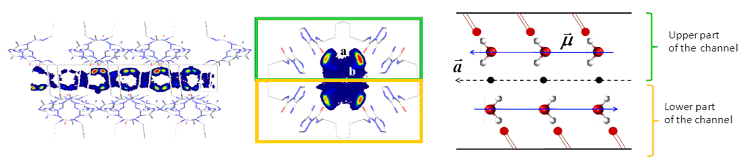
Fig.
3.
Molecular
simulations of water in TCT channels; contour plots are showing the
average density distribution of confined water molecules.
The axial density profile reveals significant positional, but heterogeneous ordering of confined water within the T-channel. There are nearly no water molecules in the center (R = 0); the waters are mostly located in two layers near to the surface (Fig. 3). The pair correlation functions between OW and HW exhibits short-range positional order very close to liquid water. Moreover these results show enhanced interactions between neighboring water molecules than those interacting with inner groups at the surface of the T-channel. We also investigated the dipolar orientation of water within the T-channel. The contour plots of the density of water molecules show two possible orientations of net dipole of water molecules within the T-channel: a) those in the upper part are orientated along the + axis while b) those in the lower part are orientated along the – axis. The net dipolar orientation is mainly imposed by strong interactions of the water molecules with the oriented –C=O groups pointing toward the center of the pore. Indeed, two successive sets of –C=O groups separated by the inversion centers point in the lower part towards + axis, while in the upper part point towards – axis.
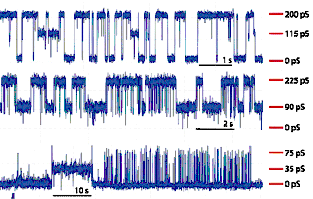
The conductance of the T-channels was assessed by the bilayer clamp technique (4) under single- and multiple-channel conditions (Fig. 4). The two open states are never an exact multiple of conductance of one another, suggesting that they are related by a relatively simple addition-subtraction of a component rather than multiple copies of a single species. Multiple conducting species are an example of the “supramolecular polymorphism” that is commonly observed with synthetic channel-forming compounds.
Fig. 4.. Single channel conductance of T-channels. “early stage” conductance records
This system - associating supramolecular chirality with water dipolar alignment inside the channels - represents an artificial mimic for ion-pumping. This artificial primitive mimic of gA might provide useful information about the molecular-scale hydrodynamics of water within simpler artificial channels which has relevance for many biological scenarios.
Agre, P. Aquaporin water channels. Angew. Chem. Int. Ed., 43, 4278-4290 (2004).
Le Duc, Y. et al. Imidazole-quartet water and proton dipolar channels. Angew. Chem. Int. Ed. 50, 11366-11372 (2011).
Barboiu, M. Artificial water channels. Angew. Chem. Int. Ed. 51, 11674-11676 (2012).
Chui, J. K. & W. Fyles, T. M. Ionic conductance of synthetic channels: analysis, lessons, and recommendations. Chem. Soc. Rev. 41, 148-175 (2012).
See more of this Group/Topical: General Submissions