
299754 PDMS Mixed Matrix Membranes With Molecular Interaction-Driven Tunable Free Volumes: Breaking the Trade-Off Between Permeability and Selectivity for Pervaporation
PDMS Mixed Matrix Membranes with Molecular Interaction-driven Tunable Free Volumes: Breaking the Trade-off between Permeability and Selectivity for Pervaporation
Gongping Liu,† Wanqin Jin,[*],† Kueir-Rarn Lee,‡ Juin-Yih Lai‡
† State Key Lab of Materials-Oriented Chemical Engineering, Nanjing University of Technology, 5 Xinmofan Road, Nanjing 210009, P. R. China;
‡R&D Center for Membrane Technology, Chung Yuan University, Chung-Li 32023, Taiwan, ROC.
The development of membrane technologies based on molecular-scale separations such as pervaporation and gas separation continues to receive tremendous attention due to the inherent advantages of energy-saving and cost-effective [1]. An ideal membrane demands for highly permeable and selective, but there is always a trade-off between permeability and selectivity exists for polymeric membranes, which are currently the dominant membranes for molecular separation because of their easy-processability and low-cost. In recent years, incorporating inorganic particles into polymers to fabricate mixed matrix membranes (MMMs) has been proven to be an efficient and cost-effective approach to improve the membrane permeability and selectivity. Although improved performance could be obtained by utilizing the high size or adsorption selectivity of the fillers, the inadequate particle dispersion and defective filler/polymer interface that lead to reduced membrane selectivity since the permeating species bypass the filler, are considered two of the major obstacles that impede the commercial implementation of this approach. Polydimethylsiloxane (PDMS), a benchmark membrane material for organophilic pervaporation (e.g., biofuels recovery from dilute aqueous solution and VOCs removal), has relative low separation performance that are still insufficient for practical applications. Previous work [2] has developed a surface graft/coating approach to obtain a homogeneous dispersion of zeolite particles in polymer to prepare defect-free PDMS MMMs. Nevertheless, like most reported MMMs, the pervaporation performance of the zeolite/PDMS MMMs were yet trapped in permeability-selectivity trade-off.
In this work, therefore, a facile strategy that by means of creating hierarchical molecular interactions between inorganic molecules and polymer chains was proposed to fabricate high-performance MMMs. Our idea aims to finely control the conformation and topology of polymer chains through appropriate intramolecular and intermolecular interactions resulting from immobilization and movement of backbone and side chain induced by the incorporated inorganic phase. Inorganic fillers of polyhedral oligomeric silsesquioxanes (POSS), a kind of molecular silica, were physically dispersed in PDMS matrix to fabricate POSS/PDMS MMMs. The membrane structures, morphologies, free volumes were systematically investigated by molecular simulation, DSC, SEM, TEM, positron annihilation lifetime spectroscopy (PALS). And the membrane separation performance was evaluated by the butanol recovery from its aqueous solution via pervaporation. The results indicated that the POSS fillers could manipulate the PDMS chain mobility and packing driven by hierarchical molecular interactions, resulting in tunable free volumes in PDMS MMMs (Figure 1a). With simultaneous utilization of solubility selectivity from POSS filler and high diffusion selectivity from tunable PDMS chain structures, the POSS/PDMS MMMs exhibited high separation performance that breaks the trade-off between permeability and selectivity in polymeric membranes (Figure 1b).
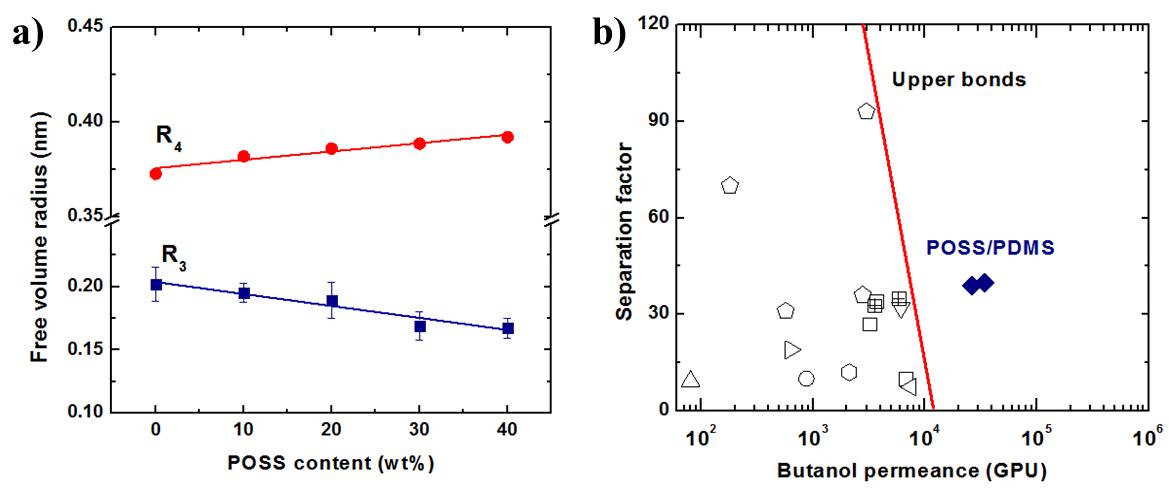
Figure 1. (a) Free volumes of the POSS/PDMS MMMs; (b) pervaporation performance comparison of POSS/PDMS MMMs with literatures
Acknowledgements
This work was supported by the National Basic Research Program of China (No. 2009CB623406), National Natural Science Foundation of China (Nos. 20990222 and 21206071), Natural Science Foundation of Jiangsu Province (No. BK2012423) and China Postdoctoral Science Foundation funded project (No. 2011M501221). This work was also supported by the R&D Center for Membrane Technology, Chung Yuan University.
References
[1] G.P. Liu, W. Wei, H. Wu, X.L. Dong, M. Jiang and W.Q. Jin, J. Membr. Sci., 373, 121 (2011).
[2] G.P. Liu, F.J. Xiangli, W. Wei, S.N. Liu and W.Q. Jin, Chem. Eng. J., 174, 495 (2011).