
300370 Polymer/Ionic Liquid Blends With Superior Separation Performance for Removing CO2 From Hydrogen and Flue Gas
Polymer/ionic liquid blends with superior separation performance for removing CO2 from hydrogen and flue gas
Hang Zheng Chen, Pei, Li and Tai-Shung Chung*
Department of Chemical and Biomolecular Engineering. National University of Singapore
*chencts@nus.edu.sg (Tai-Shung Chung)
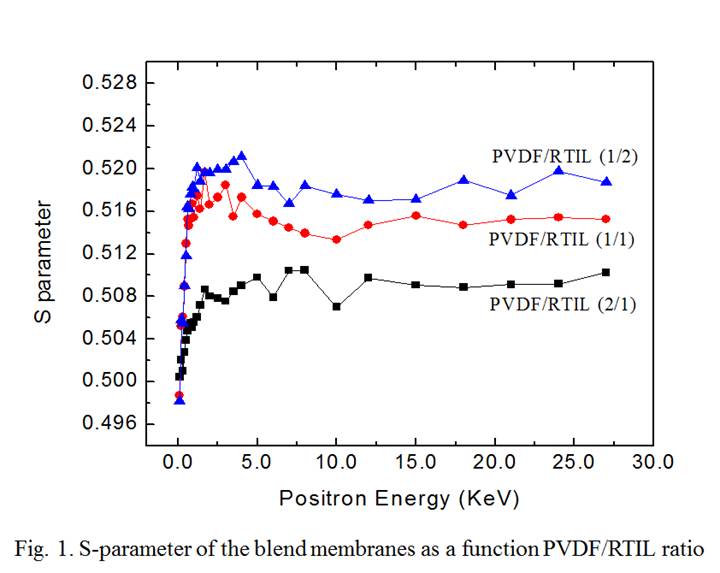
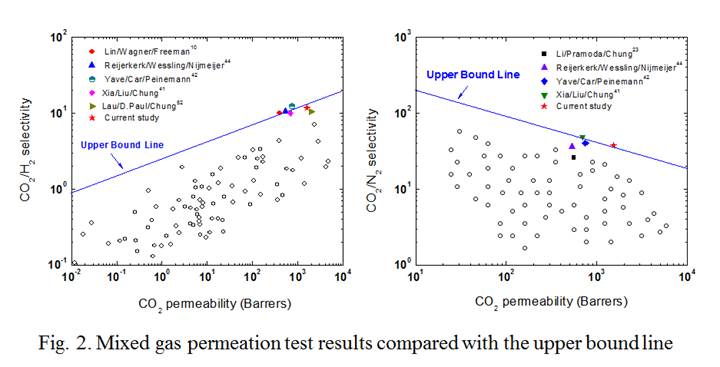
Global warming and energy shortage are the main concerns globally. Membrane technology has shown great advantages over other conventional methods for capturing CO2 and producing green fuels such as H2. In this study, for the first time, polymer blends comprising poly(vinylidene fluoride) (PVDF) and a room-temperature ionic liquid (RTIL) that show a high CO2 permeability of 1778 Barrer with CO2/H2 and CO2/N2 selectivity of 12.9 and 41.1, respectively. The low viscosity RTIL, 1-ethyl-3-methylimidazolium tetracyanoborate ([emim][B(CN)4]) possesses not only high free volume (Figure 1) but also high CO2 solubility, and plays an important role in CO2 separation. Both optical observation and Maxwell predictions confirm the heterogeneous nature of the PVDF/[emim][B(CN)4] system. Compared to miscible ionic liquid based blends, where molecular level interactions may restrain chain flexibility and reduce gas permeability, heterogeneous PVDF/RTIL blend systems display far superior gas transport properties. Most of the blend membranes in this study outperform most recent reported materials and their gas transport and separation capabilities fall within the attractive region bound by the “2008 Robeson Upper Limit” for CO2/H2 and CO2/N2 gas pairs (Figure 2). Therefore, they are potential materials for removing CO2 from hydrogen and flue gas streams.
See more of this Group/Topical: General Submissions