
301605 Impact of the Magnetic Ionic Liquids Properties On the Transport of Solutes Through Magnetic-Responsive Liquid Membranes
This work aims at studying the influence of magnetic field on the intrinsic physicochemical (e.g. rheological behavior, solubility [1]) and structural properties of a novel class of magnetic responsive ionic liquids - MILs and the potential impact of their magnetic behavior on the diffusion mechanisms of solvents and solutes through MILs liquid membranes.
The existence of ionic liquids exhibiting the ability to switch reversibly their physicochemical properties and structural organization of their ionic network by changing the conditions (intensity and directional vector) of the applied magnetic field is particularly promising regarding the design of novel membrane based separation processes – e.g. magnetic responsive supported liquid membranes. These membranes are expected to allow for an adjustable permeability and/or selectivity, contributing consequently for an improved transport of solutes through a fine tuning of the magnetic field conditions.
The molecular dynamics of MILs was assessed through proton Nuclear Magnetic Resonance (1H NMR) relaxometry. This technique provided information about the molecular dynamics of MILs ionic network in the broad range of magnetic fields (B=2pnL/g), namely between 0.2 mT and 7 T. The results obtained show the existence of a specific relaxation mechanism associated with the presence of the magnetic anions [FeCl4], which is observed in the MHz range of Larmor frequencies of the spin-lattice relaxation time (T1) dispersion (Fig. 1a). Viscosimetry analysis performed in the magnetic field range 0-2T, revealed that the MILs viscosity decreases with the increase of the magnetic field (Fig. 1b). Together, resonance relaxometry and viscosimetry analysis allowed for the determination of the evolution of MILs self-diffusion coefficients with the magnetic field as well as for the establishment of a comprehensive correlation between the magnetic induced structural rearrangements and the MILs physicochemical and self-diffusional properties.
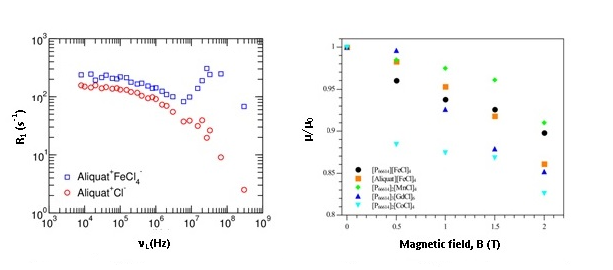
Figure1. a) 1H-NMR spin-lattice-relaxation results, as a function of the frequency nL =gB/2p, for the magnetic ionic liquid AliquatFeCl4 and for the analog non-magnetic ionic liquid AliquatCl; b) Viscosity dependence with magnetic field for the MILs.
Gas transport studies through supported liquid membranes with immobilized MILs were performed at magnetic field intensities up to 1.5 T, in order to evaluate the impact of magnetic sensitivity of MILs viscosity and self-diffusion on membrane permeability and selectivity [2]. The results obtained show that the membrane selectivity is not much influenced by the magnetic field. However, the increase of the magnetic field leads to the increase of membrane permeability to the different gases (CO2, N2 and air) tested. Therefore, it is possible to conclude that the magnetic responsive supported liquid membranes designed in this work allowed for a non-invasive modulation of gas permeability by adjustment of the external magnetic field intensity.
References
[1] S. Lee, S. Ha, H. Jin, C. You and Y. Koo, Magnetic behavior of mixture of magnetic ionic liquid bmim[FeCl4] and water, J. Applied. Physics 101 (2007) 102.
[2] E. Santos, J.Albo, C.I.Daniel, C.A.M.Portugal, J.G.Crespo, A.Irabien. Permeability modulation of Supported Magnetic Ionic Liquid Membranes (SMILMs) by an external magnetic field. Journal of Membrane Science 430 (2013) 56.
Acknowledgements
The authors gratefully acknowledge the financial support from the European Research Action Network-ERANET, ERA-CHEM/0001/2008 Project (Portugal) and Project EUI 2008- 03857 (Spain). Carla Daniel acknowledges the financial support of FCT-MCTES through the PhD grant SFRH/BD/81552/2011.
See more of this Group/Topical: General Submissions