
302167 When the Membrane Is Not Enough: A Simplified Membrane Cascade Process Using Organic Solvent Nanofiltration (OSN)
When the Membrane is not Enough: Simplified Membrane Cascades for Molecular Separation in Organic Solvent Nanofiltration (OSN)
Jeong F. Kim, Gyorgy Szekely, Ana M. Freitas da Silva, Irina B. Valtcheva and Andrew G. Livingston*
Department of Chemical Engineering and Chemical Technology, Imperial College London
Obtaining a sharp separation between two molecules in the nanofiltration range is still a challenge to be solved due to the insufficient differences in solute rejection in a single filtration stage. The concept of membrane cascade was proposed in the early 70s to overcome this separation challenge; however, to date several cascade implementation challenges, such as control difficulty, have presented major hurdles and only few experimental data have been reported [1, 2]. Industrial membrane operations in organic media are usually carried out in diafiltration mode requiring large amounts of solvents, time and energy, having significant impact on the environment and economics. Membrane cascades can circumvent these issues and have potential for process intensification allowing more sustainable membrane units. Therefore, here we present a simplified-control cascade process that not only overcomes implementation obstacles, but also minimizes the product loss and maximizes the product purity. The process operates using a single high pressure pump as the primary energy source, and without any need for a buffer tank between membrane stages (Figure 1).
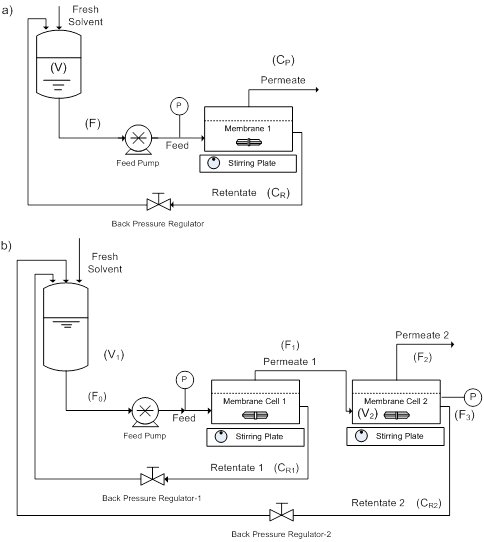
Figure 1. System diagrams of: a) single-stage diafiltration; b) two-stage cascade diafiltration. The symbols in parentheses are the variables used in the process model.
The feasibility of the process was successfully validated on pharmaceutical applications such as polyethyleneglycol separation and degenotoxification of active pharmaceutical ingredients (APIs) using polyimide and polybenzimidazole membranes, increasing the final yield from 59% to 94% without compromising purity (Figure 2). The authors believe that this new membrane cascade will transform the way membrane separations are approached and will promote industrial applications of membranes.
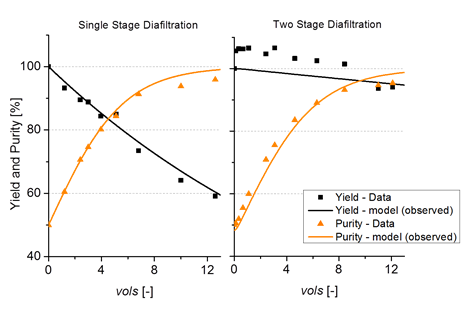
Figure 2. Comparison of PEG-2000 yield and purity between single- and two-stage diafiltrations over 12 vols. The yield increased from 59% to 94% at the purity of 98%.
The process has been studied in more detail using a mathematical model which was developed to predict the cascade performance. It was found experimentally that the recycle ratio, as well as the transmembrane pressure, affects the process yield significantly, in agreement with the model predictions. Analysis of the optimization of parameters and experimental validation are presented.
[1] E.N. Lightfoot, T.W. Root, J. L O'Dell, Biotechnol Progr 24 (2008) 599-605.
See more of this Group/Topical: General Submissions