302276 Mitigating Fouling of Ultrafiltration Membrane With Sub-Micron Surface Patterns
Mitigating Fouling of Ultrafiltration Membrane with Nanoimprinted Surface Patterns
Yifu Ding, Sajjad H. Maruf, John Pellegrino, Melissa Rickman, Liang Wang, John Mersch, and Alan R. Greenberg
Membrane Science, Engineering and Technology Center
Department of Mechanical Engineering
University of Colorado Boulder, Boulder, CO 80309-0427, USA
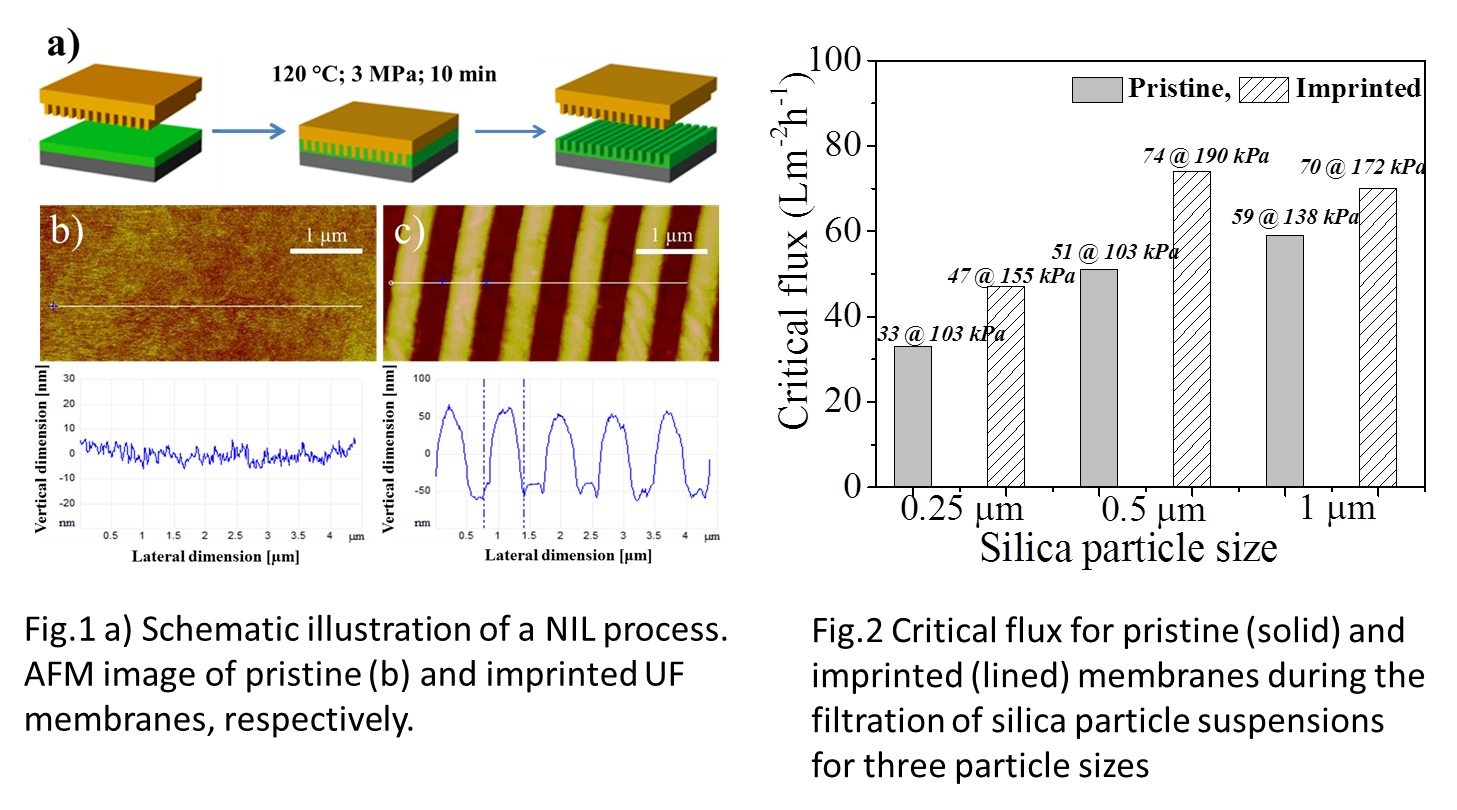
In this presentation, we describe a novel approach to improve the fouling resistance of ultrafiltration membranes by direct surface patterning via nanoimprint lithography (NIL). By careful control of the lithographic processing conditions, sub-micron anisotropic surface patterns were successfully imprinted onto the surface of a commercial ultrafiltration membrane. Figure 1 provides a schematic of the NIL process (a) while AFM images and the corresponding cross-sectional profiles of the unmodified and imprinted membranes are shown in (b) and (c), respectively. These results clearly indicate that surface patterning can be accomplished without sacrificing the separation and permeance figures-of-merit. It is important to note that this new approach does not involve any chemical modifications and should be amenable to a wide range of synthetic membranes. An important advantage of this patterning process is compatibility with industrial membrane manufacturing processes such that scale-up issues are significantly reduced.
Model suspensions (containing either colloidal particles or proteins) were filtered using patterned and non-patterned (control) membranes. For both types of suspensions, significant improvement in the overall filtration productivity and regeneration ability were found for the patterned membrane, revealing appreciable reduction in both surface deposition rates and adsorption. Figure 2 shows the enhancement of critical flux in imprinted membranes with respect to that of the pristine ones, during the filtration of colloidal suspensions with a range of different particle sizes.