
302468 Mechanisms of Virus Deposition Onto Electrochemically Generated Aluminum Precipitates Prior to Microfiltration
Charan Tej Tanneru1 and Shankar Chellam1, 2 *
1 Department of Civil and Environmental Engineering, University of Houston, TX 77204-4003
2 Department of Chemical and Biomolecular Engineering, University of Houston, TX 77204-4004
Pathogenic protozoa and bacteria are very well removed by microfiltration (MF) membranes in contrast to viruses, which are substantially smaller than membrane pore sizes. For this reason, we are developing an integrated coagulation–MF system to better control all types of microorganisms while simultaneously maintaining relatively high flux (Tanneru et al. 2013). In the current research, we explore the electrochemical dissolution of a sacrificial aluminum anode to directly release metal ion coagulant precursors for MF pretreatment. We empirically demonstrate improved MF performance by documenting > 99.99% (4-logs) removal of influent viruses even at moderate electrocoagulant concentrations using this technique. The principal objective of this research is to elucidate underlying virus destabilization/removal mechanisms in a hybrid electrochemical-MF reactor. We demonstrate that sweep flocculation is the primary virus destabilization mechanism by two different approaches; (a) quantitative elution of viruses from electrochemically generated precipitates using beef extract at elevated pH levels and (b) measuring fluorescence from FITC labeled viruses enmeshed in precipitates deposited on MF membranes (Figure 1a). Atomic force microscopy measured monotonically increasing adhesion forces between viruses and aluminum precipitates as more and more electrocoagulant was added (Figure 1b) suggesting secondary contributions to virus uptake from adsorption. Virus sorption mechanisms include charge neutralization and hydrophobic interactions with natural organic matter concurrently removed during coagulation. Enhanced virus reductions with progressively increasing aluminum concentration indicates contributions from (i) better encapsulation onto greater amounts of fresh Al(OH)3 precipitates, (ii) increased adsorption capacity associated with higher available coagulant surface area, (iii) greater virus-precipitate binding affinity due to effective charge neutralization and hydrophobic interactions, and/or (iv) additional removal by a “dynamic membrane” if a thick cake layer of precipitates are deposited onto membrane.
|

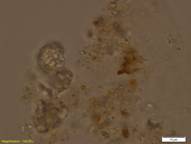
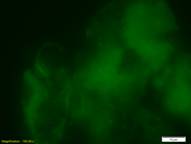
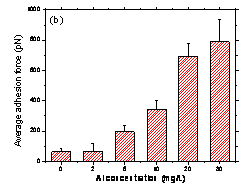
Figure 1. (a) Bright field (left) and corresponding epifluorescence image (middle) of aluminum precipitates incorporating viruses tagged using a fluorescent dye (FITC), the scale bar equal 10 µm. (b) Average adhesion forces between viruses immobilized on AFM tips and the surface of precipitates exhibit an increasing trend as the aluminum concentration is increased in the range 0 – 30 mg/L aluminum (right).
Reference
Tanneru, C.T., J.D. Rimer, and S. Chellam (2013). Sweep flocculation and adsorption of viruses on aluminum flocs during electrochemical treatment prior to surface water microfiltration, Environmental Science and Technology under revisions.
See more of this Group/Topical: Poster Submissions