
302480 Hydraulically Irreversible Fouling of PVDF Microfilters With (Electro)Chemical Pretreatment: ATR-FTIR and XPS Spectroscopy
Hydraulically Irreversible Fouling of PVDF Microfilters with (Electro)Chemical Pretreatment: ATR-FTIR and XPS Spectroscopy
Neranga P. Gamage and Shankar Chellam
Department of Civil and Environmental Engineering, University of Houston, Houston, TX 77204-4003
Hydrolysis products of electrolytically generated trivalent aluminum cations (electrocoagulation) were found to (a) increase the particle size, (b) reduce the surface charge, and (c) decrease the fractal dimension of natural colloids present in surface waters as effectively as or even better compared to alum [1,2]. This led to significant increase in flux during forward microfiltration (MF) of surface water and enhanced backwashing efficiency following electrocoagulation pretreatment. However, XPS survey analysis of the irreversibly fouled membrane surfaces showed incomplete removal of solid aluminum precipitates. In other words, even though aluminum enhanced flux, it still contributed to irreversible fouling.
Physicochemical mechanisms of irreversible
membrane fouling are commonly inferred using macroscopic measurements such as pure
 water flux reduction after hydraulic/chemical
cleaning, analysis of foulant concentrations in chemical cleaning solutions, characterization
of fouled membrane surfaces, and static adsorption measurements. We improve
upon these “traditional” approaches by delineating specific interactions
contributing to irreversible fouling of a commercial hydrophilic membrane using
Attenuated Total Reflection-Fourier Transform Infrared Spectroscopy (ATR-FTIR)
and X-ray Photoelectron Spectroscopy (XPS).
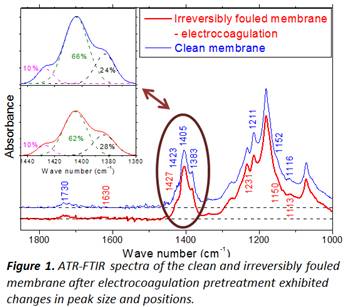
ATR-FTIR and XPS were used to investigate the interfacial chemistry between metal hydroxides and organic ligands though chemical peak shifts, peak broadening, and changes in peak intensities. Such changes in molecular level interactions are caused by perturbations to chemical bonds (changes in vibrational and rotational energies), and alterations in valence electron density due to interactions with neighboring atoms. This approach provided direct evidence for the presence or absence of specific interactions between aluminum coagulants generated chemically (Al2(SO4)3•16H2O coagulation) and via electrolysis (electrocoagulation), with the hydrophilic membrane surface. High resolution XPS and ATR-FTIR of irreversibly fouled membrane surfaces revealed hydrogen bonding and non-covalent interactions between the hydrophilic functional groups of the modified PVDF and aluminum hydroxide precipitates along with natural organic matter (Figure 1). To our knowledge, these are amongst the first such direct measurements of peak shifts and broadening caused by foulant interaction with membrane surfaces and will be discussed in much more detail during the presentation.
References
[1] N. P. Gamage, S. Chellam, Aluminum electrocoagulation pretreatment reduces fouling during surface water microfiltration, Journal of Membrane Science, 379 (2011) 97-105.
[1] N. P. Gamage, J. D. Rimer, S. Chellam, Improvements in permeate flux by aluminum electroflotation pretreatment during constant pressure microfiltration of surface water, Journal of Membrane Science, 411-412 (2012) 45-53.
See more of this Group/Topical: Poster Submissions