
302565 Brackish Water Desalination With Hybrid Ion Exchange – Reverse Osmosis (HIX-RO) Process for Enhanced Recovery and Elimination of Anti-Scaling Agents
It is well recognized that in order to address rising population growth and diminishing water supply, desalination of sea and brackish water is becoming a necessity in many regions around the world. Many brackish water RO desalination plants are away from the coastal areas and the inland disposal of reject brine constitutes a constant issue. The problem is further aggravated by the presence of anti-scaling chemicals in the reject brine due to their long-term environmental impacts. Anti-scaling chemicals are routinely added to the feed brackish water to prevent membrane fouling. Calcium sulfate scaling at the membrane surface due to concentration polarization is the top culprit in this regard. Enhanced permeate recovery without dosage of anti-scaling chemical is probably the most desirable solution and the ongoing research work presented shows that such a goal is attainable through intelligent integration of sulfate-chloride anion exchange with RO processes.
The central element of the proposed hybrid ion exchange-reverse osmosis (HIX-RO) process rests on the premise that by integrating a self-regenerating ion exchange process with pressure-driven RO process, sulfate fouling on the membrane can be eliminated for brackish water. For brackish water desalination, over 90% of scale formed is due to CaSO4. CaCl2, meanwhile, is orders of magnitude more soluble than its sulfate salt. Thus, conceptually, replacing sulfate in the feed water with chloride offers a generic solution to the scaling problem associated with higher recovery and concentration polarization. Such an approach is also independent of the specific type of RO membrane used. The individual steps of the process are as follows:
1. Incoming feedwater is passed through an anion exchanger in chloride form. At brackish water concentrations sulfate is the preferred species allowing selective replacement of sulfate with chloride,
2. Due to the removal of sulfate, the RO process can be operated at higher recoveries without threat of scaling,
3. The concentrated reject brine is passed through the previously exhausted ion exchange column. Due to its high ionic strength, chloride is preferred over sulfate due to selectivity reversal. Thus, sulfate is favorably desorbed by chloride.
Figure 1 provides a schematic of HIX-RO process which integrates a self-regenerating ion exchange process with RO to avoid membrane fouling caused by supersaturation. Scientifically, the selectivity reversal between sulfate and chloride for anion exchanger between the feed and reject concentration forms the heart of the process. While sulfate is selectively removed from the brackish water in preference to chloride, diminishing calcium sulfate fouling of the membrane, the exhausted anion exchanger gets efficiently regenerated with reject at higher chloride concentration. Most importantly, the anion exchange process added to the system does not warrant any external regenerant; the reject from the RO process serves as the regenerant. Also, the existing RO processes can be easily retrofitted to achieve higher permeate recovery.
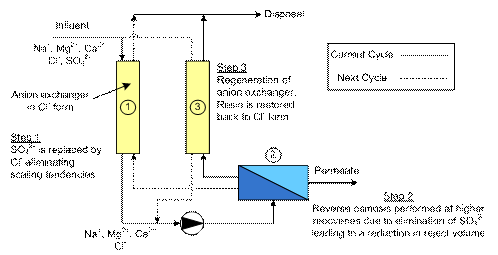
Figure 1. Schematic of the HIX-RO desalination process with three major operational steps
Challenges lie in proper selection of the anion exchange resin used. Theoretical predictions show that a 50/50 mixture between two commercially available resins should provide high sulfate selectivity at brackish water concentration (80 meq/L) yet high chloride selectivity at RO concentrate concentrations (400 meq/L). Proof-of-concept batch tests were performed by mixing varying resin masses with synthetic brackish water. A plot of the fraction of sulfate on the resin (yS) vs fraction of sulfate in solution (xS) is shown in Figure 2.
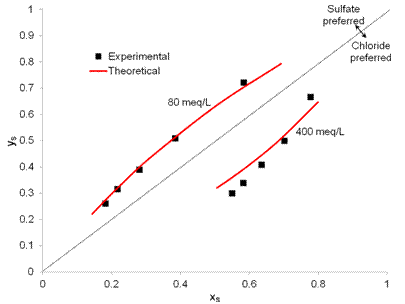
Figure 2. Demonstration of selectivity reversal effect allowing for reneneration of the resin by the RO concentrate
Correlation between preditctions and results suggest the theoretical model is accurate. Initial column runs performed using the same 50/50 mixture demonstrate >95% sulfate removal. Subjecting the effluent to RO and using the concentrate for regeneration results in the column being converted back to chloride form at an efficiency of >90%. In short, the theoretical calculations combined with experimental data show strong evidence that a hybrid ion exchange-membrane process can provide efficient brackish water desalination.