
302838 Mixed Matrix Membrane Containing MOFs for Ethylene/Ethane Separation
Currently, ethylene/ethane separation is carried out by cryogenic distillation, consuming large amounts of energy [1]. Yet significant energy reductions of 30% can be obtained by the use of hybrid membrane-distillation units [2]. However, the performance of native polymer membranes is still too low to be economical viable [3]. Since it is well known that addition of metals-ions to membranes can increase the ethylene/ethane selectivity, we propose to incorporate Metal-Organic Frameworks (MOFs) in a polymer matrix, creating Mixed Matrix Membranes (MMMs) [4]. After the investigation of MOFs with different metal-ions (i.e. Cu2+, Al3+ and Fe3+), the most promising MOF are studied in more detail. Results and discussion
Several analysis techniques like SEM, TGA, DSC, static and dynamic sorption and gas permeation were performed to determine the best performing MOF [5]. Figure 1 shows the ethylene permeability and ethylene/ethane selectivity for the three investigated MOFs in MMMs at various feed pressures.
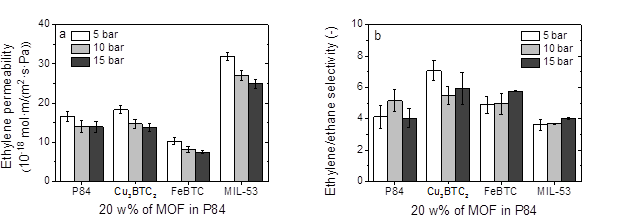
Figure 1. Average ethylene permeability (a) and ethylene/ethane selectivity (b) (± 2σ) of native P84 and 20 w% Cu3BTC2, FeBTC and MIL-53 MMMs at 5, 10 and 15 bar mixed gas feed pressure.
Figure 1a shows that the permeability upon addition of 20 wt% Cu3BTC2 does not change significantly from the native P84 membranes. However, Figure 1b shows that the addition Cu3BTC2 does increase the selectivity significantly from 4.1 to 7.1 at 5 bar feed pressure, unlike addition of FeBTC or MIL-53. The availability of empty d-orbitals in Cu2+-ions allows for a reversible interaction with ethylene by accepting electrons from the double bond, according to the Dewar-Chatt-Duncanson model [6, 7]. Since Fe3+ and Al3+ cannot form such a complex, Cu3BTC2 was selected for further study.
Figure 2a shows the effect of Cu3BTC2 concentration on the ethylene permeability in MMMs. No significant increase in permeability is observed up to 20 wt% addition of Cu3BTC2, which indicates the absence of non-selective voids in the membrane. This is also confirmed with DSC measurements showing a decreasing Tg with increasing Cu3BTC2 concentration, indicating the formation of a new flexible intermediate phase [8]. Figure 2b shows that the ethylene/ethane selectivity increases with increasing concentration of Cu3BTC2 up to 20 wt%, as the result of the reversible interactions between Cu2+ ions and ethylene.
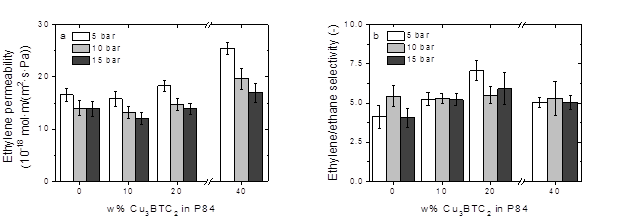
Figure 2. Effect of mixed gas feed pressure on the (a) ethylene permeability and (b) ethylene/ethane selectivity (± 2σ) for P84 MMMs with various wt% of Cu3BTC2. Acknowledgements
This project is financially supported by AgentschapNL. The authors would like to thank ECN, Dow and SolSep for the fruitful discussions. References
[6] M.J.S. Dewar, A review of the pi-complex theory, Bull. Soc. Chim., 18 (1951) 8.
See more of this Group/Topical: General Submissions