
303000 Polybenzimidazole Membranes for Organic Solvent Nanofiltration Applications in Extreme pH
Title: Polybenzimidazole Membranes for OSN applications in extreme pH conditions
Authors: Irina Valtcheva, Santosh Kumbharkar, Jeong Kim, Andrew G Livingston
Many pharmaceutical and chemical processes require separations at different stages of their production. Industrial applications often involve separation between dissolved molecules in the range of 200 – 2000 g.mol-1. Membrane nanofiltration (NF) can provide the necessary discrimination between solutes in this range. Development of polymeric NF membranes has started in the early 1970s and since then membranes have been widely applied to processes in aqueous environments e.g. in food production and water softening [1]. The lack of solvent stable polymer materials has so far limited the use of NF in non-aqueous environments. However, organic solvent nanofiltration (OSN) has gained interest in recent years and much research has been carried out to improve chemical resistance of membrane materials. Although much progress has been made to improve OSN technology [2], current membranes still face several issues in OSN – low discrimination between target molecules and waste reagents, poor chemical stability especially in basic/acidic environments and poor consistency over service life time.
Polybenzimidazole (PBI) has been chosen as the polymer for fabrication of OSN membranes to address the issues of chemical stability in different acidic or basic environments. PBI offers chemical resistance towards a wide range of solvents, bases and acids. Upon chemically crosslinking (Figure 1) the polymer chains PBI membranes also become suitable for filtrations in polar aprotic solvents [3]. Furthermore, crosslinking the polymer brings the molecular weight cut-off (MWCO) of the membranes in the NF range.
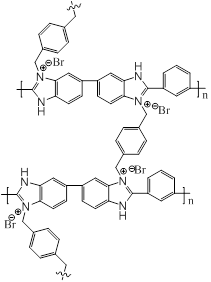
Figure 1: Chemical structure of PBI polymer chains covalently linked by a,a'-dibromo-p-xylene (DBX)
To illustrate the stability of crosslinked PBI based membranes, the conditions of two pharmaceutical processes have been chosen. Peptides and oligonucleotides are a new emerging class of drugs and crude mixture separation can be facilitated using membranes. However, current OSN membranes are not stable in the pH conditions used in the synthesis of these drugs. PBI membranes have been tested in the acidic and alkaline environments required and have shown good chemical tolerance towards pH changes and recovered their initial performance upon neutralization (Figure 2).
This new type of OSN membranes could lead to a wider implementation of membrane units in separation processes in harsh and corrosive environments.
|
|
|
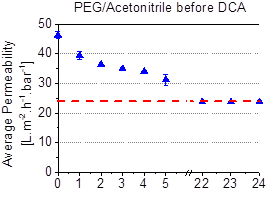
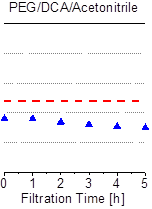
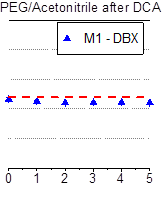
Figure 2: Permeability profile for DBX crosslinked PBI membranes using PEG/acetonitrile and dichloroacetic acid (DCA)
[1] Schäfer A.I., Fane A.G., Waite T.D. Nanofiltration – Principles and Applications, Elsevier Ltd., 2005
[2] Vandezande P., Gevers L.E.M., Vankelecom I.F.J. Solvent resistant nanofiltration: separating on a molecular level, Chemical Society Reviews, 37 (2008), 365
[3] Livingston A.G., Bhole Y. Asymmetric membranes for use in nanofiltration, WO 2012/010886 A1
See more of this Group/Topical: General Submissions