
303117 Making Ultrathin Separation Layer: High Permeation Through Polymer Membrane With Intrinsic Microporosity
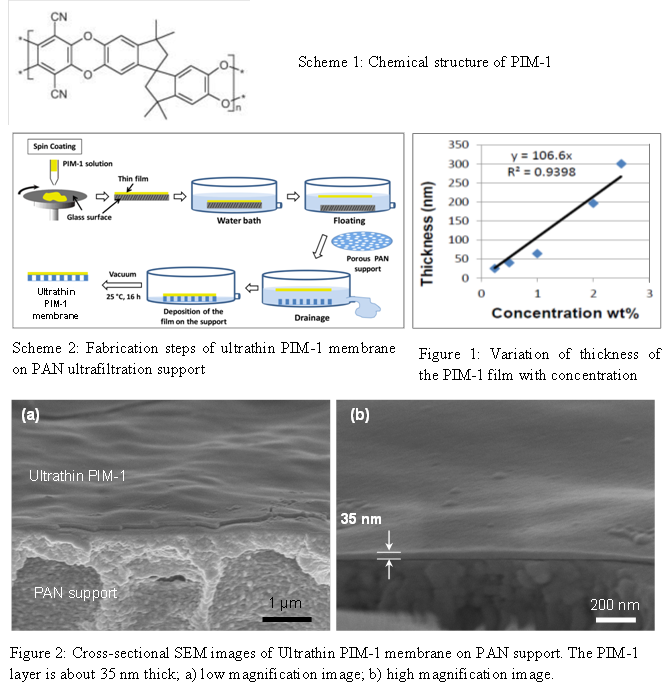
Size-selective filtration and ultrafast solvent transport through membranes are strongly demanded in chemical and petrochemical industries to separate highly-purified products from reaction mixtures and natural resources. To achieve the ultrafast transport of solvent, the real challenge is to make the skin layer of the membranes mechanically robust at the thickness of a few tens of nanometers, since the solvent flux increases inversely proportional to the thickness of the membrane i.e. the thickness of the skin layer [1]. The real challenge is to make such a thin membrane mechanically robust. To date, research on the use of polymers of intrinsic microporosity (PIMs) [2] for organic solvent nanofiltration (OSN) is limited; research on PIMs has mainly focused on pervaporation of mixtures of aliphatic alcohols and water, and gas separations [3,4]. S. V. Adymkanov et al. [3] studied PIM-1 membranes for pervaporation of binary mixtures of lower aliphatic alcohols and water, resulting in high flux (0.47 kg.m-2.h-1) and high permeability (14.6 kg.µm.m-2.h-1) without decreasing over time. One of the recent targets of our group is to make very thin polymer membranes to achieve high solvent permeability and image them with electron microscopy to better understand their transport mechanism. Here we will demonstrate some preliminary results of ultrathin PIM-1 (chemical structure shown in Scheme 1) membrane for OSN with extraordinary solvent permeability. The ultrathin PIM-1 membranes were prepared by spin coating a diluted PIM-1 solution on a glass substrate and floating in water followed by transferring on a polyacrylonitrile (PAN) ultrafiltration support membrane (see Scheme 2). Membranes were then dried under vacuum and used for OSN in n-heptane. By using different concentrations of PIM-1 solutions (0.25 – 2.5 wt. %) during spin coating, it was possible to change the thickness of the top layer (Figure 1). We have successfully prepared stable and defect free PIM-1 membranes of thickness down to 35 nm.
Recently Fritsch et al. [5] produced thin film composite membranes using PIM-1 (300 nm thick) for OSN showing 30 times higher permeability (L.h.m-2.bar-1) than commercial StarmemTM 240. Our thinnest PIM-1 membrane, having 35 nm thickness (see Figure 2), showed much higher permeability than the membrane prepared by Fritsch et al. The permeability of heptane exceeded up to 10 – 16 L.h.m-2.bar-1 at 13 bar and 89 – 94% rejection of a model impurity [hexaphenylbenzene, molecular weight: 534.6 g.mol-1]. Permeance of heptane was approximately 130 – 150 times higher than that of commercial StarmemTM 240. Such high-performance ultrathin PIM-1 membranes could be useful for the removal of low molecular weight compounds from organic solvents for oil refining to pharmaceutical applications.
References: [1] S. Karan, et al., Science, 335 (2012) 444. [2] N. B. McKeown, ISRN Materials Science,
2012 (2012) 513986. [3] S. V. Adymkanov, et al., Polymer
Science Series A, 50 (2008) 444. [4] P. M. Budd, et al., Journal of Membrane Science, 251 (2005)
263. [5] D.
Fritsch, et al., Journal of Membrane Science, 401 (2012) 222.
See more of this Group/Topical: General Submissions