
303228 Continuous Affinity Protein Separation With Dynamic Electrochemical Membranes
Using genetic modification of a host cell to produce complex biomolecules is a critical route to new pharmaceutical production. However the separation of the desired protein from the myriad of required chemicals in living systems is the most costly and complex step. Typical separations use a genetically modified marker, such as histidine, on the protein to bind to a nickel complex on a chromatography column. This bound protein is later released into a collection stream using a release agent such as low pH or imidizol. The problems with the conventional techniques are non-specific binding, inefficient mass transport to binding sites, and inefficiencies in purge cycling. Nature on the other hand is able to separate proteins by pumping them across cellular membranes. Needed for efficient bio-chemical production is a separation system that can selectively pump proteins across a membrane barrier in a continuous process. Here we show a membrane system with nm-scale thick electrodes that is able to selectively bind genetically modified proteins and pump them across the membrane with sequential voltage pulses. The electrodes are located at the first 5nm of pore entrances and bound proteins block non-specific protein transport through the pores. During the release cycle, concentration of imidizol is controlled to keep the pore blocked while release proteins at the bottom edge of electrode. A separation factor for GFP and BSA of 16 was achieved with observed GFP electrophoretic mobility of 3x10⁻⁶ cm2/v-S. This non-optimized membrane system with an area of 0.9 cm2 has the same throughput as 1ml of commercially available chromotagraphy columns showing viability as a continuous industrial process. This system will enable continuous separation of expressed proteins directly from fermentation broths dramatically simplifying the separation process as well as reducing biomolecule pharmaceutical production costs.
1. Sun, X., Su, X., Wu, J., Hinds, B. J*. Electrophoretic Transport of Biomolecules through Carbon Nanotube Membranes. Langmuir. 2011, 27, 3150¨C3156.
2. Wu, J., Gerstandt, K., Zhang, H., Liu, J., Hinds, B. J*. Electrophoretically induced aqueous flowthrough single-walled carbon nanotube membranes. Nature Nanotechnology. 2012, 7, 133-139.
3. Sun, X., Wu, Ji., Chen, Z., Su, X., and Hinds, B. J*. Fouling Characteristics and Electrochemical Recovery of Carbon Nanotube Membranes. Adv. Funct. Mater. 2013, 23, 1500-1506.
4. Yu, S., Lee, S. B., Kang, M., Martin, C.R. Size-Based Protein Separations in Poly (ethylene glycol)-Derivatized Gold Nanotubule Membranes. Nano letters. 2001, 1, 495-498.
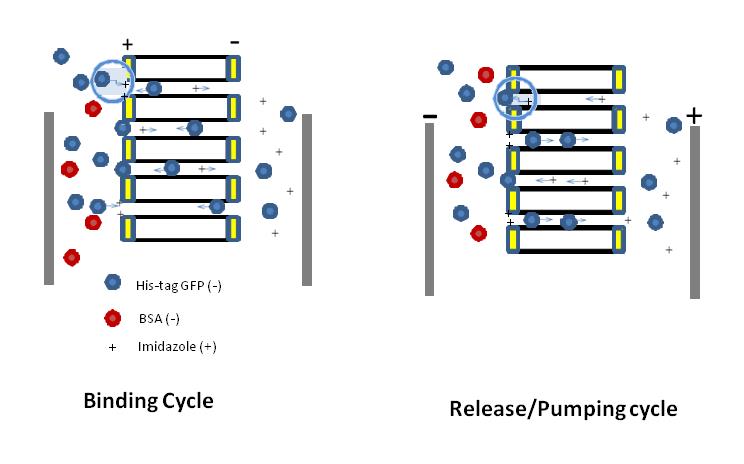
Schematic of pulse electrophoresis process across functionalized AAO membrane
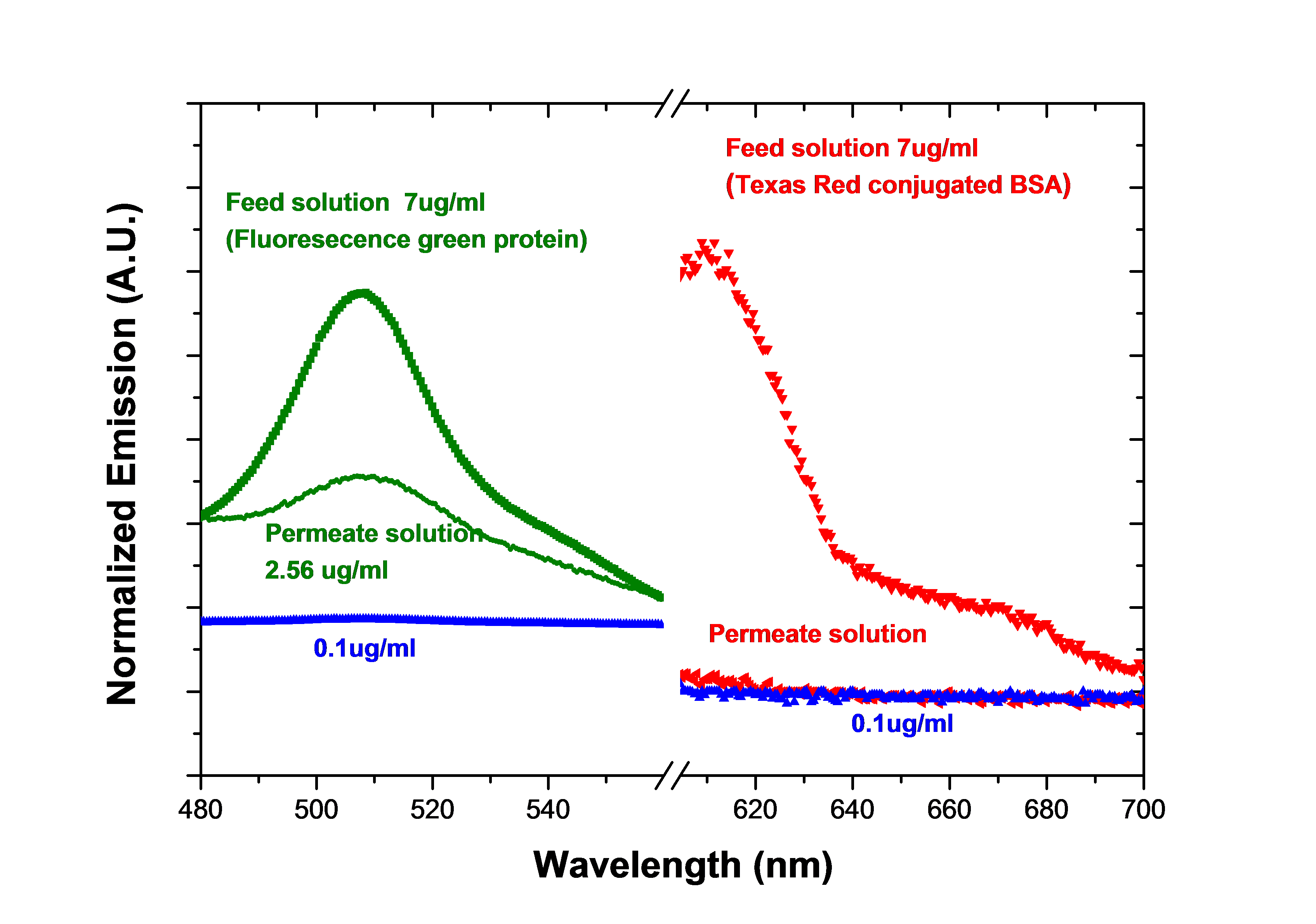
Fluorescence spectra showing the emission intensity of the feed and permeate solutions after pulse electrophoresis.
See more of this Group/Topical: General Submissions