
303252 A Model-Based Approach for Understanding Scaling in Reverse Osmosis Devices
A model-based approach for understanding scaling in reverse osmosis devices
A.I. Radu 1,2, M.C.M. van Loosdrecht 1, C. Picioreanu 1
1 Department of Biotechnology, Faculty of Applied Sciences, Delft University of Technology, Julianalaan 67, 2628 BC Delft, The Netherlands
2 Wetsus, Centre of Excellence for Sustainable Water Technology, Agora 1, P.O. Box 1113, 8900 CC Leeuwarden, The Netherlands
Keywords: mechanistic model; precipitation; feed spacer; gypsum; ionic activity
Background. Reverse osmosis (RO) is an increasingly popular technology for drinking water production from fresh, brackish and seawater. Crystallization of sparingly soluble salts (scaling) can lead to severe operational issues and membrane degradation in RO plants. In addition, scaling limits recovery in many cases. Currently, scaling prediction is based on one-dimensional models including drastic simplifications, i.e., uniform flow and concentrations varying only along the main flow direction in the feed channel. The complex flow pattern and solute distribution encountered in membrane processes require the development of a multidimensional (2-d and 3-d) model for a better understanding and prediction of the scaling process.
Methods. A numerical model was constructed to study mineral precipitation in the feed channel of an RO membrane device. The model combines liquid flow and mass transport of solutes with a particle-based approach for crystal nucleation and growth. Gypsum was chosen as model precipitate, because it is a commonly occurring scalant in the RO process. Sodium chloride is an additional solute, one of the main contributors to the total ionic strength in several types of feed water (brackish water, seawater).
Results. Numerical simulations performed with and without feed spacer indicate that the presence of spacers greatly facilitates local scaling. The spacer niche areas can reach significantly higher degrees of saturation, enhancing nuclei formation and crystal growth (Figure 1 and Figure 2). Results indicate that in the presence of feed spacers scaling can occur even for under-saturated feed water. The importance of considering local phenomena for scaling studies is clearly emphasized.
The presence of NaCl in the feed water has been shown to affect in multiple ways gypsum scaling. At higher NaCl concentrations: (i) accelerated nucleation rate occurs; (ii) enhanced crystal growth rate is observed; (iii) the activity coefficients for Ca2+ and SO42- are reduced (as calculated from Pitzer equations) thus reducing the potential for gypsum precipitation and (iv) the local driving force for permeation is altered, and thus affects the local concentration polarization for CaSO4 (Figure 3A).
Gypsum precipitation was also evaluated under operational conditions encountered in practical situations: constant flux and constant pressure operation and also conditions representative for the lead membrane element (high cross-flow and low bulk concentration) and the tail element (low cross-flow and high bulk concentration). Interestingly, numerical results indicate that scale formation on the membrane under constant flux conditions will lead to local flux enhancement in scale-free area to compensate for flux loss in covered areas (Figure 3B,C). This effect will increase the amount of precipitate formed under constant flux compared to constant pressure conditions.
Model results confirm that: (i) more scaling can occur in the tail element of an RO train; (ii) operation at a higher flux or a higher pressure leads to more precipitate formation.
Impact. The model can mechanistically describe mineral precipitate formation at micro-scale in complex 3-d geometries (i.e., the feed channel with spacers in reverse osmosis devices) and different operational conditions. The general numerical framework developed here can be easily adapted to describe scaling or precipitate fouling in various systems (i.e., heat exchangers, membrane distillation devices, ion-exchange membranes, forward osmosis systems), with multiple soluble components and precipitating salts.
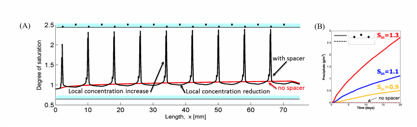
Figure 1. (A) Degree of saturation along the lower membrane (black line) showing enhanced super-saturation in the spacer niche; (B) Amount of precipitate formed in the feed channel for different saturation states of feed water.
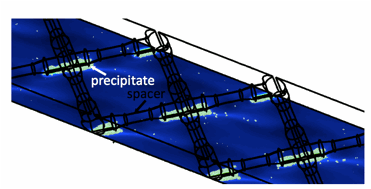
Figure 2. 3-d simulation detail showing precipitate formation mainly in the spacer-membrane contact areas where higher gypsum super-saturation occurs (blue=low, red=high).
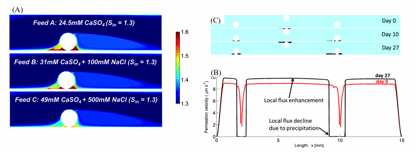
Figure 3. (A) Degree of saturation profiles for gypsum at several feed water compositions; (B) Local flux alteration due to scaling on the membrane under constant flux operation; (C) Development of precipitate in time in the feed channel.
See more of this Group/Topical: General Submissions