
303376 Tuning the Gaz-Diffusion Through Dynameric Membranes-Toward Rubbery Organic Frameworks-Rofs
Tuning the gaz-diffusion through dynameric membranes-toward Rubbery Organic Frameworks-ROFs
Gihane Nasr, Thomas Macron, Mihail Barboiu*
Institut Européen des Membranes – ENSCM-UMII-CNRS 5635, Place Eugène Bataillon, CC 047, F-34095 Montpellier, Cedex 5, France.E-mail: mihai.barboiu@iemm.univ-montp2.fr
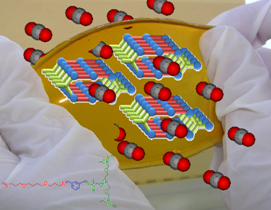 High
permeability whilst keeping a reasonable selectivity is the most important
challenge in developing membrane systems for gas separation. Valuable
performances are usually obtained with polymeric membranes for which the gas
transport is controlled by the gas-diffusivity in glassy polymers and by
gas-solubility in rubbery polymers. During the last decade, important advances
in this field are related to the molecular
control of the gas separation properties. The combination/replacement of
classical glassy polymers with metal-organic crystalline frameworks (MOFs,
ZIFs, zeolites…) providing reasonable permeability through porous free volume
network and high selectivity due to so-called “selectivity centers”
specifically interacting with the gas molecules. Despite the impressive
progress, important difficulties are observed to get dense mechanically stable
thin layer MOFs on various supports. Taking advantage of high permeabilities
observed with the rubbery polymers and to their flexible casting properties, there
should be very interesting to build rubbery organic frameworks-ROFs, as
alternative for gas membrane separation systems. Here we use low macromolecular
constituents and dialdehyde core connectors in order to constitutionally
generate rubbery organic. Differently to rubbery polymeric membranes the ROFs
performances depend univocally of diffusional behaviors of gas molecules
through the network. For all gases, a precise molecular composition of linear
and star-type macromonomers generates an optimal free volume for a maximal
diffusion through the matrix. These results should
initiate new interdisciplinary discussions about highly competitive systems for
gas separation, constitutionally controlled at the molecular scale.
1. M. Barboiu, , Encyclopedia of Membrane science and Technology, Review, 2013, Wiley.
2. G. Nasr, A. Gilles, T. Macron, C. Charmette, J. Sanchez, M. Barboiu, Israel J. Chem. 2013, 53, 97-101.
3. G. Nasr, T. Macron, A.Gilles, C. Charmette, J. Sanchez, M.Barboiu, Chem. Commun.,2012, 4 11546.
4. G. Nasr,T. Macron, A. Gilles , Z. Mouline, M. Barboiu, Chem. Commun., 2012, 48, 6827-6829.
5. G. Nasr, T. Macron, A. Gilles, E. Petit, M. Barboiu, Chem. Commun. 2012, 48, 7398-7400.1. Adaptive Supramolecular Nanosystems Group,Institut Européen des Membranes – ENSCM-UMII-CNRS 5635, Place Eugène Bataillon, CC 047, F-34095 Montpellier, France
See more of this Group/Topical: General Submissions