
303383 Identification of Novel Thermally Stable Pd-Alloy Composite Membranes for High-Temperature Applications
Identification of novel thermally stable Pd-alloy composite membranes for high-temperature applications
Hani Abu El Hawa1, Stephen N. Paglieri2, Aadesh X. Harale3, and J. Douglas Way1
1Department of Chemical & Biological Engineering, Colorado School of Mines,
Golden, CO 80401, USA
2TDA Research Inc., Wheat Ridge, CO 80033, USA
3 Saudi Arabian Oil Company, Dhahran, 31311, KSA
Pd-based membranes are considered to be an appealing alternative to separate and purify hydrogen in an industrial setting due to their high permeability as well as being permselective to hydrogen [1, 2]. When integrated into a catalytic reactor for hydrogen production, such as in the case of steam methane reforming (SMR), Pd-based membranes can selectively permeate out hydrogen from the catalyst bed causing the reaction to proceed in a non-equilibrium mode that favors the formation of additional product (H2). Furthermore, such a configuration implies a reduction in capital costs (reducing the reactor volume) and operating costs (operating at much lower temperatures) [3].
Nonetheless, there have been a few challenges that prevented this technology from being fully commercialized such as the membrane's thermal stability when operated at elevated temperatures of 500 ºC and above, in terms of both the inert gas leak evolution and hydrogen flux stability. In this talk, we will address the thermal stability problem typically observed in thin supported electrolessly plated Pd-based membranes.
Prior research identified the leak evolution mechanism in electrolessly plated pure Pd membranes to be the activated self-diffusion of Pd [4]. Our novel approach includes doping Pd with a higher melting point element such as Ru or Pt to increase the melting point of the metal, thereby increasing the membrane's thermal stability. All the membranes reported in this work were synthesized by the electroless plating technique on Zr2O/SS porous substrates purchased from the Pall Corporation. Figure 1 compares the rate of nitrogen leak growth in the temperature range (550-600 ºC) for various Pd-alloy membranes in a pure hydrogen atmosphere with periodic nitrogen leak measurements. The Ru composition was determined to be 0.3 wt% by ICP-AES after testing. The Pt composition was determined gravimetrically and confirmed by surface EDS and XRF to be around 27% by mass. The tests were run for at least 500 hours. The results showed that doping Pd with Pt or Ru significantly reduced the rate at which the nitrogen leak grew compared to a pure Pd membrane.
The other variable that was also affected by high temperatures was the hydrogen flux stability. As shown in Figure 2, the hydrogen flux continued to decline at 600 ºC for both the Pd and the PdRu membranes. Paglieri et. al. [5] observed similar declining trend in pure Pd membranes when operated under similar conditions. They attributed this behavior to a surface annealing effect which resulted in loss of the surface area available for hydrogen dissociation over time. We believe that the addition of a trace amount of Ru to Pd was sufficient to enhance the thermal stability of pure Pd in terms of the lower nitrogen leak growth rate, though it was not sufficient to improve the hydrogen permeation flux stability.
The PdPt alloy, despite having a lower hydrogen permeance compared to either Pd or PdRu, had showed a very stable hydrogen flux at 600 ºC. In order to investigate the influence of Pt composition on the membrane's thermal stability, a 5.4 micron thick Pd-14Pt was synthesized and tested in a similar fashion. Figure 3 shows the relevant results where both the pure hydrogen flux and the nitrogen leak growth rate are reported for a pure Pd membrane and two PdPt alloy membranes with different compositions (14 or 27% Pt by mass). By lowering the Pt content to from 27 to14% mass%, it was found that the nitrogen leak growth rate was not significantly altered and the pure hydrogen flux was higher by a factor of approximately 2. Future work will focus on further optimization of the Pt composition in Pd-based membranes as well as evaluations in more representative mixed gas and or membrane reactor environments.
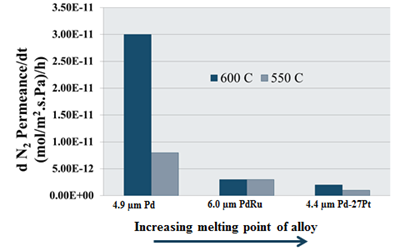
Figure 1. Comparing the rate of nitrogen leak growth in the temperature range (550-600 ºC) for various Pd-alloy membranes tested in pure hydrogen with periodic nitrogen leak measurements. The Ru composition was determined to be 0.3 mass% by ICP-AES after testing. The Pt content was determined by mass gain after plating and confirmed with surface EDS and XRF after testing.
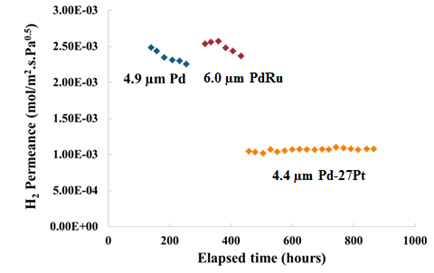
Figure 2. Comparing the pure hydrogen permeance stability at 600 ºC for various Pd-alloy membranes. The Ru composition was determined to be 0.3 mass% by ICP-AES after testing. The Pt content was determined by mass gain after plating and confirmed with surface EDS and XRF after testing.
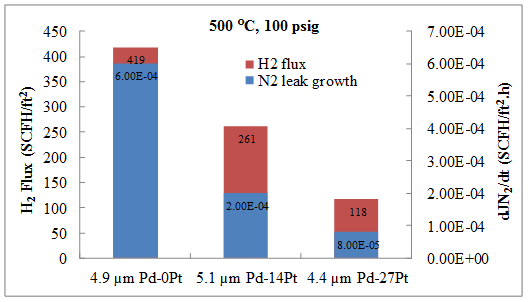
Figure 3. The influence of Pt composition on the membrane's thermal stability and hydrogen flux at 500 ºC and 100 psig feed pressure. Permeate was left at local ambient conditions (12 psia). The Pt content was determined by mass gain after plating and confirmed with surface EDS and XRF after testing.
References
See more of this Group/Topical: General Submissions