
303469 Optimization of Polyvinylamine/ Polysulfone Hollow Fibers for Natural Gas Sweetening
Key words: natural gas sweetening, hollow fibers spinning, CO2, composite membranes, coating
Corresponding author: May-Britt Hägg <may-britt.hagg@ntnu.no>
Session: gas separation
The membrane separation process presents a unique advantage among the other separation processes because of low energy consumption and lack of additional chemicals. High permeance and selectivity combined with low cost and operational stability are needed for membrane systems in order to compete with amine absorption for CO2 capture. The membranes systems are favoured for applications limiting the size and weight of the system such as offshore gas exploitations [1].
The commercial membranes for natural gas sweetening do not exhibit optimum separation properties, hence the methane loss is relatively high, and CO2-flux fairly low with the result that a large membrane area is needed. The materials used today are derivate of cellulose acetate (CA) or polyimides (PI), and usually in a spiral-wound configuration. Processing large volume of gases requires a large membrane area with a minimal foot print and hollow fibre membrane geometry represents optimum solution due to the high ratio of membrane area per volume.
Baker [1] and Kimmerle [3] suggested that depending on membrane and process conditions composite membranes may display the separation properties of the support, the coating layer or a contribution of both. Our previous reported results for low feed pressure and CO2/N2 separation [2] were correlated with the theory [1, 3] and showed that overall separation performances of a PVAm/ porous support composite membrane are strongly influenced by the support material, its porosity and its separation mechanism.
This study presents the preparation and optimization for high pressure testing of polysulfone (PSf) hollow fibres as porous support for composite membranes polyvinylamine/polysulfone. The overall aim of our study is to document a CO2 permeance up to 0.3 m3 (STP)/(bar m2 h) and a CO2/ CH4 selectivity of 30 for the coated hollow fiber. The dope composition and spinning parameters were optimized to obtain support fibers with high CO2 permeance and simultaneously good mechanical properties (round, pinhole-free asymmetric hollow fibers). The coating procedure was also optimized in order to obtain thin (1-2 µm), defect free selective layer of polyvinylamine (PVAm).
Different hollow fibers batches were spun having different dope compositions: PSf concentration from 18% to 32%, with and without additives such as glycerol. The spinning parameters such as take-up speed, air gap and temperature of coagulation bath were optimized for each dope composition.
Generally, higher porosity is related to higher gas permeance due to less mass transfer resistance of a more porous support. At the same time, too big pores or too big porosity may create a porous structure susceptible to compression and pore collapse when tested with high gas pressure.
Pore size distribution measurements gave useful indications about the optimum spinning conditions and the choice of which hollow fibers to choose for gas testing. The measurements indicate that a more porous structure is obtained when dope flow rated is increased to 2 ml/min., the take-up speed is reduced to 8-10 m/min and less concentrated dope solution is used (25%). The results correlated well with gas permeation measurements.
The pH solution of PVAm solution was adjusted from pH 4 to pH 10 based in our previous results for flat sheet membranes which documented the positive effect of basic pH on membrane separation performances [4, 5]. The fibres were coated by dip coating using aqueous PVAm solution with two concentrations of 3% and respective 7% by weight based on previous reported procedure [2], SEM pictures, gas permeation and PVAm solution viscosity measurements.
SEM pictures (Fig.1) of obtained hollow fibers were correlated with the spinning conditions, dope composition, porosity measurements and gas permeation measurement up to 40 bars.
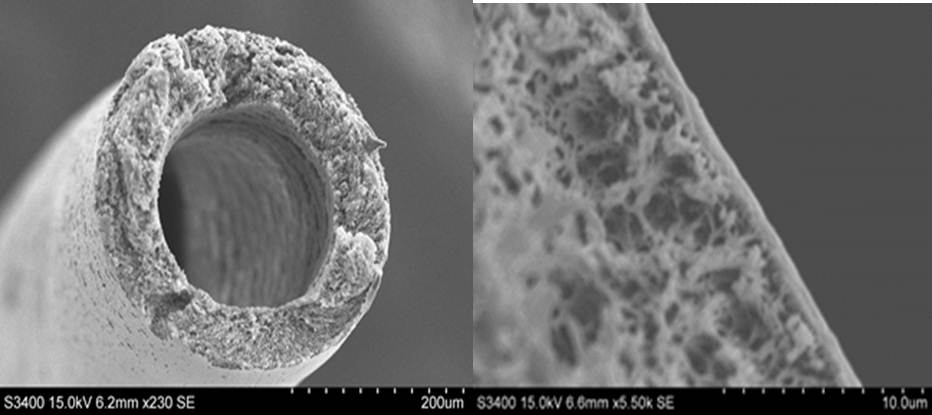
Fig. 1 Uncoated fiber cross-section (left) and coated fiber (right)
Two to four fibers having an area of 10 to 20 cm2 were packed in 35 cm long stainless steel modules and were tested in "outside –in" configuration. The gas permeation experiments were performed by using humidified mixed gas feed (10% CO2 - 90% CH4) and helium as sweep in the bore side of the fibers and the permeate composition and permeate flow was determined with a gas chromatograph and respective flow meter.
Investigation of the gas feed pressure effect on separation performances provided also useful information about the mechanical strength of fibers- some of the fibres collapsed when tested at 35 bar pressure.
Decreasing the PSf concentration in the spinning dope from 32% to 25% increased the CO2 permeance two-three folds for the coated fiberat low pressure The CO2 permeance measurements were in good agreement with porosity measurements, the most porous fibers (25%) having the highest gas permeance. The CO2/CH4 selectivity obtained for all batches at pressures below 15 bar was between 34-41. The scratches and pin holes of the PSf fibers surface affected the quality of the coating layer and consequently by increasing the pressure above 15 bar some of the pin holes surface defects re-opened and selectivity decreased to values of 12-15. The most constant CO2/CH4 selectivity with pressure was obtained for the fibers having the smallest number of surface defects, a CO2/CH4 of 34 being maintained up to 20 bar feed pressure.
As a preliminary conclusion, our results show that that the quality of the support (PSf hollow fibers) affects to a large extent the results, both CO2 permeance and CO2/CH4 selectivity of the coated fibers.
Acknowledgements
We would like to thank for financial support in the NaGaMa project to Norwegian Council of Research, Petrobras, Brazil and Statoil Norway
References
1) Baker, R. W. (2004) Membrane Technology and Applications, McGraw- Hill
2) M.Sandru, S.H. Haukebø, M.-B. Hägg, Composite hollow fiber membranes for CO2 capture, J.of Membr. Sci.346 (2010), 172-186.
3) K. Kimmerle, T. Hofmann, H. Strathmann, Analysis of gas permeation through composite membranes, J. of Membr. Sci., 61, (1991), 1-17.
4) M.Sandru, T.J.Kim, M.B.H¨agg, Gas separation membrane, Patent WO2010086630A1, 2010.
5) T.-J. Kim et al. / Journal of Membrane Science 428 (2013) 218–224