
303496 Poly(vinyl alcohol)–Functionalized Silica Nanocomposite Electrolyte Membranes for Elevated-Temperature PEM Fuel Cells
Poly(vinyl alcohol)–functionalized silica nanocomposite electrolyte membranes for elevated-temperature PEM fuel cells
The proton exchange membrane fuel cell (PEMFC) is
considered as one of the most promising power sources due to its wide
applications in vehicular transportation and portable electronic devices.
Perfluoro sulfonic acid ionomer Nafion® which is initially developed
by DuPont and successfully used in fuel cell, is currently the most commonly
utilized proton exchange membrane (PEM) for PEMFC due to its good chemical and
thermal stability and high ionic conductivity. However, the expensive cost,
loss of conductivity at high temperature (>80 °C) and difficulty in
synthesis and processing have limited their wide commercialization. To overcome
the temperature limitations of the current electrolyte materials, several
organic/inorganic hybrid membranes have become the focus of intense research recently
[1]. So far, many kinds of inorganic fillers, such as TiO2, SiO2,
ZrO2, zeolite nanoparticles as well as mesoporous silica (MCM41)
have been employed for use in these organic/inorganic hybrid membranes for
PEMFC applications at high temperatures [2-3]. Another approach was doping of
the acidic polymers with aromatic heterocyclic structures such as imidazole [4],
pyrazole [5], benzimidazole and triazole [6]. The introduction of azole groups
has generated much excitement in previous years with the hope that the
azole-based electrolytes may meet the requirements for a new generation of PEM
fuel cells [7]. In this study, a silica nanoparticle is synthesized
as an inorganic filler to modify a PVA membrane. Silica was functionalized by
using 3-mercaptopropyltri-methoxysilane (MPTMS 98 wt.%) as a precursor for the
formation of sulfonate groups. The functionalization of these inorganic fillers
can provide sulfonate groups which will serve to increase the proton
conductivity of these materials. Functionalized silica
groups were introduced into PVA matrix at various molar ratios. Also we have prepared the acid–base composite materials by
mixing of a sulfonated Silica-poly(vinyl alcohol) (PVA) with the high proton exchange capacity heterocycles
(1,2,4-triazole, 3-amino-1H,1,2,4-triazole, 5-amino-1H-tetrazole, 1H-1,2,3-benzotriazole).
The polymers were characterized with Fourier transform infrared (FT-IR),
thermogravimetric analysis (TGA), and differential scanning calorimetry (DSC).
The proton conductivity of the anhydrous samples was studied by an impedance
spectrometer, and the results are compared with the previously reported
systems. Fourier transform infrared spectroscopy (FT-IR) results
confirmed that the sulfonic acid groups were successfully grafted onto the silica
nanomaterials. The PVA-F-Silica composite membranes were thermally stable up to
200 °C, and they had suitable thermal stability as electrolyte
membranes for the high-temperature fuel cells under dry condition. Differential
scanning calorimetry results illustrated the homogeneity of the materials and
show the restrictions of segmental motions of the polymer chains.
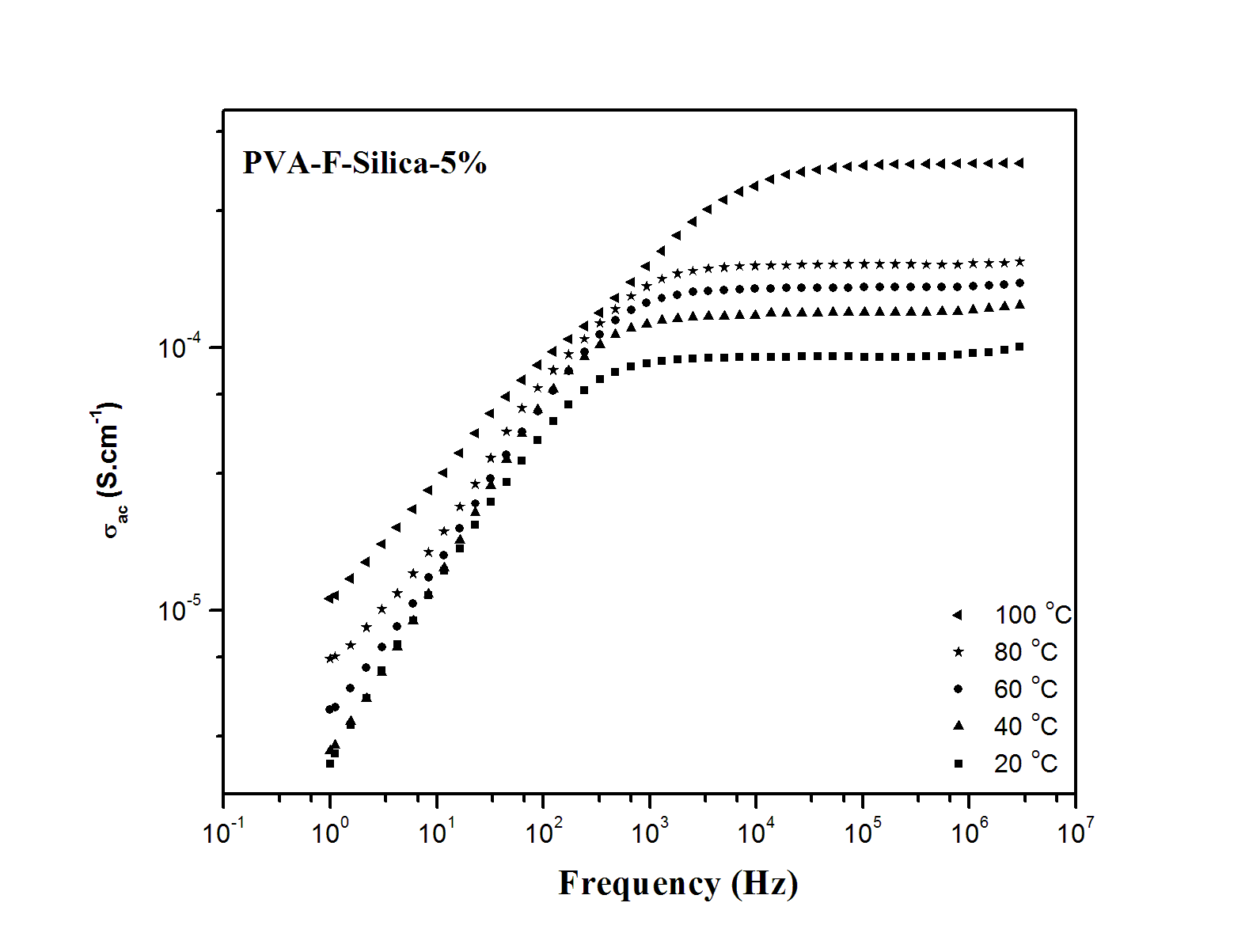
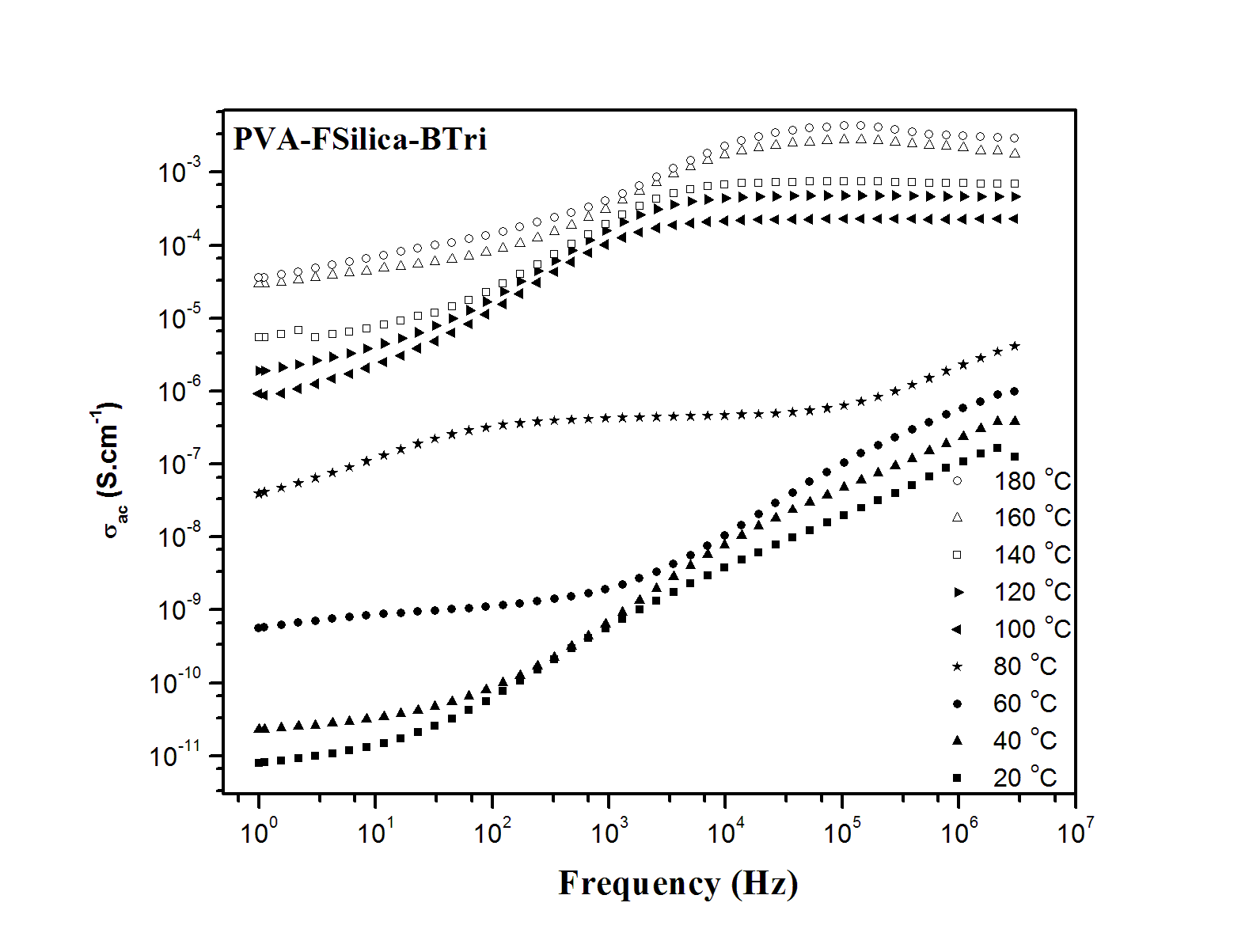
(a) (b) Figure
1. AC conductivity versus frequency of (a)
PVA-F-Silica-5% and (b) PVA-F-Silica-BTri at several temperatures. AC
conductivity, sac, versus frequency curves are shown in Fig. 1
(a, b) for anhydrous PVA-F-Silica-5% and PVA-F-Silica-BTri at several temperatures. The protonic conductivity of the
composite membranes decreases with increasing silica content and the maximum proton
conductivity was obtained for the sample PVA-F-Silica-5% as 4.78x10⁻⁴
S/cm at 100 °C under 100% humidity. In the anhydrous state, the proton
conductivity of PVA-F-Silica-BTri is found to be 2.45x10⁻³ S/cm at 180 °C. Proton conductivity of these
membranes are also measured and compared with previous studies. The results
suggest that proton conduction is occurred between surfaces of the nano-silica
particles with the aid of sulfonic acid units. The conductivities of all the polymers steadily
increased with temperature, which would be due to the increased segmental
motion of the proton transport groups at higher temperatures, facilitating
rapid formation and breaking of hydrogen bonding, resulting in fast proton
transfer dynamics. The higher number of nitrogen sites in the
1H-1,2,3-benzotriazole groups may facilitate easier proton hopping in the PVA-F-Silica-BTri blend membranes compared to
that in the azole based systems. REFERENCES 1.
Lin, Y.F., Yen, C.Y., Ma, C.C. M., Liao, S.H., Hung, Y.H., Hsiao, Y.H., J.
Power Sources, 14, 692 (2007). 2.
Elena C., Michael B.P., Mark V.F., David J.W., Serguei N.L., J Electrochem
Soc, 152, A1035 (2005). 3.
Aparicio M, Klein LC., J. Electrochem. Soc., 152, A493 (2005). 4.
Sevil F., Bozkurt A., J. Phys. Chem. Solids, 65, 1659 (2004). 5.
Yamada M., Honma I., Electrochim. Acta. 48, 2411 (2003). 6.
Gunday S.T., Bozkurt A., Meyer
W.H., Wegner G., J. Polym. Sci. Part B: Polym. Phys., 44, 3315 (2006). 7.
Schuster M.F.H., Meyer W.H., Schuster M., Kreuer K.D.,
Chem. Mater. 16, 329 (2004).
See more of this Group/Topical: Poster Submissions