
303584 An Integrated Reverse Osmosis-Oxidation Process for Treatment of Wastewaters Containing Antineoplastic Compounds
This work aims at developing a system integrating reverse osmosis (RO) and electro-oxidation processes (Figure 1) allowing for efficient treatment of wastewaters containing persistent organic pollutants, e. g. antineoplastic agents, through concentration and subsequent chemical degradation of these compounds.
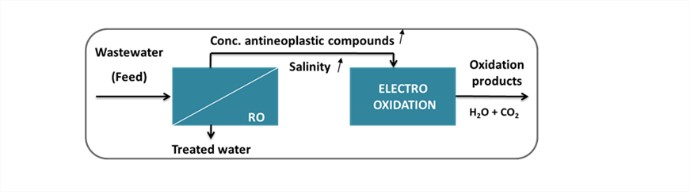
Figure 1. Schematic representation of the process integrating reverse-osmosis (RO) and electro-oxidation systems for treatment of wastewaters containing persistent organic pollutants.
Antineoplastic agents are genotoxic compounds used in cancer and autoimmune diseases therapies. The potential presence of these compounds in wastewater results from both their laboratorial manipulation and their incomplete degradation by the human organisms, which lead to their emission to the environment via urinary excretions [1].The general inability of conventional water treatment processes to remove these compounds from water streams coupled to their low biodegradadility [2], promote their accumulation in the ecosystems and the consequent amplification of their potential toxic effect. An efficient degradation of these compounds is possible through incineration. However, it leads to the simultaneous emission of toxic gases (e.g. dioxins, furans, carbon dioxide and monoxide) [3] and requires high energy consumption.
The proposed RO/electro-oxidation integrated process is intended to be an alternative to incineration processes, allowing for a sustainable and eco-efficient treatment of wastewaters containing this type of pollutants. This integrated treatment process (Figure 1) permits the chemical degradation of the antineoplastic compounds, by using an electrochemical oxidation cell equipped with a boron-doped diamond (BDD) anode, while benefiting from the advantages offered by RO. RO allows the reduction of the volume of wastewater requiring oxidation treatment and, simultaneously, it generates a retentate stream with a higher concentration of organic pollutants and salts that increase the solution electric conductivity, leading consequently to a lower energy demand for the electro-oxidation step.
The rejection and transport of 5-aminouracil (5AU) through flat RO membranes, SW30 (FilmTec, Dow), were studied. 5AU is a less toxic chemical and a structural analogue of 5-fluorouracil (5FU), which is one of the most widely used antineoplastic agents. 5AU represents the antineoplastic compound with one of the smallest molecular weights, MW5AU = 130 g/mol, and a low octanol-water partition coefficient, LogKO/W-5AU= -0.81. A wastewater containing 0.8 g/L of 5AU and salts content, leading to an osmostic pressure identical to that of a hospital effluent, was used to feed a RO membrane system operated in a cross-flow mode. It was shown that 5AU rejection increased asymptotically with the increase of transmembrane pressure (ΔPTM), reaching values higher than 85 % at ΔPTM above 10 bar, in the absence of salt. However, as expected the increase of salt concentration exerts a negative impact in the 5AU rejection that is more pronounced at lower transmembrane pressures.
The retentate stream obtained upon RO process was fed to an electro-oxidation cell (DiaCell, Adamant Technologies) equipped with a BDD anode and operated at a current of 1 A. The degradation of 5AU through BDD anodic oxidation was monitored by HPLC and total organic carbon (TOC) measurements. The HPLC analysis clearly revealed the decrease of the peak corresponding to the 5AU signal followed by significant reduction of TOC value. In order to get a better comprehension of the reaction kinetics and mechanisms inherent to the 5-AU anodic oxidation, ongoing studies for the identification of the degradation products obtained at different processing times are being performed through LC-MS/MS analysis.
Acknowledgements
The financial support from Fundação para a Ciência e a Tecnologia (FCT-MEC), Portugal, through research project PTDC/AAC-AMB/100960/2008 is acknowledged. P.I.C.Oliveira acknowledges FCT-MEC, for the PhD grant SFRH/BD/47587/2008.
References
[1] Kümmerer, K. (2001), Drugs in the environment: emission of drugs, diagnostic aids and disinfectants into wastewater by hospitals in relation to other sources - a review, Chemosphere, 45, 957-969.
[2] Steger-Hartmann, T. (1997) Biological degradation of cyclophosphamide and its occurrence in sewage water. Ecotoxic. Environ. Safety, 36, 174-179.
[3] Emmanuel, J. et al. (2004), Non-incineration medical waste treatment technologies in Europe, edited by Health Care without Harm Europe, Czech Republic.
See more of this Group/Topical: Poster Submissions