
303639 Sequential Glycosyltransferases On Functionalized Anodic Aluminum Oxide Membrane-Electrode System
Enzyme-complex systems are Nature's remarkable chemical factories that increase reaction efficiency by passing intermediate products directly to the next required enzyme catalyst attached to the complex. In principle this can be mimicked in a membrane system with flow down a pore carrying reagents to sequentially attached enzymes. A genetically modified His-tagged glycosyltransferase (GTs) was successfully immobilized onto nm-scale electrodes at the pore entrances/exits of modified Anodic Aluminum Oxide Membrane to mimic one step of of a natural enzyme-complex system. Uridine diphosphate (UDP) glycosylation yield catalyzed, using a p-nitrophenol-based glycoside to drive the equilibrium in reverse, by the immobilized enzyme was as high as 71%. The use of the the immobilized system was advantageous for two primary reasons. First, removal of product (UDP-Glu) via the flow system eliminated the potential for product inhibition. Second, the reduction of the residence time of 2-chloro-4-nitrophenyl glucose (PNP-Glu) on the enzyme as a result of the flow system helps reduce potential enzyme catalyzed substrate hydrolysis. Sequential reaction of substrate molecules on immobilized enzymes at pore entrances and exits was demonstrated with a flow experiment, where the second reaction reagent was only in the permeate solution. A his-tagged GT was immobilized to the nm-scale thick electrodes by traditional Ni-NTA coupling, with the NTA coupled to Au electrode by thiol linkage. The system is remarkably robust with specific activity as high as 15 min-1. The immobilized enzyme retains more than 50% of its activity after two months of storage at 4°C. Enzyme was removed with imidazole treatment and EDTA was used for the regeneration of the NTA-exposing surface. The membrane was regenerated with fresh enzyme attachment with 95% of original activity. One-step purification and immobilization of GTs from cell crude solution was also demonstrated, which greatly reduces the effort and cost to prepare the immobilized enzyme system. The glycosylation yield of both UDP (98%), to form UDP-Glc, and the subsequent transglycosylation (from PNP-Glc) of the model acceptor 4-methylumbelliferone (4Me-UMB) (80%) are significantly higher using the one-step purification and immobilization GTs than immobilizing a solution of purified GTs.
1. Gantt, R.W., Peltier-pain, P., Cournoyer, W.J., Thorson, J.S. Using simple donors to drive the equilibria of glycosyltransferase-catalyzed reactions. Nature Chemical Biology. 2011, 7, 685-691.
2. Gantt R. W, Peltier-Pain P, Singh S, Zhou M, Thorson J. S. Broadening the scope of glycosyltransferase-catalyzed sugar nucleotide synthesis. Proc. Natl. Acad. Sci. USA, 2013, in press.
3. Schoffelen, S. and Jan C. M. van Hest. Multi-enzyme systems: bringing enzymes together in vitro. Soft Matter, 2012, 8, 1736–1746.
4. Onda, M., Lvov, Y., Ariga, K., Kunitake, T. Sequential Actions of Glucose Oxidase and Peroxidase in Molecular Films Assembled by Layer-by-Layer Alternate Adsorption. Biotechnology and Bioengineering. 1996, 51, 163-167.
5. Lee, S. B., Mitchell, D. T., Trofin, L., Nevanen, T. K., Soderlund, H., Martin, C. R. Antibody-Based Bio-Nanotube Membranes for Enantiomeric Drug Separations. Science, 2002, 296, 2198-2200.
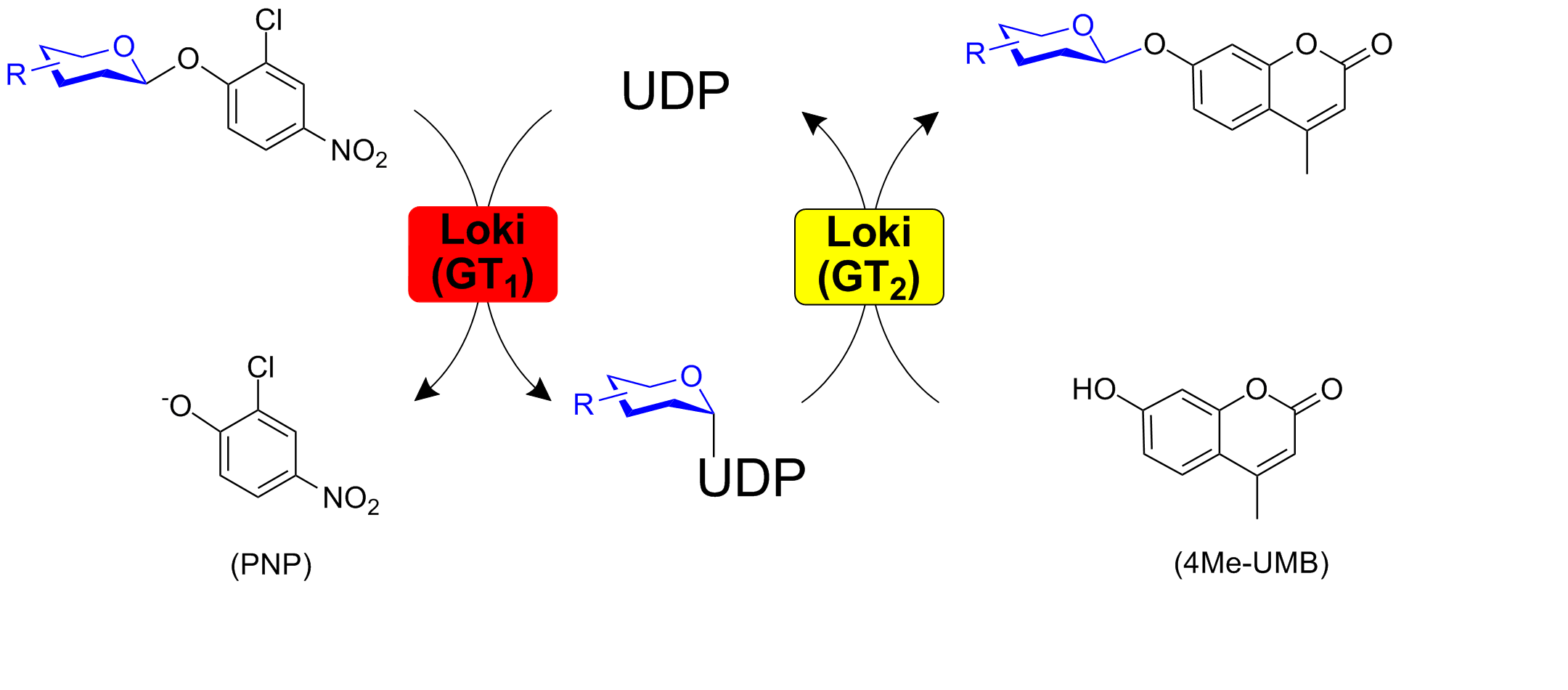
Single-enzyme coupled system with 4-methylumbelliferone (4Me-UMB)
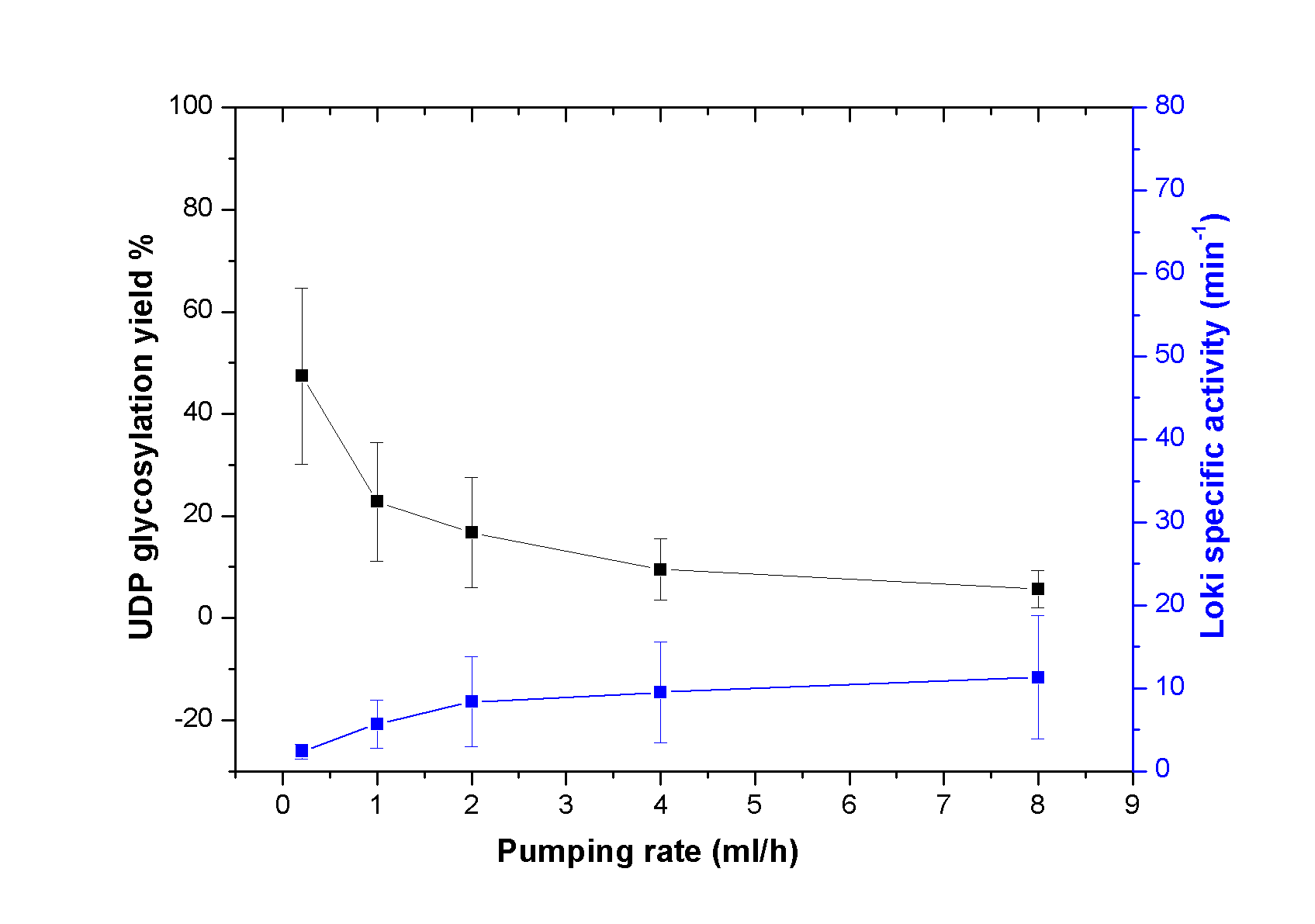
UDP glycosylation yield and GTs specific activity at different pumping rate