
303656 Understanding the Influence of Temperature On H2 Flux in the Presence of H2S On Pd-Based Ternary Alloy Membranes
Understanding the Influence of Temperature on H2 Flux in the Presence of H2S on Pd-based Ternary Alloy Membranes
A.E. Lewis1, J. D. Way1, S.D. Hopkins2, H. Zhao2
1Colorado School of Mines, Golden, CO
2Pall Corporation, Cortland, NY
Palladium (Pd) based membranes are appealing for hydrogen separation applications [1-4]. The use of pure Pd has been limited due to poor chemical tolerance in the presence of carbon monoxide and hydrogen sulfide (H2S), which are stream contaminants commonly found in coal-derived syngas [5-7]. Carbon species deactivate hydrogen dissociation sites on the Pd surface [8, 9]. H2S can block hydrogen dissociation sites, and cause Pd-sulfide formation, which has lower hydrogen permeability than Pd [3, 10, 11]. The hydrogen flux of a pure Pd membrane was reduced by 71% in a gas mixture with only 4 ppm of H2S in hydrogen [7]. In order to enhance chemical stability, Pd is alloyed with other metals such as gold, copper, and platinum [7, 9, 12-18]. Although Pd-based binary alloys have been studied for over 50 years and have a presence in current literature, recent research has focused on Pd-based ternary alloys for improved chemical tolerance [19-21]. Fabrication and testing of these ternary alloys is in its infancy, but there are a few compositions with notably enhanced properties. Pd80Au10Pt10 alloy membranes fabricated by magnetron sputtering had a flux reduction of 21% when 20 ppm H2S was added to a water-gas shift mixture at 673 K and 1.27 MPa feed pressure [20]. Pd74Ag14Au12 showed no sulfide formation when exposed to 1000 ppm H2S in hydrogen at 623 K [19].
The purpose of this work is to further the understanding of the hydrogen permeation behavior of Pd-Au-Pt and Pd-Ag-Au ternary alloy membranes in the presence of H2S at different temperatures. The results will be compared to similar testing in literature. The membranes will be prepared by sequential electroless deposition, annealed, pure-gas tested, and then tested in a gas mixture of 20 ppm H2S in hydrogen at a feed pressure of 689.5 kPa and temperatures up to 773 K. A Pd-Ag-Au alloy composite membrane was fabricated on a Pall AccuSep® substrate tube and subsequently annealed. This Pd-Ag-Au alloy membrane had a pure-gas hydrogen permeance at 673 K of 1.29x10⁻³ mol H/m2/s/Pa0.5 which is comparable to that of pure Pd on a similar substrate [22]. The alloy was pure-gas tested up to 873 K and feed pressures of up to 689.5 kPa as seen in Figure 1. The apparent activation energy of the Pd-Au-Ag alloy for hydrogen permeation derived from Figure 1 was 9.39 kJ/mol, which is a little less than that of pure Pd [23]. Figure 2 shows the hydrogen flow reduction at 773 K for the Pd-Au-Ag membrane. When exposed to the gas mixture of 20 ppm H2S in hydrogen for 24 hours at a feed pressure of 689.5 kPa, the hydrogen flux was reduced by 52%, 60%, and 75% at 773, 723, and 673 K, respectively.
The preliminary results of this study provide insight to the hydrogen flow reduction in the presence of H2S. The steep drop in hydrogen flux when the H2S is introduced could be attributed to surface site-blocking. Once the initial drop in hydrogen flow occurs, a steady state value is achieved. This indicates that no sulfide has formed. These results are similar to a test done on binary Pd-Au membranes by Chen, et al [24]. Once the H2S is removed, the hydrogen flow begins to recover, which is further evidence no sulfide has formed. Post-testing characterization is not yet complete to confirm this observation. This particular alloy exhibits a larger flow reduction with decreasing temperature, which may be an important finding for applications with operating temperatures above 673 K.
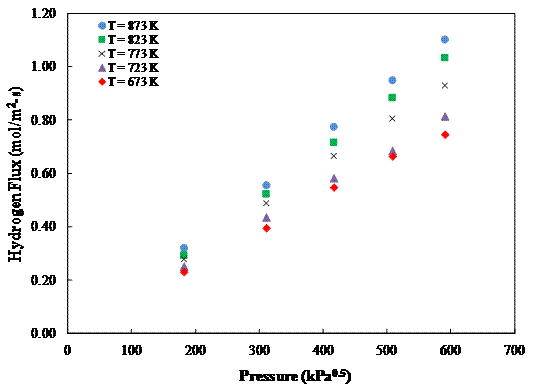
Figure 1. Pure-gas hydrogen flux of a 9 micron Pd-Au-Ag as a function of feed pressure and temperature.
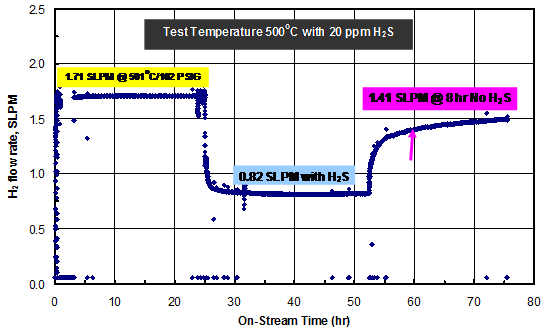
Figure 2. Hydrogen flow of a 9 micron thick Pd-Au-Ag alloy membrane in 20 ppm H2S in hydrogen gas mixture at 689.5 kPa feed pressure.
References
[1] M. Abdollahi, J. Yu, P.K.T. Liu, R. Ciora, M. Sahimi, T.T. Tsotsis, Hydrogen production from coal-derived syngas using a catalytic membrane reactor based process, J. Membr. Sci., 363 (2010) 160-169.
[2] A.C. Bose, Inorganic Membranes for Energy And Environmental Applications, Springer, New York, 2008.
[3] M.V. Mundschau, X. Xie, C.R. Evenson Iv, A.F. Sammells, Dense inorganic membranes for production of hydrogen from methane and coal with carbon dioxide sequestration, Catal. Today, 118 (2006) 12-23.
[4] P. Pinacci, M. Broglia, C. Valli, G. Capannelli, A. Comite, Evaluation of the water gas shift reaction in a palladium membrane reactor, Catal. Today, 156 (2010) 165-172.
[5] A. Li, W. Liang, R. Hughes, The effect of carbon monoxide and steam on the hydrogen permeability of a Pd/stainless steel membrane, J. Membr. Sci., 165 (2000) 135-141.
[6] H. Li, A. Goldbach, W. Li, H. Xu, PdC formation in ultra-thin Pd membranes during separation of H2/CO mixtures, J. Membr. Sci., 299 (2007) 130-137.
[7] D.L. McKinley, Metal alloy for hydrogen separation and purification, U.S. Patent 3,350,845, (November 7, 1967).
[8] J.P. Collins, R.W. Schwartz, R. Sehgal, T.L. Ward, C.J. Brinker, G.P. Hagen, C.A. Udovich, Catalytic Dehydrogenation of Propane in Hydrogen Permselective Membrane Reactors, Ind. Eng. Chem. Res., 35 (1996) 4398-4405.
[9] A.E. Lewis, D.C. Kershner, S.N. Paglieri, M.J. Slepicka, J.D. Way, Pd-Pt/YSZ Composite Membranes for Hydrogen Separation from Synthetic Water-Gas Shift Streams, J. Membr. Sci., (Accepted on February 17, 2013).
[10] B.D. Morreale, B.H. Howard, O. Iyoha, R.M. Enick, C. Ling, D.S. Sholl, Experimental and Computational Prediction of the Hydrogen Transport Properties of Pd4S, Ind. Eng. Chem. Res., 46 (2007) 6313-6319.
[11] C.P. O'Brien, A.J. Gellman, B.D. Morreale, J.B. Miller, The hydrogen permeability of Pd4S, J. Membr. Sci., 371 (2011) 263-267.
[12] S.K. Gade, S.J. DeVoss, K.E. Coulter, S.N. Paglieri, G.k.O. Alptekin, J.D. Way, Palladium-gold membranes in mixed gas streams with hydrogen sulfide: Effect of alloy content and fabrication technique, J. Membr. Sci., 378 (2011) 35-41.
[13] A. Kulprathipanja, G.O. Alptekin, J.L. Falconer, J.D. Way, Pd and Pd-Cu membranes: inhibition of H2 permeation by H2S, J. Membr. Sci., 254 (2005) 49-62.
[14] P.M. Thoen, F. Roa, J.D. Way, High flux palladium-copper composite membranes for hydrogen separations, Desalination, 193 (2006) 224-229.
[15] R. Bhandari, Y.H. Ma, Pd-Ag membrane synthesis: The electroless and electro-plating conditions and their effect on the deposits morphology, J. Membr. Sci., 334 (2009) 50-63.
[16] S.K. Gade, Palladium-gold membranes for hydrogen separations: development, characterization, and optimization, in: Chemical Engineering, Colorado School of Mines, Golden, 2009, pp. 127.
[17] A. Kulprathipanja, G.O. Alptekin, J.L. Falconer, J.D. Way, Effects of Water Gas Shift Gases on Pd-Cu Alloy Membrane Surface Morphology and Separation Properties, Ind. Eng. Chem. Res., 43 (2004) 4188-4198.
[18] M. Kajiwara, S. Uemiya, T. Kojima, Stability and hydrogen permeation behavior of supported platinum membranes in presence of hydrogen sulfide, Int. J. Hydrogen Energy, 24 (1999) 839-844.
[19] F. Braun, J.B. Miller, A.J. Gellman, A.M. Tarditi, B. Fleutot, P. Kondratyuk, L.M. Cornaglia, PdAgAu alloy with high resistance to corrosion by H2S, Int. J. Hydrogen Energy, 37 (2012) 18547-18555.
[20] K.E. Coulter, J.D. Way, S.K. Gade, S. Chaudhari, G.O. Alptekin, S.J. DeVoss, S.N. Paglieri, B. Pledger, Sulfur tolerant PdAu and PdAuPt alloy hydrogen separation membranes, J. Membr. Sci., 405-406 (2012) 11-19.
[21] T.A. Peters, T. Kaleta, M. Stange, R. Bredesen, Development of ternary Pd-Ag-TM alloy membranes with improved sulphur tolerance, J. Membr. Sci., 429 (2013) 448-458.
[22] O. Hatlevik, S.K. Gade, M.K. Keeling, P.M. Thoen, A.P. Davidson, J.D. Way, Palladium and palladium alloy membranes for hydrogen separation and production: History, fabrication strategies, and current performance, Sep. Purif. Technol., 73 (2010) 59-64.
[23] B.D. Morreale, M.V. Ciocco, R.M. Enick, B.I. Morsi, B.H. Howard, A.V. Cugini, K.S. Rothenberger, The permeability of hydrogen in bulk palladium at elevated temperatures and pressures, J. Membr. Sci., 212 (2003) 87-97.
[24] C.-H. Chen, Y.H. Ma, The effect of H2S on the performance of Pd and Pd/Au composite membrane, J. Membr. Sci., 362 (2010) 535-544.
See more of this Group/Topical: Poster Submissions