
303684 Novel Hydrophilic Nylon 6,6 Supported Thin Film Composite Membranes for Engineered Osmosis
Novel Hydrophilic Nylon 6,6 Supported Thin Film Composite Membranes for Engineered Osmosis
Liwei Huang1, Mark T. Meyering2, Thomas J. Hamlin2, and Jeffrey R. McCutcheon1
1Department of Chemical and Biomolecular Engineering, University of Connecticut, Storrs, CT 06268-3222, USA
23M Purification INC,
400 Research Parkway, Meriden, CT 06450-0108, USA
Recent studies show that Engineered Osmosis (EO) may be a viable technology for desalination, water and wastewater treatment, and power generation. However, the absence of a membrane designed for such processes is a significant obstacle hindering further advancements of this technology. Conventional thin film composite (TFC) reverse osmosis membranes yield poor water flux in EO due to their thick and hydrophobic polysulfone (PSu) support layers resulting in internal concentration polarization (ICP). In this study, a new class of thin film composite membranes based on hydrophilic nylon 6,6 supports has been designed for the first time. Two different support structures of nylon 6,6 have been employed: one is conventional phase-inversion casting microfiltration support provided by 3MTM, another is lab-made electrospun nanofiber mat. The ultra-thin polyamide (PA) selective layer has been built via in situ interfacial polymerization.
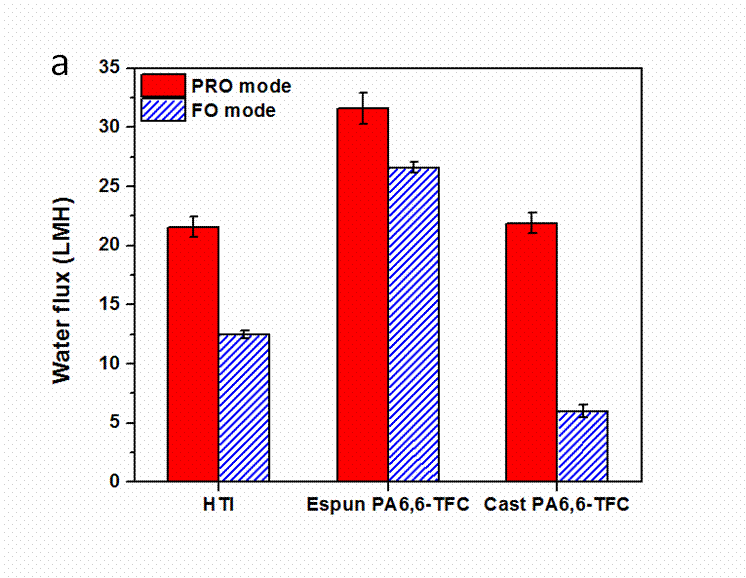
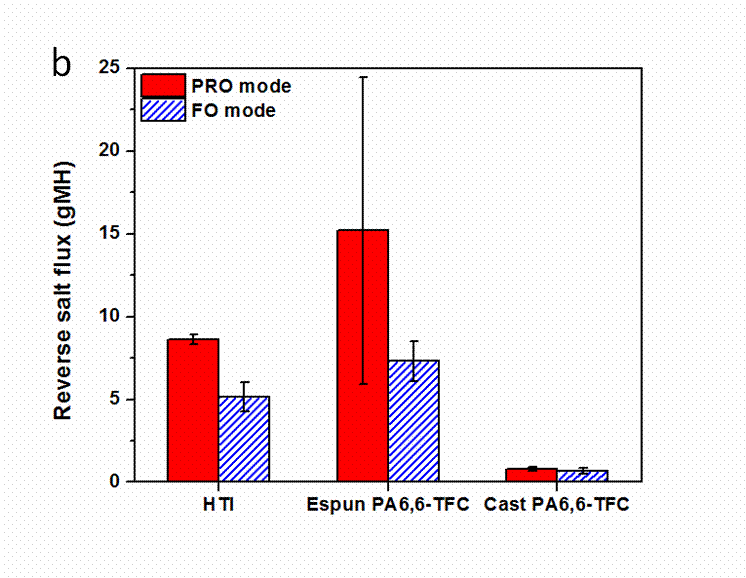
Results show that defect-free polyamide selective layer was able to form on both support structures and its permselectivity can be carefully controlled by manipulating the monomer concentration, varying the support pore size or adding co-solvent into the organic phase (hexane). Osmotic flux tests (Fig. 1) revealed that both the nylon 6,6 cast film and the electrospun nanofiber supported TFC membranes exceeded the performance of commercial forward osmosis membrane from Hydration Technology InnovationsTM (HTI). The cast-film supported TFC showed matched water flux with 10X lower reverse salt flux than HTI-CTA membrane largely due to the high permselectivity of the TFC. The flux performance was further improved by nanofiber supported TFC membrane, which showed 1.5X water flux than HTI-CTA membrane in PRO mode and 2X water flux in FO mode. The high osmotic flux of the nanofiber supported TFC, as well as the small flux difference between PRO mode and FO mode, can be attributed to its favorable support structure (low thickness, high porosity, low tortuosity and hydrophilicity) that helps to mitigate ICP, as indicated by its low structural parameter of only 200 microns. This is one of the lowest structural parameter ever reported for EO membranes.
|
See more of this Group/Topical: Poster Submissions